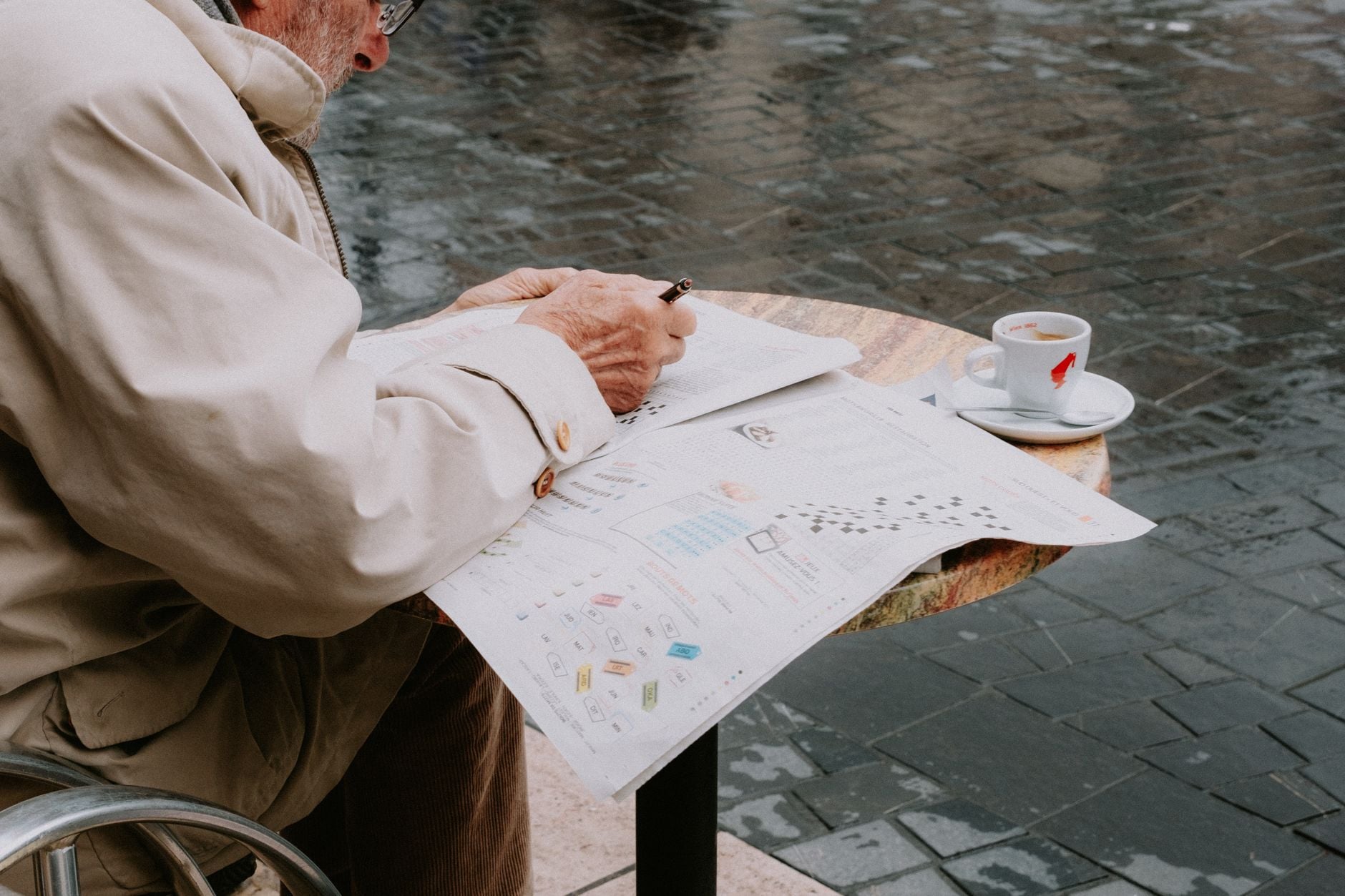
The advice to do a crossword every day to keep your mind sharp is one of the most repeated pieces of folk wisdom about aging, and it is the one with the weakest evidence behind it. That does not make it bad advice. It makes it different advice from what most people think they are following.
We are writers, not clinicians or researchers. What follows is a careful reading of the research, not medical advice.
The clearest place to start is a trial that has been running long enough to have real answers.
The Artful Age
A weekly letter on aging well, family across generations, and the creative life after the kids leave home.
What the ACTIVE trial actually found
ACTIVE, which stands for Advanced Cognitive Training for Independent and Vital Elderly, enrolled 2,832 older adults and randomly assigned them to one of three kinds of training, memory, reasoning, or speed of processing, or to a control group that got no training. The ten-year follow-up, led by George Rebok and published in the Journal of the American Geriatrics Society in 2014, is summarized by the National Institute on Aging.
Two of the three trainings held up. At ten years, 73.6 percent of the reasoning group and 70.7 percent of the speed group were performing at or above their own baseline, against 61.7 percent and 48.8 percent of controls.
The memory training did not hold up at all. After ten years there was no difference in memory performance between the people who had been trained on memory and the people who had not.
There is one more detail worth sitting with. Participants across the training groups reported having less difficulty with everyday tasks than controls did. When researchers measured those same everyday abilities with standardized assessments rather than asking, the differences disappeared.
People felt more capable. The measurements did not agree.
Why training transfers so poorly
This is the pattern across the wider literature, not a quirk of one trial. Daniel Simons and colleagues reviewed the commercial brain-training evidence in Psychological Science in the Public Interest in 2016, and the Stanford Center on Longevity summary of that review puts the conclusion plainly: there is no strong body of evidence that computerized training programs produce generalized gains beyond getting better at the practiced games.
You get better at the thing you practice. Practicing a puzzle makes you better at that puzzle, and often at puzzles that closely resemble it. What it does not reliably do is make you better at remembering where you put your keys, following a conversation in a loud room, or managing your own medication.
The reasoning and speed results in ACTIVE are the interesting exception rather than a refutation, and even there the honest description is that trained people held their own on the trained ability for a long time. That is worth something. It is not the same as a stronger mind in general.
What the evidence points toward instead
The most useful summary of the broader picture is the Lancet Commission on dementia. Its 2024 report, led by Gill Livingston at University College London, identifies 14 modifiable risk factors and estimates that addressing them could prevent or delay up to 45 percent of dementia cases worldwide. Alzheimer’s Research UK has a plain-language summary of the report.
The list is duller than the puzzle books, which is probably why it travels less well: quality of education in early life, hearing loss, high cholesterol, depression, traumatic brain injury, physical inactivity, diabetes, smoking, high blood pressure, obesity, excessive alcohol, social isolation, air pollution, and uncorrected vision loss. The two added in 2024 were uncorrected vision loss and high cholesterol, together associated with about 9 percent of cases.
Uncorrected hearing and uncorrected vision are on that list. Not crosswords.
What the 45 percent figure does not mean
This is the number most likely to be misread, so it is worth being exact about it.
It is a population-level estimate. It describes what might happen to dementia rates across whole populations if these risk factors were reduced everywhere. It is not a personal probability, and it does not mean that 45 percent of any individual’s risk is under their control. Alzheimer’s Research UK states this directly in its summary: the finding does not mean individual cases can be attributed to lifestyle or non-lifestyle factors, and there is no reliable way to prevent dementia.
Most of these factors are also associations drawn from observational data rather than results from trials that assigned people to change them. Some of the associations may run partly in the other direction. Early hearing loss and early depression, for instance, can be signs of a process already underway as easily as causes of one.
None of this is a reason to ignore the list. It is a reason not to treat it as a set of guarantees, or to read a diagnosis backward into someone’s habits.
Where making things actually fits
We write about creative work, so we should be plain about this: we have not found good evidence that painting, drawing, pottery, or music will protect anyone’s memory into their eighties. The studies that look at creative and cognitively demanding activity in later life are mostly observational, and they run into the same problem every time, which is that the people who keep painting at 78 may be the people whose minds were holding up anyway.
What the Lancet list does include is social isolation, and a lot of making happens with other people. A weekly class, a shared table, a choir. That is a genuine overlap and not a forced one, though it points at the company rather than the paint.
The better reason to keep making things is the one that does not need a study attached. It is absorbing, it is yours, and it does not need to be justified by what it might do to your brain in twenty years.
If you or someone in your family is genuinely worried about memory, the person to talk to is a doctor, who can look at the things on that list that are actually checkable, starting with hearing, vision, blood pressure, and mood.
The part of all this we keep returning to is how much of the useful list is unglamorous and how little of it involves a puzzle book. Getting a hearing test is not an inspiring piece of advice. It is just one with better evidence behind it than the crossword.