

In the summer of 1907, in a converted barn at Snug Rock, the estate he had bought just north of Yonkers, New York, a Belgian-born chemist named Leo Hendrik Baekeland finally coaxed a syrupy mixture of phenol and formaldehyde into behaving. Under carefully controlled heat and pressure inside a heavy iron vessel he had designed himself and nicknamed the Bakelizer, the goo hardened into a dark, amber-brown solid that would not melt when reheated, would not dissolve in solvents, and could be moulded into almost any shape before it cured. He called it Bakelite. It was the first fully synthetic plastic — a material with no ingredients borrowed from plants, animals, or insects.
The patent was filed in 1907.
More than a century later, the chemistry Baekeland stumbled through in that Yonkers workshop is still sitting on kitchen tables around the world. When a toddler bangs a melamine plate on the tray of a highchair and it bounces instead of shattering, that stubbornness — the refusal to soften with heat, the resistance to cracking — traces back to the same family of reactions Baekeland was probing with his iron pot.
The Artful Age
A weekly letter on aging well, family across generations, and the creative life after the kids leave home.
The problem he was actually trying to solve
Baekeland wasn’t hunting for a wonder material. He was hunting for a cheaper substitute for shellac.
Shellac, at the turn of the twentieth century, was a critical industrial coating. It insulated wires. It sealed wood. It was scraped, boiled, and refined from the resinous secretion of the lac insect, a tiny scale insect that lives on trees in India, Thailand, and elsewhere in Southeast Asia. Britannica puts the yield at somewhere between 17,000 and 90,000 insects for a single pound of shellac — the word itself descends from a Sanskrit term meaning a hundred thousand. Demand from the booming electrical industry was outpacing what those forests could supply.
Baekeland, by then a wealthy man — he had sold Velox photographic paper and his company to Eastman Kodak in 1899 for a reputed $750,000 — had the resources to spend years chasing a synthetic replacement.
Other chemists had noticed that phenol (carbolic acid, distilled from coal tar) and formaldehyde reacted violently when mixed. The result was usually a brittle, useless resin that fouled glassware and refused to be shaped. Baekeland’s insight, worked out over hundreds of laboratory experiments, was that the reaction could be tamed by controlling heat and pressure at the same time.
Inside the Bakelizer
The Bakelizer looked less like laboratory equipment and more like an industrial pressure cooker: a heavy iron vessel with a bolted door, a pressure gauge, and heating coils. Baekeland could load phenol, formaldehyde, and a catalyst inside, seal it, and then step the temperature and pressure up in stages.
What happened chemically was cross-linking. Phenol molecules and formaldehyde molecules bonded not in tidy chains but in a three-dimensional web. Once the web set, it could not be undone by heat. The material had, in effect, become a single giant molecule. The Smithsonian, which holds the original machine, describes the product as a thermosetting resin, readily mouldable and strong when combined with fillers.
That property — permanence under heat — is the dividing line that still separates two great families of plastic. Thermoplastics, like the polyethylene in a milk jug, soften every time they are warmed and can be melted down again. Thermosets, like Bakelite, cure once and stay cured. Put a lit match under a thermoplastic spoon and it will bend. Put one under a Bakelite radio knob and it will scorch before it deforms.
A material advertised as having a thousand uses
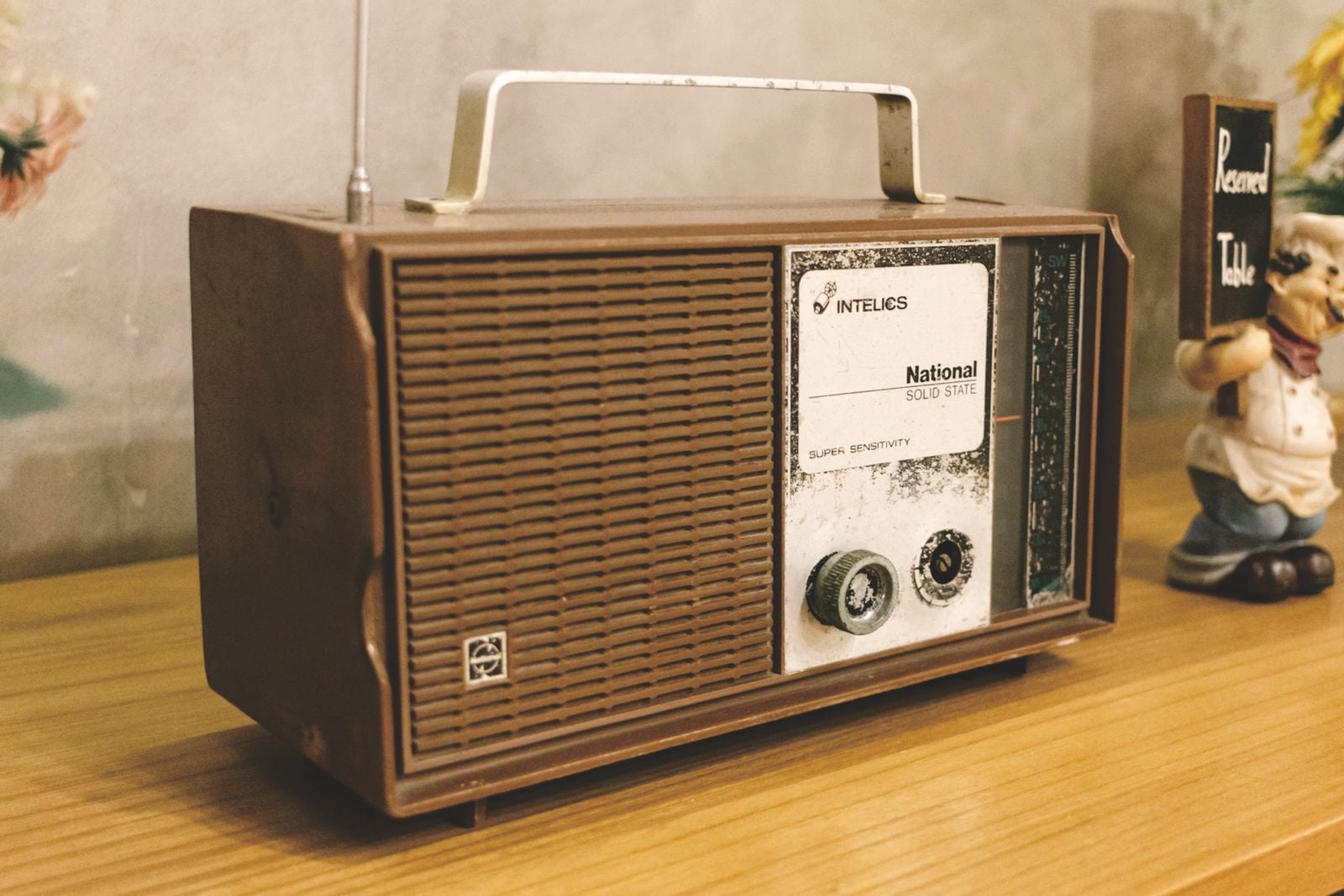
The first Bakelite products were unglamorous: electrical insulators, distributor caps, telephone handsets, the black knobs on early radios. Baekeland’s company marketed the material as The Material of a Thousand Uses, and by the 1920s the claim was close to literal. Bakelite ended up in billiard balls, pipe stems, cameras, fountain pens, iron handles, jewellery, and the fuse casings of both world wars.
It arrived at a useful moment. The Science History Institute frames the whole search as an electrical one: Baekeland was after a synthetic substitute for shellac to meet the needs of a rapidly electrifying United States. Cities wiring themselves up in the 1910s and 1920s needed a material that could insulate current, tolerate heat from a light socket, and be mass-produced in identical shapes. Wood warped. Ceramic cracked. Rubber degraded. Bakelite did none of those things.
Baekeland held numerous patents on phenolic resins and related processes. He died in 1944, having lived long enough to see plastic move from a laboratory curiosity to a wartime necessity.
From Bakelite to the melamine plate on a highchair
The plates a small child eats spaghetti off today are not Bakelite. They are melamine — melamine-formaldehyde resin, first made in the 1930s and widely available for tableware after the Second World War.
But the family resemblance is direct. Melamine is a rigid thermoset, always compression moulded. It cures through the same kind of cross-linking reaction with formaldehyde that Baekeland worked out in Yonkers. The result is a plate that can be dropped on tile without shattering, warmed by a bowl of soup without softening, and washed thousands of times without crazing.
The colour palette shifted, and not for the reason people usually assume. Bakelite came in browns, deep reds, and mottled greens because the pure resin was brittle and had to be strengthened with fillers, usually cellulose in the form of sawdust, which left the finished colours opaque and often muddy. Melamine takes any colour and holds a high gloss — pastel yellow, forest animals, dinosaurs, the alphabet.
The mechanical property that matters at the highchair, though, is inherited straight from 1907. When a toddler slams a melamine plate down, the three-dimensional bonded network absorbs and distributes the impact rather than propagating a crack the way a rigid ceramic lattice does. It is the same reason a Bakelite telephone handset from 1935 can still be picked up out of an antique shop today, dropped once, and remain in one piece.
Accident, or hundreds of experiments?
Bakelite is often filed under the heading of accidental invention. The Christian Science Monitor’s roundup of accidental inventions lists plastic alongside the potato chip and Post-it Notes, and Mental Floss has run a similar list, with Baekeland at number two.
The label is only half fair. Baekeland was not looking for the plastics industry. He was looking for a shellac replacement, and what he found turned out to be far more consequential than the thing he was hunting. In that sense, yes, the discovery was oblique.
But it was not lucky. The Bakelizer was the product of hundreds of failed runs. The pressure and temperature curves had to be worked out empirically because the underlying polymer chemistry — the very idea of large, complex molecules — was not yet well understood in mainstream chemistry. Baekeland was building something whose theory did not yet exist.
His laboratory notebooks, including the June 1907 volume in which the first hard, insoluble sample is recorded, are preserved in the Smithsonian’s archives as founding artefacts of the synthetic age.
What the lineage looks like today
Bakelite itself is largely gone from consumer life. It has been outcompeted by plastics that are cheaper, lighter, or more colourful. But the thermoset family it inaugurated is enormous. Epoxy resins, which glue aircraft wings together and seal the circuit boards in a phone, are thermosets. Polyurethane foams in a car seat are thermosets. The Formica on a mid-century kitchen counter is a phenolic laminate — a near cousin of Bakelite, and originally a fabric coated with it. The melamine plate on a highchair is a thermoset. The dental filling in a molar is a thermoset.
Roughly speaking, if a plastic gets harder rather than softer when heated during manufacturing, and if it will not melt afterward, it is a descendant of what Baekeland worked out in that iron pot.
There is a small irony worth naming. Plastic in general has become synonymous with environmental burden — the drifting bottles, the microplastics in ocean sediment, the recycling streams that never quite close. Thermosets, though, are unusually persistent even by plastic standards. Because they cannot be remelted, they cannot easily be recycled by conventional means; about the only route is to grind them into powder or flakes for other uses. A Bakelite radio knob dug up from a landfill in 2026 will look, chemically, roughly the way it did when it was moulded in 1935.
The small object that carries the lineage
Baekeland’s story is often told as a founding myth of modernity — the Belgian émigré in Yonkers, the iron pot, the patent filed that year. What is easier to miss is how quiet the inheritance can be. There is no plaque on a melamine plate. The toddler does not care. The plate lands, bounces once, and skitters across the kitchen floor with a sound closer to a wooden block than to broken ceramic.
The Artful Age Editorial Team has written before about the small, unglamorous physics of a child’s world — the way the number of toys within reach shapes how long play lasts, or the way a four-year-old’s questions cluster around naptime. The melamine plate belongs to the same category of objects: quietly engineered, easy to overlook, part of the invisible scaffolding of a domestic afternoon.
In Washington, the original Bakelizer sits in the Smithsonian’s collection, made of iron alloys and still in usable condition, dubbed Old Faithful by the men who once ran it. The chemistry it started is still running — in the fuse box behind the wall, in the epoxy holding a wind-turbine blade together, in the pale green plate now sitting upside-down on the kitchen floor with a smear of yogurt across the rim.