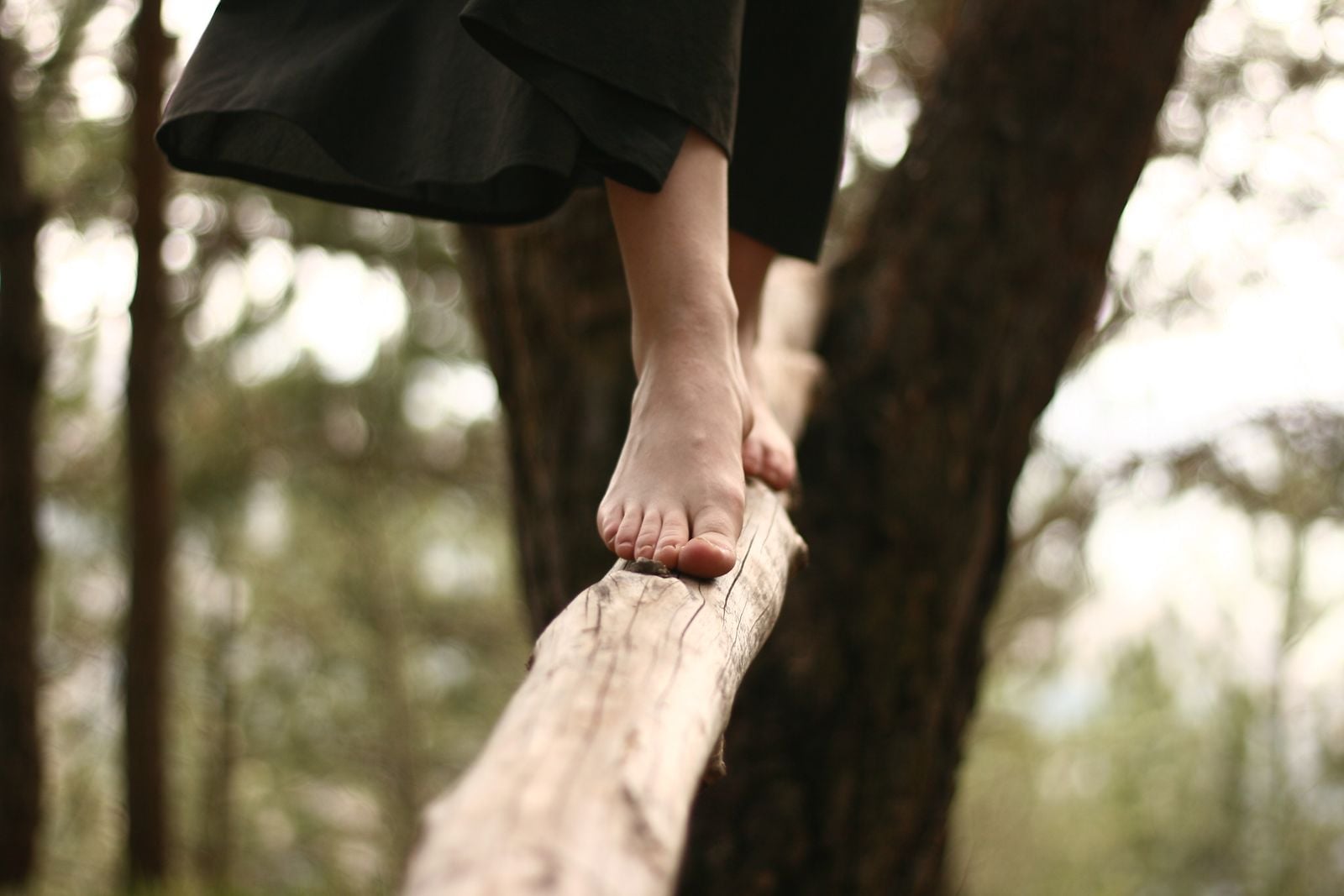
A five-year-old crossing a mossy log is doing something a treadmill cannot teach. The foot lands, the ankle rolls a few degrees, tiny muscles along the shin fire before the child has consciously registered the tilt, and the whole body course-corrects in under a tenth of a second. Do this a few hundred times a week — over roots, down slopes, across wet stones — and the nervous system builds a map of the ground that flat rubber tarmac simply never asks for.
That, at least, is the working hypothesis behind a body of Norwegian research on what happens when children play on uneven natural ground versus level, engineered surfaces. The clearest evidence comes from Ingunn Fjørtoft, a motor-development researcher at Telemark University College, who ran a quasi-experimental study comparing five-, six- and seven-year-olds playing in a natural forest landscape against children on a traditional playground. Her findings, published in the Early Childhood Education Journal, showed the forest-playing children came out significantly ahead on balance and co-ordination. Ankle proprioception — the joint’s ability to sense its own position without looking — is the physiological mechanism researchers point to for that gap: it’s the sense most directly exercised by ground that refuses to stay flat.
The three-hour threshold, and why it matters
The figure that keeps surfacing in discussions of outdoor kindergartens is roughly three hours a week of unstructured play on natural terrain. Not three hours of hiking. Not three hours of coached movement. Three hours of the kind of play where a child decides, unprompted, to climb the root ball of a fallen spruce because it looks interesting.
The Artful Age
A weekly letter on aging well, family across generations, and the creative life after the kids leave home.
Three hours is a low bar. It is less time than many children now spend on screens in a single afternoon. The competition for the three hours is fierce, and it is largely indoor.
What the foot is actually doing on a mossy log
Proprioception is the sense that tells you where your ankle is without having to look. It runs on receptors buried in the joint capsule, in the ligaments that wrap the ankle, and in the muscle spindles of the lower leg. Every one of those receptors is a tiny reporter, firing information up the spinal cord about angle, load, stretch, and speed of change.
On a flat playground, most of those reporters are bored. The ground under a five-year-old’s trainer is predictable. The ankle stays roughly at ninety degrees. The peroneal muscles along the outside of the shin fire in the same pattern, step after step.
Put the same child on a slick log covered in moss and the reporting rate jumps. The forefoot lands at an angle the child could not have predicted from a metre away. The ankle rolls maybe three degrees to the outside. Stretch receptors in the peroneals fire. A reflex arc, some of it not even reaching the brain, contracts those muscles to pull the ankle back to neutral. The child adjusts. Sometimes the child falls.
Falling is part of the curriculum
Falling, in this literature, is not the failure state. It is the data. Toddlers during free play move in short bursts rather than steady lines, accumulating numerous falls and thousands of steps per hour. A fall is a full-body recalibration event. The vestibular system logs the drop. The visual system logs the world tipping. Muscle spindles across the legs, hips and trunk all fire at once. The brain, in the seconds afterward, updates its model of the ground.
Take away the uneven ground and you take away the falls. Take away the falls and you take away thousands of tiny calibration events per year. The child grows up with a nervous system that has mostly practised standing on flat things.
Why Norway keeps producing this research
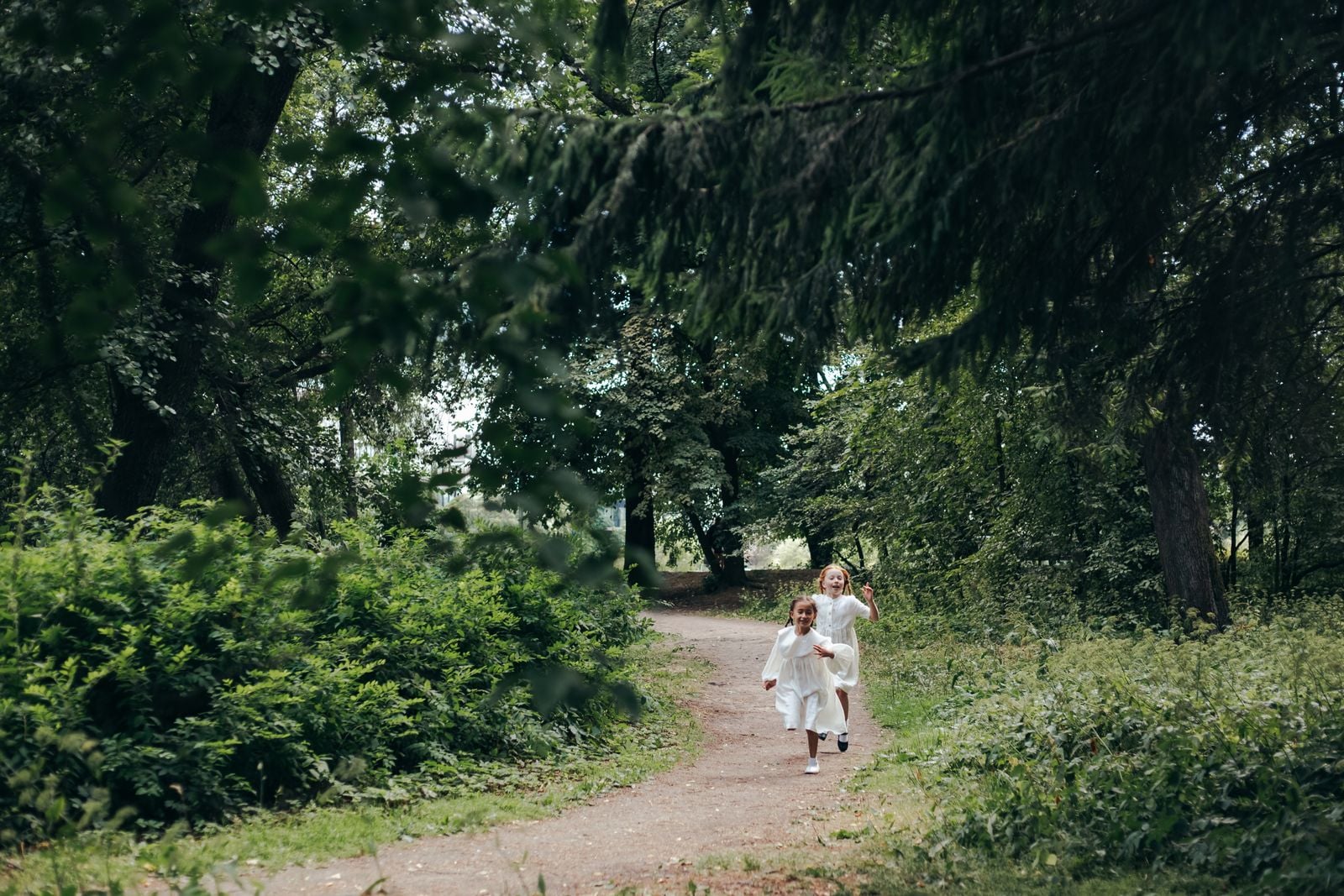
Norway is not accidentally interested in this. The country runs one of the world’s densest networks of friluftsbarnehager — outdoor kindergartens, where children spend most of the day outside regardless of weather, often in forest. The kindergarten system is part of Norway’s broader cultural architecture around outdoor time. It also means researchers have a large, stable population of children on uneven ground for hours a day, and a comparison group on conventional playgrounds.
The children in the forest groups are not doing anything a child in a Manchester park could not, in principle, do. They are climbing, dragging sticks, walking on logs, sliding down mud. The variable is the ground.
The mechanism, in plainer terms
A useful way to think about it: the nervous system learns what it is asked to learn. This is the same principle behind sensory integration work in other populations, where children are asked to process varied sensory input in movement — the same principle, applied deliberately in a clinical setting.
Uneven natural ground is a passive, free version of that. Nobody has to coach it. The mossy log does the work.
Ankle proprioception in particular has an outsized role in adult life. It is the sense that stops a middle-aged commuter from turning an ankle on a kerb. It is the sense that lets a seventy-year-old walk a gravel path without a stick. Building it early appears to matter, because the receptors and the neural pathways that read them mature through use, and the window in early childhood is when the system is most plastic.
What flat playgrounds were designed to solve
Modern playgrounds were not built to bore the ankle. They were built, largely from the 1970s onwards, to reduce injury liability. Rubber crumb surfaces, level platforms, code-compliant fall heights. All of it makes sense on the injury column of the ledger. It also, quietly, removes almost every micro-adjustment the foot used to have to make.
The trade-off has consequences that only show up years later. The child who never had to negotiate a slippery root at five is the teenager whose ankle gives out on a netball court at fifteen, and the adult whose balance testing at sixty comes back below age-matched norms.
The wider shift in how children spend time
The three-hour figure lands against a childhood that has been getting steadily more indoor and more still. The pattern is one of a generation trading scraped knees and invented games for something emptier. Scraped knees are the visible cost. The invisible cost is the calibration.
Minecraft and games like it build a rich model of an imagined ground while the actual ground under the child stays flat and predictable. HELLO! Magazine has offered parents advice on managing children’s screen time. The three-hour number keeps returning, from both sides — the ceiling for screens, the floor for uneven ground.
What a mossy log costs
Nothing. This is the strangest part of the finding. The intervention is free. It requires no equipment, no coach, no app. It requires a wood, a park with roots, a beach with rocks, a hillside behind a housing estate. The child does the rest.
Parents who want to translate the research into a Tuesday afternoon do not need a plan. Take the shoes off in the garden. Walk the low wall on the way home from school. Let the child pick the path through the woods, even when the path is the muddy one. Skip the tarmac loop for the rooty one. Open-ended ground teaches the ankle to problem-solve.
The receptors keep working after childhood
The proprioceptive system does not shut down at eighteen. It just gets less new information. Adults who take up hiking, climbing or barefoot walking in middle age often report, within weeks, that their feet feel more awake. That is not romantic. That is the receptors reporting again, at a higher rate, because the ground has finally started asking questions of them.
Balance training in older adults is a well-established fall-prevention strategy, and the mechanism is the same one at work in the five-year-old on the log. The system responds to being asked. It is just that the five-year-old’s system responds faster and more permanently, because the wiring is still being laid down.
What lingers
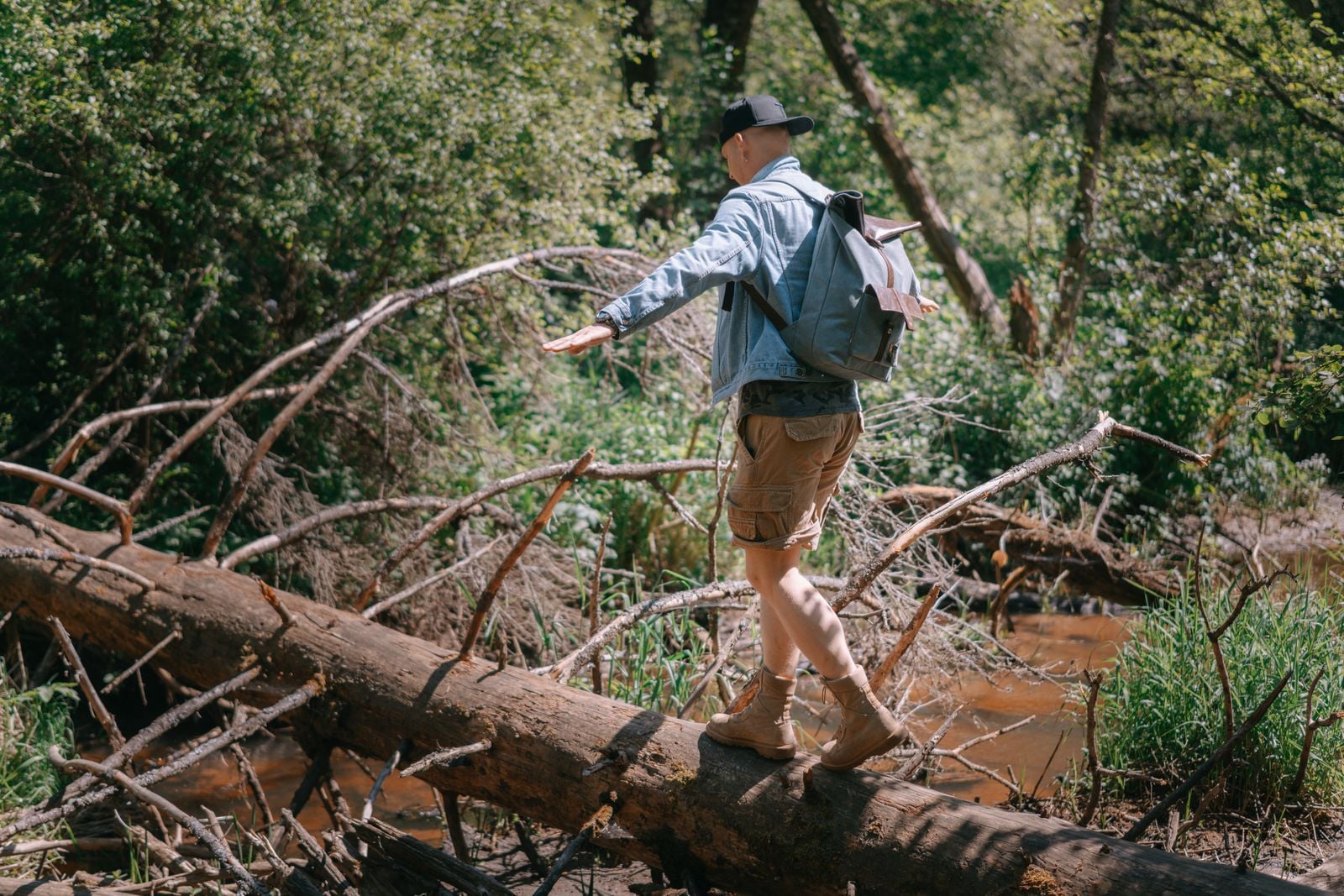
Somewhere in Norway right now it is late August. A group of five-year-olds is walking single file along a fallen birch about the height of a kitchen counter above the forest floor. One of them stops, wobbles, spreads her arms, feels the log flex slightly under her weight, and keeps going. The peroneal muscles in her right leg have just fired in a pattern she will use, without ever thinking about it, when she is sixty-eight and stepping off a kerb in the rain.
The log does not know it is teaching her anything. It is simply there, damp and slightly rotten, waiting for the next foot.