Scott Kelly’s blood, urine, saliva, stool, and cognitive test scores were collected and compared against samples drawn from his identical twin Mark in Arizona. When the results were published in 2019, the combined finding was that spaceflight thickens artery walls, lengthens then collapses telomeres, dysregulates gene expression, shifts the gut microbiome, affects the back of the eyeball, and measurably slows reaction time after landing.
And almost none of it was disqualifying for Mars.
Two brothers, one variable
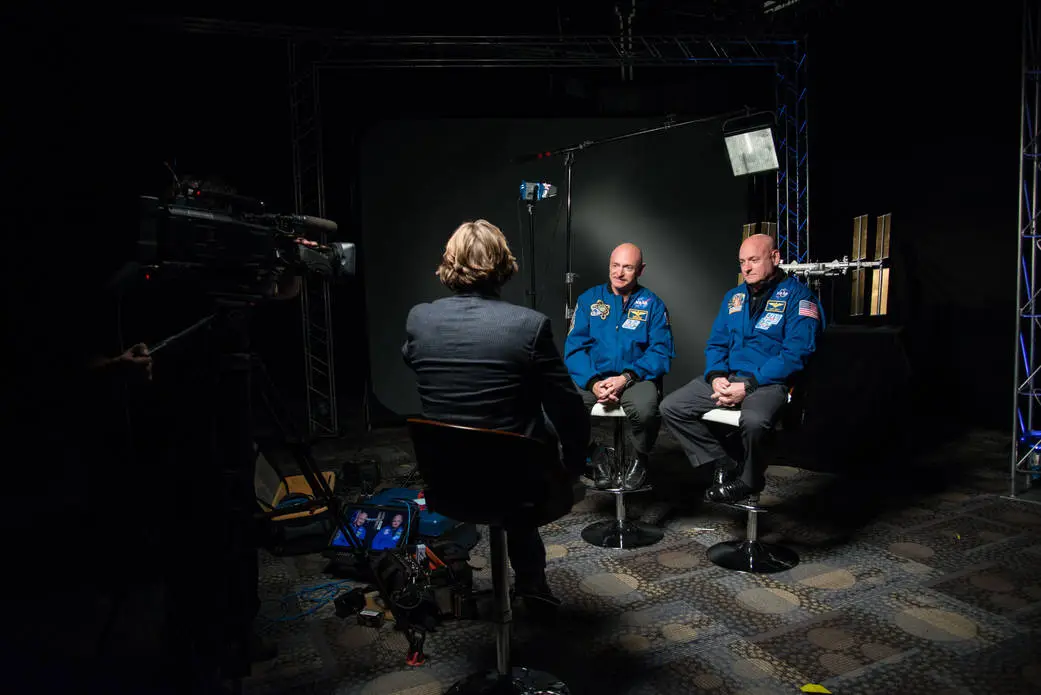
Scott and Mark Kelly are identical-twin astronauts who both flew for NASA. Both have the same genome, the same Irish-American upbringing in West Orange, New Jersey, and most of the same lifetime environmental exposures. When Scott launched to the International Space Station in 2015, Mark stayed on the ground as what biologists call a matched control.
The Artful Age
A weekly letter on aging well, family across generations, and the creative life after the kids leave home.
That sentence sounds like a science-fair setup. It is the closest thing modern biology has produced to a controlled experiment on a human being under extreme environmental exposure. Genetically identical subjects. One variable changed — orbital velocity, cosmic radiation, chronic microgravity, elevated cabin CO₂, restricted diet, disrupted sleep. A longitudinal dataset on both brothers, before, during, and after the flight.
NASA will not get another matched pair. Whatever the next two decades of long-duration flight reveal about the molecular cost of leaving the planet will be measured against the baseline that Scott and Mark Kelly happened to provide.
Ten teams, one body
NASA parceled Scott’s samples out to multiple principal investigator groups, each looking at a different biological layer. Johns Hopkins researchers handled the epigenome — chemical methylation marks that switch genes on and off without altering the underlying DNA sequence. Colorado State handled the telomeres. Weill Cornell handled gene expression and the microbiome. Other teams handled the cardiovascular data, cognition, nutrition and biochemistry, and so on, layer by layer, through immune function, proteomics, metabolomics, and epigenetics. In total, ten teams across twelve universities and 84 researchers worked the case.
The findings did not sit in separate buckets. They interlocked.
The telomere surprise
Telomeres are the repetitive DNA sequences that cap the ends of chromosomes. They shorten with every cell division, with chronic stress, with poor sleep, and with age. Every prediction going into the study said Scott’s telomeres would be shorter when he came home, because spaceflight is, by every available measure, a high-stress environment.
They were longer. Substantially longer, on average, throughout the mission. The result was so unexpected that the team initially suspected a sample-handling error and re-ran the assays. The lengthening was real.
Then, shortly after landing, his telomeres collapsed. Not back to baseline — below it. He returned from orbit with a population of unusually short telomeres and a measurable increase in chromosomal aberrations, a finding published in the peer-reviewed Twins Study paper in Science. The most plausible interpretation is that microgravity altered the cell-division dynamics of his hematopoietic stem cells in orbit, and the return to gravity and Earth-normal fluid distribution triggered a wave of accelerated cellular aging on the ground.
The seven percent that never came back
The headline that traveled fastest in 2019 was that seven percent of Scott Kelly’s DNA had changed. That version is wrong. The genome itself — the sequence of base pairs — does not rearrange itself in a year of spaceflight. Scott remains genetically identical to Mark in the strict sense.
What did change was gene expression. Which genes were switched on, which switched off, and how loudly each was being read by the cellular machinery. Most of the genes that shifted activity levels during flight returned to normal after landing. Some did not.
The genes that stayed dysregulated clustered in exactly the systems most stressed by radiation and microgravity: immune function, DNA repair, bone formation, hypoxia response, mitochondrial activity. The cellular machinery that would need to work reliably for two to three years on a Mars transit stayed altered the longest.
The thicker carotid
During the mission, ultrasound scans showed the wall of Scott’s carotid artery had thickened. The change appeared early and stayed throughout the flight. On Earth, carotid wall thickening is a marker cardiologists use as an early sign of vascular aging. In orbit, with fluids shifted headward by the absence of gravity and elevated cabin CO₂, the artery was behaving as if Scott had aged rapidly.
The eyeball changed too. The back of his retina thickened. Folds appeared in the choroid, the vascular layer behind the retina. These changes — grouped under the acronym SANS, or Spaceflight-Associated Neuro-ocular Syndrome — have shown up in astronauts on long-duration missions, with a pattern that appears to differ between male and female astronauts.
The microbiome swap
Researchers sequenced the bacteria in Scott’s gut before, during, and after flight. The community shifted markedly in orbit — the ratio of dominant bacterial groups tipped in ways not seen in Mark’s parallel samples. When Scott landed, most of the gut community drifted back toward its preflight composition within months. Some populations did not.
The skin microbiome shifted too, which is unsurprising given that every patch of skin the size of a pencil eraser carries roughly a million bacteria, and the entire ISS environment is a closed loop of shared human microbes recirculating through the air filtration for months at a time. Scott spent his mission breathing air his own body had partially colonized.
The cognitive fingerprint
Scott went through a battery of cognitive tests before, during, and after flight. His reaction times and accuracy held up well during the mission, with modest declines in the final months. The unexpected finding came after landing. His speed and accuracy on several tasks dropped below preflight baseline and stayed depressed through the post-mission testing window.
He had not recovered. Whether he ever fully did is a question the published paper does not answer. Long-duration crews studied elsewhere have shown similar patterns — the brain, like the immune system, does not snap back the way muscle and bone eventually do.
The height, and other reversible things
Some of the changes reversed within days. Scott came home taller than when he left, because the intervertebral discs in the spine expand without gravity compressing them. That stretch reverses within days of landing — a pattern documented across six-month ISS crews. He lost bone density in his hips and lumbar spine, which is the standard microgravity signature and the reason astronauts spend hours each day strapped to the ISS treadmill and resistive exercise device. He lost lean muscle mass. His fluid balance shifted headward and gave him a puffy face for the first weeks in orbit.
These are the changes that fit inside a NASA press briefing slide. The molecular changes — telomere collapse, mitochondrial signatures, persistent gene dysregulation — are the ones that took years and multiple labs to describe.
What the epigenome didn’t do
Johns Hopkins researchers looked specifically at DNA methylation in two types of white blood cells, CD4+ and CD8+, isolated from both brothers. Methyl groups are chemical tags added to DNA that influence which genes get expressed. The prediction was that a year in space would leave Scott’s methylation pattern radically different from Mark’s.
It did not. There was less than a 5 percent difference in overall methylation between the twins during the mission. The largest gap came nine months in — 79 percent of Scott’s DNA was methylated, versus 83 percent of Mark’s. About as many epigenetic changes occurred in earthbound Mark’s DNA as in his space-flying twin.
The locations differed, though. Scott’s methylation shifts clustered near immune-response genes, and those shifts tracked with independent inflammation markers his blood was throwing off. According to research published in the Johns Hopkins Hub, scientists found no massive disruption of the epigenome in either twin, though the study’s small sample size limited broader conclusions about spaceflight’s effects. Researchers acknowledged that with only two participants, the study was limited in what definitive conclusions could be drawn about spaceflight’s broader effects on human genetics.
The Mars question
Scott Kelly’s mission was the American single-flight record until Frank Rubio spent 371 days in orbit ending in September 2023, after his planned six-month stay was extended by a Soyuz coolant leak. Christina Koch holds the women’s single-flight record at 328 days, and in April 2026 she became the first woman to travel around the Moon as a mission specialist on Artemis II’s roughly ten-day lunar flyby.
A round-trip Mars mission runs roughly 900 days. Six months out, roughly 18 months on the surface waiting for planetary alignment, six months back. Every long-duration crew adds another data point to what the twin study began. None of them has a genetic doppelganger on the ground.
The radiation environment beyond low Earth orbit is qualitatively different from the ISS environment, which sits inside the relative protection of Earth’s magnetosphere. A Mars crew would absorb several times more ionizing radiation, including periodic solar particle events that can deliver a year’s worth of dose in hours. Even the ten-day Artemis II lunar mission required new dosimetry hardware to track crew exposure in real time.
Why the trip still gets green-lit
Read cold, the twin findings are alarming. Read against the standard NASA uses — is any single finding a hard disqualifier for a Mars crew? — almost none of them are.
Bone loss can be mitigated with exercise regimens and pharmaceuticals. Muscle atrophy responds to resistive training. Radiation exposure can be partially shielded and pharmacologically buffered. Telomere collapse is worrying but not acutely dangerous. Gene expression dysregulation is worrying but has not, so far, produced measurable disease in any of the astronauts who have flown long-duration missions. The vision changes are permanent in some cases but do not prevent an astronaut from functioning. The cognitive slowdown is real but small.
The systems flagged as most affected — immune, mitochondrial, cognitive, telomeric — are exactly the systems a Mars mission would need to function reliably for two to three years without resupply. And they are the systems least addressed by current countermeasures. The twin study did not prove that Mars is impossible. It handed the medical planners a specific list of what to worry about, in the specific tissue types where the worry lives.
What the body remembers
Seven years after publication, the cleanest summary remains the one offered at the time: human physiology is more plastic, more reactive, and less reversible under spaceflight conditions than the pre-mission models predicted. Most of what changed in Scott Kelly came back. A measurable fraction did not.
The body remembers orbit. Not metaphorically. It remembers in the form of gene-expression patterns that never fully reset, telomere distributions that never fully recover, and cognitive baselines that may have permanently shifted. Scott Kelly came back to Earth a slightly different man, in a literal molecular sense, than the one who left.
His brother Mark, meanwhile, went on to be elected a United States Senator from Arizona in 2020. He still has the shorter spine, the shorter telomeres relative to the ones Scott had in orbit, and the gene expression pattern of a man who spent the same time walking around a state that averages 299 days of sunshine a year. The control condition, sitting in the desert, aging normally, casting votes on the Senate floor while his identical twin’s cells quietly decided what they were going to remember about the trip.