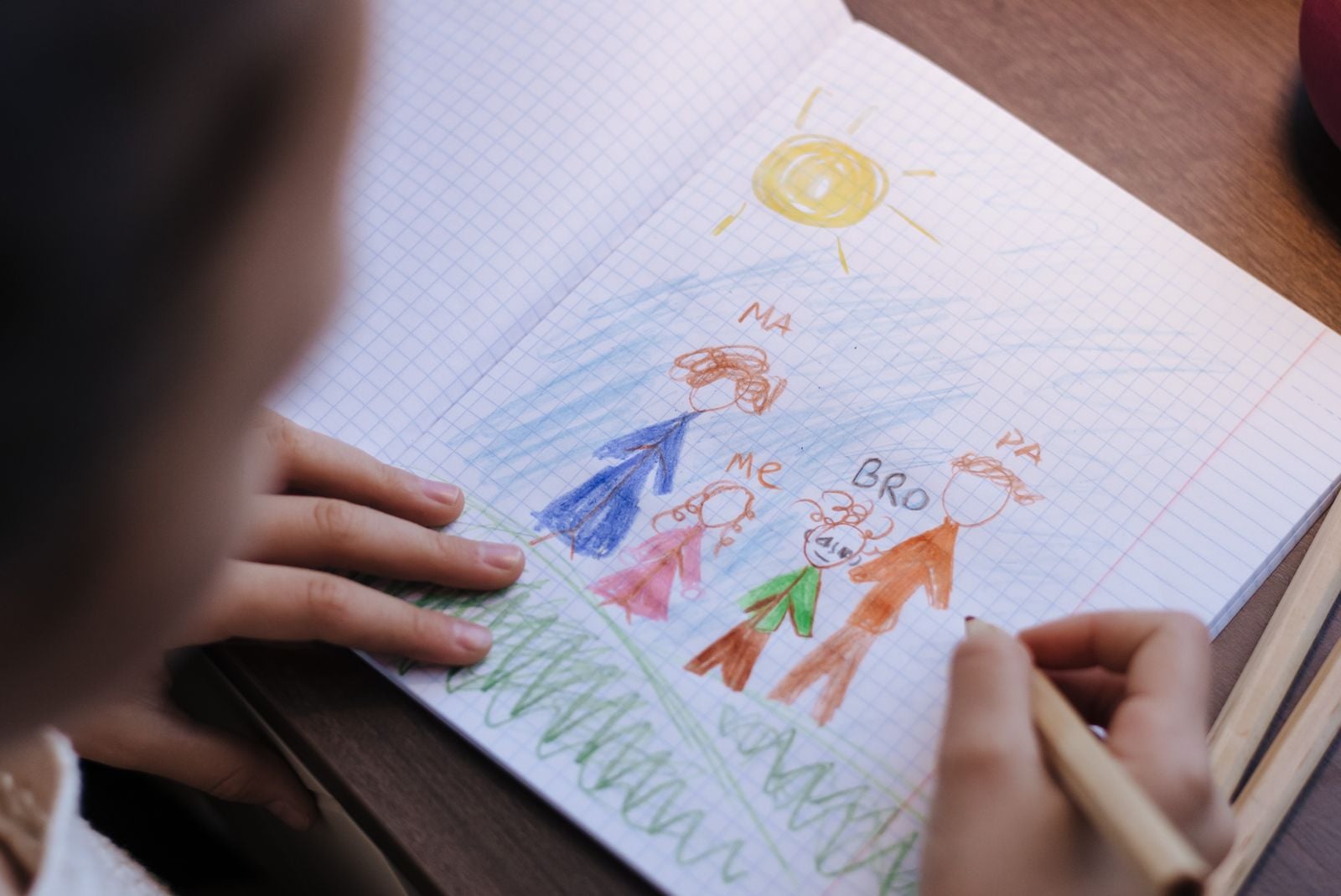
Hand a four-year-old a yellow crayon and ask for a picture of outside, and something remarkable tends to happen. A circle appears near the top of the page. Straight lines shoot out from its edges like spokes. Two dots and a curved smile fill the middle. The sun in the child’s actual sky may be white, or hazy behind cloud, or a pale disc in a Scandinavian winter — but the sun on the page is yellow, radiant, and grinning.
This little glyph is one of the most reliably reproduced images in the human species. Parents, teachers, and art therapists see it appear in classrooms in Milan, in kindergartens in Nairobi, in family drawings collected during the Italian COVID lockdowns. The 2022 Frontiers in Psychology study of lockdown drawings by Italian primary and middle-school children includes outdoor scenes in which shining or partially clouded suns appear above houses, gardens and play areas. The children were drawing from memory, often recalling grey March afternoons. The suns still appeared.
The moment the circle grows a face
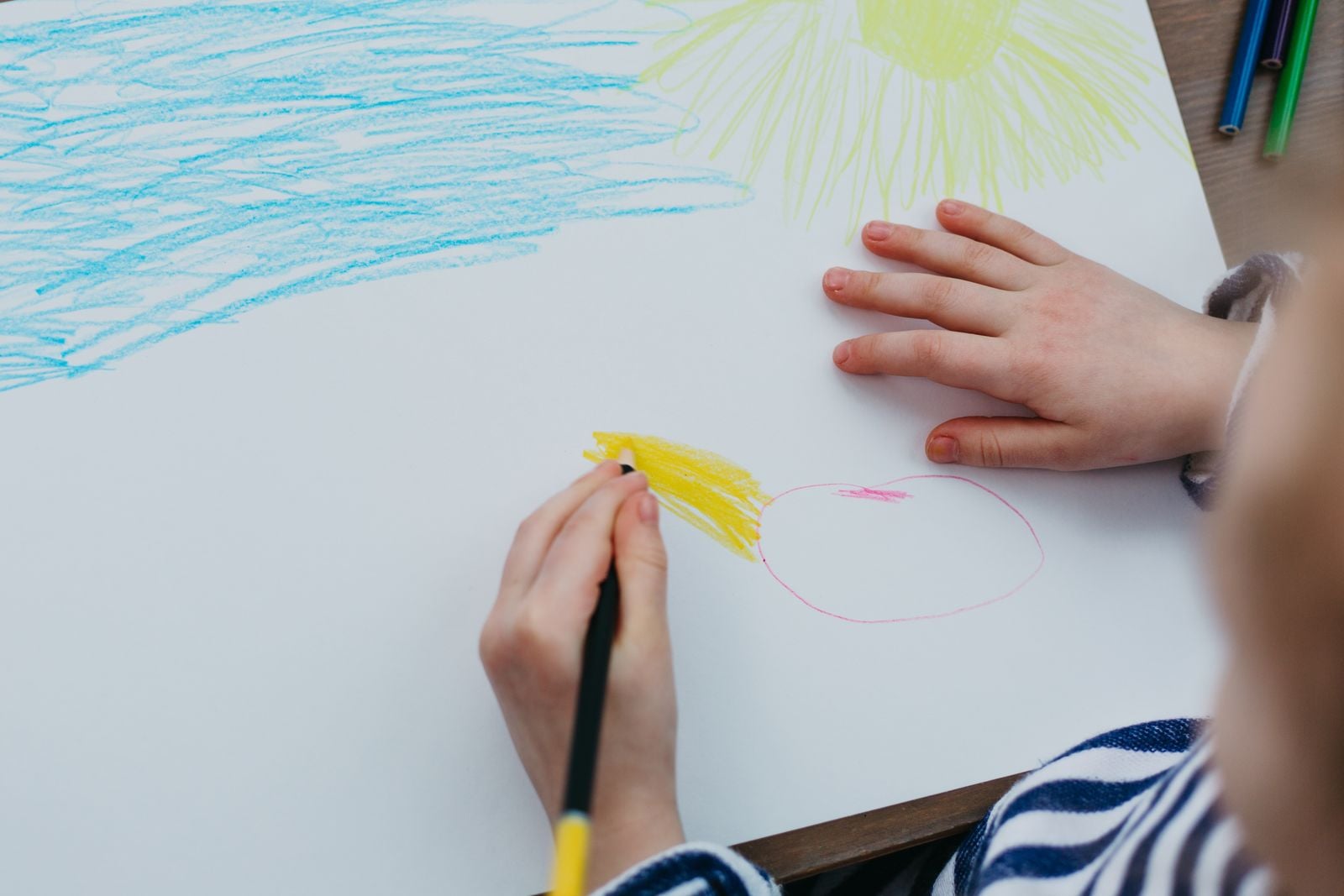
The rayed, smiling sun tends to appear somewhere between the third and fifth birthday, alongside a broader shift in how children use a page. Before that, drawing is largely a record of the arm. Toddlers scribble in loops and arcs because the shoulder swings that way. The mark on the paper is the trace of a body in motion, not a picture of anything.
The Artful Age
A weekly letter on aging well, family across generations, and the creative life after the kids leave home.
Then, gradually, the marks begin to stand for things. A circle becomes a head. A line becomes a leg. A yellow blob with spikes becomes the sun. Developmental researchers describe this as a move from perceptual drawing — trying to render what the eye sees — to symbolic drawing, where the child assembles a visual vocabulary of agreed-upon signs. The sun-with-a-face is one of the earliest and most stable entries in that vocabulary.
A 2026 review in Frontiers in Human Neuroscience traces the classic stages first outlined by Georges-Henri Luquet and Rhoda Kellogg, and later confirmed by empirical work: uncontrolled scribbling from roughly 12 to 24 months, controlled scribbling from around two to three, and then the emergence of recognisable symbols in the years that follow. The rayed sun sits inside that later phase, when children are no longer just moving the crayon but deciding what the crayon should mean.
Why the sun gets a face before the sky gets a colour
Ask a four-year-old why the sun is smiling and you often get a straightforward answer: because it is happy, or because it is looking at them. This is not a stray bit of poetry. It is a feature of how young children make sense of the world.
Piaget noticed that young children often believed the moon was following them on evening walks. Three- and four-year-olds routinely assign intention to the sun, clouds, and wind. The sky, in a preschooler’s mind, is populated. The sun is a somebody.
So when the child draws it, the sun gets what somebodies get: eyes, a mouth, a mood. The face is not decoration. It is the child’s honest report of what the sun is.
Rays that don’t match the sky
The spokes shooting out from the disc are the other giveaway. Real sunlight, when a child looks up, is not a set of black lines. It is glare, warmth, a squint. But the rayed convention shows up whether the child is drawing in Reykjavik or Recife.
Part of the reason is the crayon itself. A four-year-old’s hand is still learning what the fingertips can do. The 2026 Frontiers review describes how children move from proximal control — big movements from the shoulder and elbow — toward distal control at the wrist and fingers, and how gesture planning slowly catches up with intention. Straight radiating lines are motorically satisfying at that age. The arm knows how to make them. The wrist can pivot around the disc.
But motor ease alone doesn’t explain the universality. Children who see very different suns still draw the same sun because they are copying each other, copying picture books, copying the sun on a yogurt pot, copying the sun their older sibling drew last week. The symbol propagates because it works: everyone recognises it instantly, including the child.
A shared vocabulary, not a shared sky
The tadpole person is the sun’s close cousin in this vocabulary. A big circle for a head, two lines dangling down for legs, sometimes arms sprouting from the sides of the face. The pattern is the same: a symbol that reduces a complicated thing to its most essential parts.
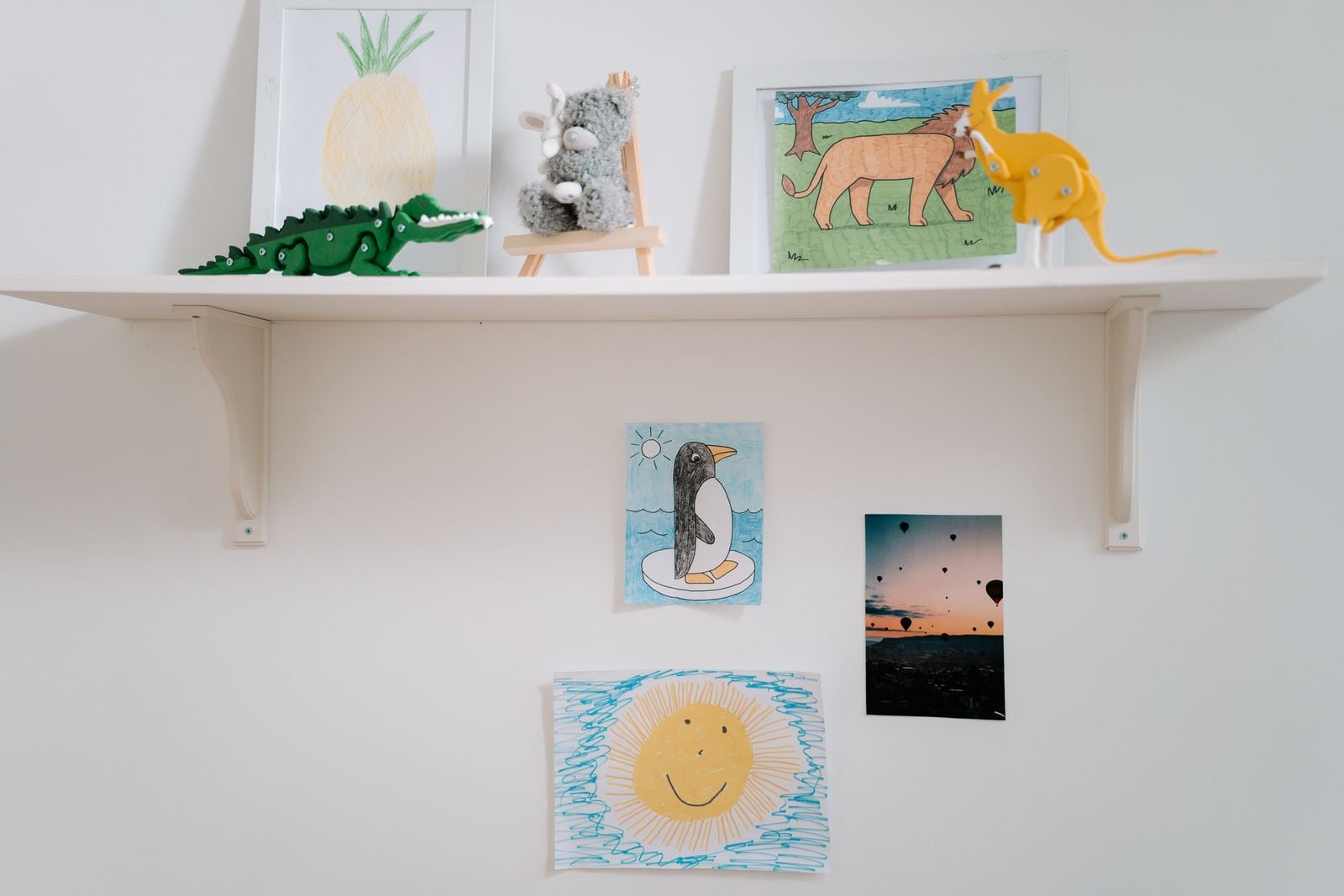
Research on children’s family drawings shows how consistent these forms are across the family portraits children produce — round heads, stick limbs, and, very often, a sun beaming down from the upper corner. The corner sun in particular is so common that clinicians assessing children’s drawings barely comment on its presence. They notice when it is missing.
Cross-cultural comparisons of tadpole figures reinforce the point: children in different countries, with different picture-book traditions and different visual environments, converge on similar early symbols. The convergence is what interests developmental psychologists. It suggests the symbols are not learned wholesale from adults but assembled by children solving the same problem — how do you put a person, or a sun, on a piece of paper? — with roughly the same equipment.
What the child is really drawing
Look closely at a four-year-old’s sun and you will notice it is almost never overhead. It sits in a corner, usually the top left or top right, hovering above a house or a family. The sun is where the child places the feeling of a good day, not the astronomical body.
This is the perceptual-to-symbolic shift in miniature. The child is not looking out the window and reporting. The child is composing a scene — house, family, sun, maybe a tree, maybe a dog — from a stock of known pieces. Each piece carries meaning rather than resemblance. The sun means outside, daytime, warm, happy. The face on it says all of that at once.
Georges-Henri Luquet, the French philosopher who first described children’s drawing stages, called this realisme intellectuel: intellectual realism, drawing what you know rather than what you see. A child of four drawing a house will often include windows on all four walls even though only one wall is visible, because the house has four walls and the child knows that. The sun works the same way. It has warmth and radiance and, in the child’s cosmology, a friendly disposition. So the drawing shows all of that.
Repetition is how the symbol locks in
Anyone who has spent an afternoon with a small child at a kitchen table has watched the same sun get drawn ten times in a row. This repetition looks aimless but it is doing serious developmental work.
Maria Montessori noticed children in her classroom returning to the same cylinder-block puzzle up to forty times in a single sitting. That repetition is now understood as motor rehearsal driving myelination in developing circuits. Drawing the sun over and over is doing the same job for the hand and eye. Each iteration tunes the grip, the pressure, the arc of the rays. Each iteration also strengthens the symbol as a mental object the child can summon at will.
By the time a five-year-old draws a sun, the movement has become close to automatic. Circle, dots, curve, rays. The child can talk while doing it. This is the same efficiency that lets an adult sign their name without thinking. The symbol has moved from something the child constructs to something the child has.
What changes around age seven
The smiling sun does not last forever. Somewhere around age seven or eight, most children start to feel embarrassed by it. The face comes off. The rays get shorter, or disappear. Some children begin drawing the sun as a partial disc peeking from behind a cloud, or leave it out entirely. Skies get coloured in with blue crayon rather than left white with a sun-glyph parked in the corner.
This shift lines up with what developmental research calls the move toward visual realism — the child begins to want the drawing to look like what the eye actually sees. The 2026 Frontiers review notes that optimal multisensory integration, the kind that lets you combine what you see with what you feel and what you remember into a coherent picture, is still maturing well into late childhood. Marko Nardini and colleagues found that children only begin integrating visual and auditory spatial cues in an adult-like way around age eight, and haptic-auditory integration for size continues developing until roughly ages ten to twelve.
The smiling sun, in other words, belongs to a specific window of childhood: after the child has enough motor control to make the shape reliably, and before the child has enough visual sophistication to feel that the shape is wrong.
Why it matters that adults recognise it
The rayed sun is one of the few images that an adult from almost anywhere can identify as a child’s drawing from across a room. Grandparents pin it to fridges. Nursery schools laminate it onto welcome posters. Illustrators of picture books draw it deliberately when they want a page to feel like it was made by a small hand.
Part of the pleasure adults take in it is nostalgic — a shorthand for a stage of childhood that passes quickly. Part of it is aesthetic; the glyph is genuinely well-designed, a piece of visual communication refined by millions of small hands over decades. And part of it, perhaps, is recognition of the animism underneath. The four-year-old drew a sun that was looking back at them. For a little while, everyone believed it was.
Save a few of these drawings if you have them. In a year or two the same child will draw the sun as a plain yellow disc, then stop drawing it at all, then draw a landscape at fourteen with a pale sky and no sun in the frame. The version with the face and the spokes only comes around once.