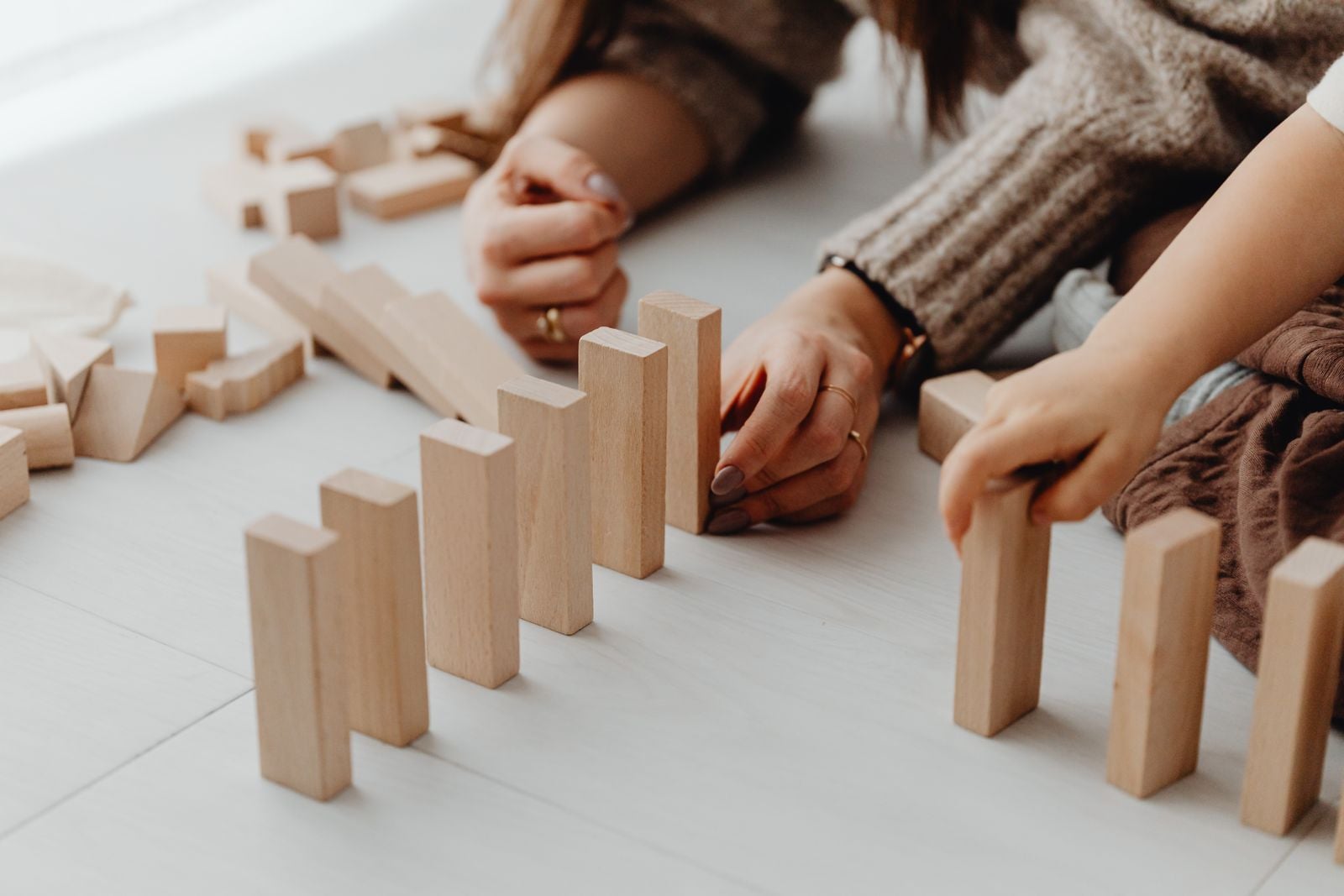
A child turning the same wooden block over, rebuilding a fallen tower, or trying a wider base is practising how objects relate in space. Research supports a careful version of that observation. In a University of Delaware and Temple University study, three-year-olds who were better at copying block structures also performed better on an assessment of early maths skills.
That finding does not show that children must use the same blocks for hours, or that changing toys every fifteen minutes harms spatial reasoning. No study cited here ran that comparison. A separate study investigated how the number of available toys affected toddlers’ play, while later FIU research examined how children solve mental-rotation problems.
What the Delaware study actually found
The Delaware and Temple researchers asked three-year-olds to reproduce six model structures using separate blocks. They also assessed early maths abilities ranging from counting to basic addition and subtraction. Children who copied the structures more successfully tended to perform better on the maths assessment.
The Artful Age
A weekly letter on aging well, family across generations, and the creative life after the kids leave home.
Copying a block structure draws on several spatial decisions. A child must notice whether one piece is above or below another, whether two edges are aligned, and which face of a block should point upwards. The study found a relationship between block-building and early maths performance, but it was not a long-term experiment showing that extended block sessions caused later academic success.
What mental rotation actually is
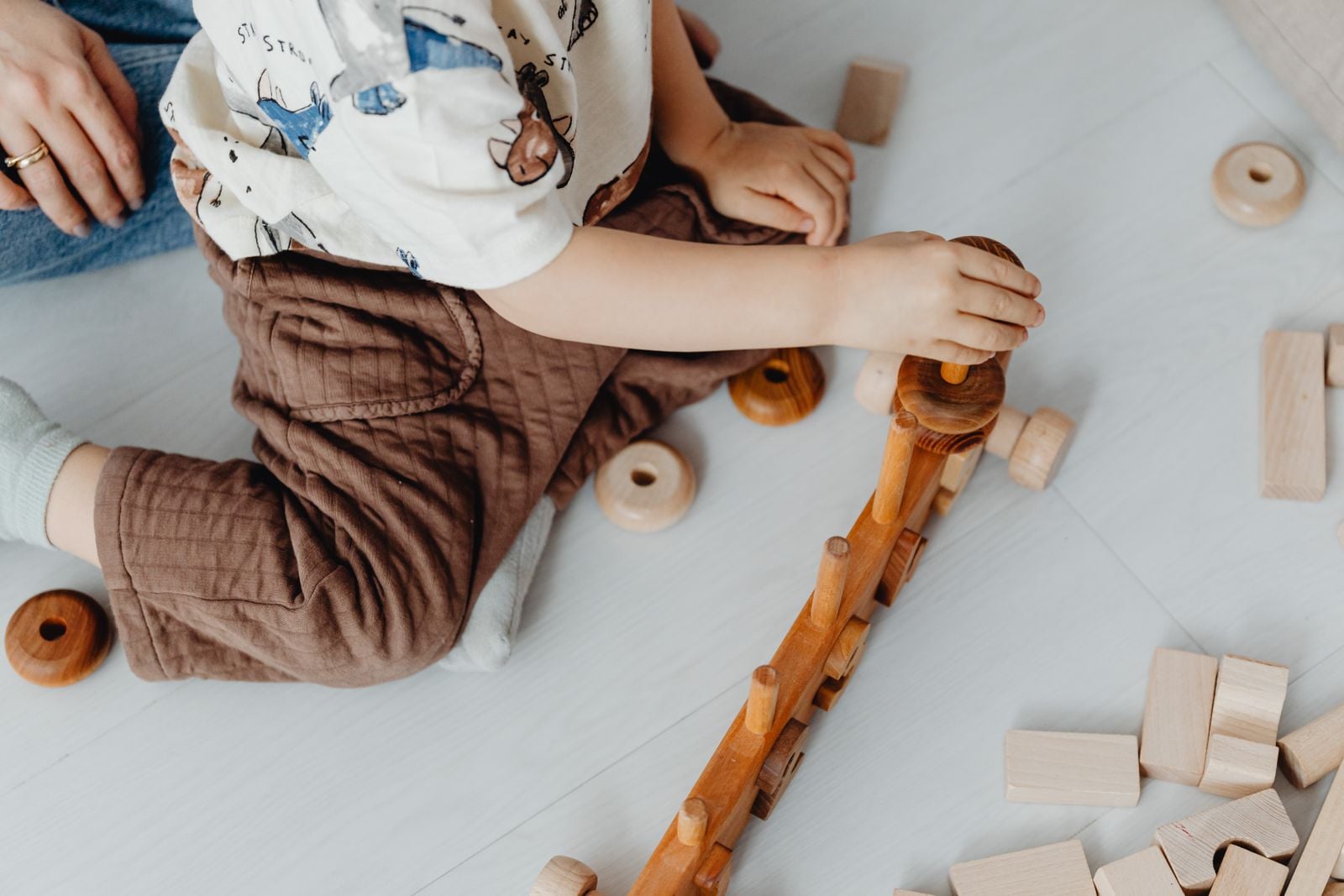
Mental rotation is the ability to imagine an object turning without physically moving it. Children use it when deciding whether a puzzle piece will fit, recognising an object shown from another angle, or working out whether a shape must be turned or flipped. Blocks provide one physical way to practise those transformations.
A Florida International University study used eye-tracking technology to observe 148 children between three and seven years old. Lead author Karinna A. Rodriguez and her colleagues showed the children one large object and two smaller alternatives. One alternative could be rotated to match the original, while the other was a mirror image.
Most children appeared to process the object as a whole rather than examining it piece by piece. Those using this holistic strategy solved the problems about twice as fast as children using a piecemeal approach. Writing in The Conversation, developmental researchers Shannon Pruden and Karinna Rodriguez explained that puzzles, blocks, maps, writing, and physical movement all draw on forms of mental rotation.
Fewer toys can support longer play
The evidence about toy quantity comes from a different experiment. In a 2018 study published in Infant Behavior and Development, 36 toddlers played under two conditions: one with four available toys and another with sixteen. With four toys, the children played with individual toys for longer and explored them in a greater variety of ways.
That result supports reducing the number of choices available at one time. It does not establish that the same wooden blocks are superior to every novel toy, nor does it prescribe a fifteen-minute rotation schedule. Toy rotation may still be a useful way to manage space or renew interest, provided it does not interrupt a child who is already deeply engaged.
What adults can add to block play
The FIU researchers recommend pairing spatial materials with words such as under, around, bigger, farther, and corner. These words give children language for describing relationships they can already see and touch. An adult might wonder aloud which block belongs underneath an arch or ask what could make a tower more stable.
However, the evidence should not be overstated. A 2019 Frontiers in Psychology study examined mother-child block-building interactions across four U.S. ethnic groups. At age four, the time mothers spent building structures that matched the test examples was associated with children’s block-building performance, but verbal instruction and adult initiation were not independent predictors.
By the age-five assessment, the relationship between mothers’ test-specific building and children’s performance was no longer significant. That makes the study an argument for shared participation rather than constant direction. Adults can describe, notice, and ask questions while still leaving the construction decisions with the child.
Origami, tangrams, and other spatial materials
Blocks are only one route into spatial thinking. A 2025 Frontiers in Education paper examined an origami-based programme for elementary-school children. Its online trial reported improvements in spatial vocabulary and reduced maths anxiety, while a longer in-person version also produced gains in spatial visualisation and geometry.
The study involved structured lessons rather than casual preschool folding, so its results should not be extended to every child making a paper crane. Still, folding requires children to follow spatial language, anticipate where a crease will land, and transform a flat sheet into a new form. Tangrams and three-dimensional puzzles offer similar opportunities to turn, compare, and fit shapes.
What the gender research shows
Research on sex differences in young children’s spatial abilities is mixed. The cited 2018 study of 96 Hispanic pre-kindergartners did not find that girls narrowed the gap after receiving regular spatial-play opportunities. It was not an intervention study, and it found that boys made significantly greater mental-rotation gains across the pre-kindergarten year.
The authors suggested that different exposure to blocks, construction toys, spatial activities, or spatial language might help explain the result. They also stated that this explanation was speculative because the study had not measured the children’s classroom exposure. It therefore cannot establish that toy preferences caused the difference.
The more useful conclusion is that spatial ability can be practised. A KQED report on spatial-skills education describes training that uses sketching, paper folding, cross-sections, and objects viewed from multiple perspectives. Giving all children access to blocks, puzzles, maps, construction activities, and spatial vocabulary offers more opportunities to develop those skills without treating ability as fixed.
What this means for the toy shelf
The research does not require parents to remove every colourful or electronic toy. It suggests keeping the number of simultaneous choices manageable and making open-ended materials easy to reach. A set of blocks, a puzzle, tangrams, and folding paper can each support different forms of spatial exploration.
Timing matters less than attention. If a child is repeatedly rebuilding an arch or studying how two shapes fit, there is little reason to replace the activity simply because a timer has sounded. Rotation can happen between play sessions, while sustained engagement can be allowed to continue when it arises naturally.
The value of an unhurried attempt
A block that keeps falling gives a child a problem with visible consequences. The child can widen the base, turn a piece, remove weight, or begin again. Each attempt supplies immediate information without requiring an adult to announce whether the answer is right.
Not every tower predicts a future engineer, and no single afternoon determines later maths performance. What block play offers is repeated practice in noticing shape, balance, orientation, and position. Sometimes the most useful response from an adult is simply to leave enough time for the next attempt.