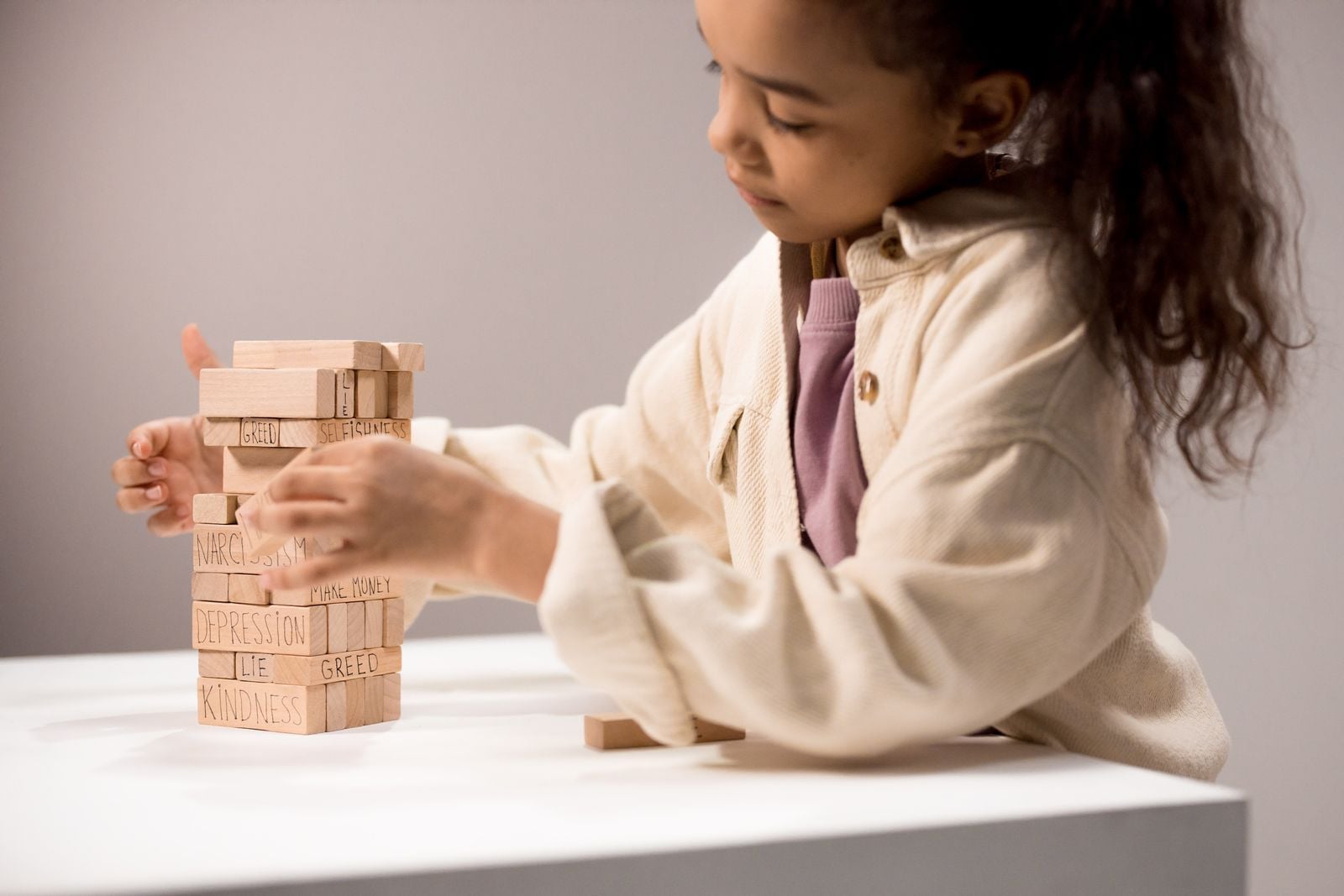
In a converted tenement in Rome’s San Lorenzo district, in January 1907, a physician named Maria Montessori opened a daycare for the children of factory workers and began doing something unusual for the era: she watched. She wrote down what they did. And what she recorded, again and again in her notebooks, was repetition. A three-year-old would take a wooden block studded with ten graduated cylinders, remove each cylinder, mix them up, and fit them back into their sockets. Then do it again. Then again. Montessori counted forty-four repetitions in a single sitting, the child indifferent to the noise around her, and when she finally stopped of her own accord, she looked around contentedly — in Montessori’s description, like someone waking from a refreshing sleep.
Montessori did not know why. She had no MRI, no way to see inside the cortex of a small child. What she had was a notebook, a count, and the discipline of a trained observer. More than a century later, developmental neuroscientists studying how the brain wires itself for motor skill are describing something that maps closely onto what she wrote down.
The cylinder block and the observation that started it
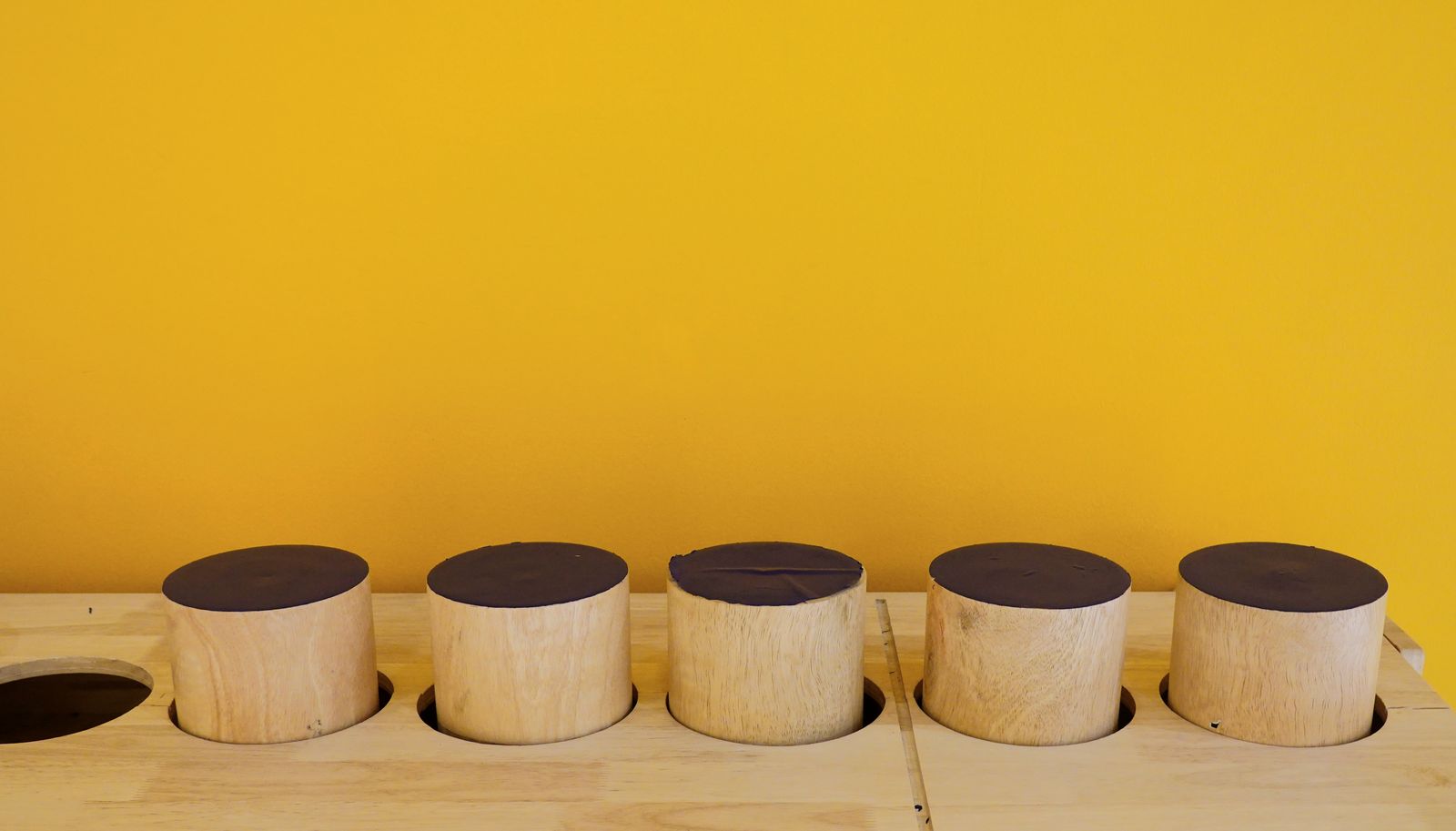
The material Montessori watched being used is still made today. It is a rectangular block of wood with ten cylindrical holes, each hole slightly wider and deeper than the last. Ten wooden cylinders, each with a small knob, fit into exactly one socket. A child who forces the wrong cylinder into the wrong hole discovers that one cylinder is left over at the end, and one hole is empty. The material corrects the child without an adult saying a word.
The Artful Age
A weekly letter on aging well, family across generations, and the creative life after the kids leave home.
What struck Montessori was not that children solved the puzzle. It was what they did after solving it. They did not put it away. They tipped the cylinders out and started over. The girl she wrote about at length in The Montessori Method (1912) worked through the cylinders forty-four times while Montessori deliberately tried to break her concentration — lifting the child, chair and all, onto a table, then asking the other children to sing. The girl held the block steady and carried on.
Montessori called the phenomenon polarisation of attention. The word she reached for afterwards was not exhaustion but rest: the child seemed to have been doing work that satisfied something, and the repetition itself was the point.
What is happening under the scalp
For most of the twentieth century, the story of brain development was told in the language of neurons and synapses. Myelin, the fatty sheath wrapped around long nerve fibres, was treated as insulation. As the neuroscientist Nathan Michaels put it in a Psychology Today survey of myelin research, the field long thought of it as “a passive structure—essential to brain function, but something like the concrete footing of a house.”
That picture has come apart over the past two decades. Myelin, it turns out, is laid down and remodelled throughout childhood, adolescence and well into adulthood, and the process is shaped by what the person actually does with their body. Fredrik Ullén, a cognitive neuroscientist at the Karolinska Institutet, found that the white matter tracts connecting the brain regions used in piano playing were markedly more developed in professional pianists than in non-musicians, and that the difference tracked how much they had practised. In a separate study, people learning to juggle showed roughly a five per cent increase in white matter after six weeks.
Myelin thickens where a signal is used. A nerve fibre firing over and over is wrapped more heavily by oligodendrocytes, the octopus-shaped cells that spool myelin around axons, and the signal begins to travel faster and more reliably. A National Institutes of Health review of adolescent neurodevelopment describes myelination as partly experience-dependent, driven in part by the electrical traffic running along the axons waiting to be wrapped. The field’s name for it is activity-dependent myelination.
Why forty repetitions, and not four
A cylinder is not a piano concerto. But for a two-and-a-half-year-old, threading a wooden peg into a hole that fits it exactly requires the pincer grip, wrist rotation, visual matching of diameter, and the small proprioceptive correction that happens when the cylinder catches on the rim. Each attempt sends a bundle of signals down the same motor pathways. Each repetition asks the same oligodendrocytes to wrap a little more sheath around the same axon.
The clearest demonstration of what that wrapping is for came from Bill Richardson’s laboratory at University College London. Mice genetically unable to make new myelin as adults were put on a wheel with unevenly spaced rungs, a task that demands fine motor coordination. Normal mice learned to run it. The myelin-deficient mice could not.
Read backwards, this suggests that the child who does the cylinder block forty times is not being obsessive. She is doing the biological work of wrapping a specific set of nerve fibres in the sheath that will make the movement fast and automatic. Once it is automatic, she moves on. Montessori observed exactly this: after the long period of repetition, the child would suddenly stop, look up, and never return to that material with the same intensity again. It was, in her language, finished.
The metabolic side of the story
Myelin is expensive. Oligodendrocytes need fuel to build it, and a study published in Nature Neuroscience in 2026 by a team at the Advanced Science Research Center at the CUNY Graduate Center found that glucose itself acts as a metabolic switch for oligodendrocyte progenitor cells, telling them when to divide and when to mature into myelin-forming cells. Mapping glucose across developing mouse brains, the team found that regions with higher glucose contained more actively dividing progenitors, while regions with lower glucose held cells beginning to differentiate.
The lead author, Sami Sauma, a postdoctoral researcher with the centre’s Neuroscience Initiative, described the finding in a write-up of the study in plain terms: glucose is not just fuel, it is a signal to divide. The division of labour is finer than that, though. Progenitors depend on glucose-derived acetyl-CoA to multiply; mature oligodendrocytes build the sheath itself using acetyl-CoA generated from other fuels, including ketone bodies. The centre’s own account of the work notes that the developmental window studied in mice corresponds to roughly 32 to 40 weeks of human gestation — the period in which premature birth can produce white-matter injury.
The picture that emerges is a small child whose brain is running a metabolic and structural project of enormous scale: laying down the physical wiring that will let her hand find a button, a pencil, a violin string, without conscious thought, for the rest of her life. Repetition is how that project gets funded.
What Montessori saw without knowing the mechanism
Montessori was not a neuroscientist. She was among the first women in Italy to qualify as a physician, graduating in medicine at the University of Rome in 1896, and she came to children first through her work at the university’s psychiatric clinic. Her method, as it developed in the Casa dei Bambini and later in schools across Europe and the Americas, rested on a small number of observations she recorded before there was any biological language for them.
One was that children of a certain age would choose a physical, structured task and repeat it far past the point an adult would consider useful. Another was that interrupting the repetition — offering praise, suggesting they move on, changing the material — broke the concentration and, she believed, cost the child something. A third was that the same child, given the same material a week later, might not touch it. Whatever had been happening had happened.
The mechanism she could not see was myelin. Her field notes were not a theory of myelination. They were a theory of not interrupting. But the two turn out to carry the same practical instruction: when a small child is doing a task with fierce focus, over and over, something structural is being built inside them, and pulling them away costs more than the adult can see.
The wider window
Myelination is not a one-shot event of early childhood, and it does not proceed everywhere at once. A study of human and chimpanzee cortex published in PNAS found that myelinated axon density in the human neocortex keeps rising past adolescence and into the third decade — and that the ordering is uneven. Across the lifespan in that sample, motor cortex carried the highest density of myelinated fibres and frontopolar cortex the lowest, consistent with the broader finding that sensory and motor areas mature early while the front of the brain finishes last.
None of this validates every specific Montessori claim, and Montessori herself made claims that would not survive contact with modern developmental science. What has survived is the observational core: that children of roughly eighteen months to four years often display extended, self-chosen repetition of physical, precision-based tasks, and that this repetition appears to be doing something worth not interrupting.
What this looks like in a living room
The forty-times child is not rare. Parents watching a toddler open and close a cabinet door, pour rice between two cups, climb the same three stairs, or wedge a shape sorter’s yellow triangle into its slot over and over are watching the same phenomenon Montessori clocked in 1907. The instinct to redirect — to hand the child a book, suggest a snack, offer something new — is almost always the adult’s discomfort with the repetition, not the child’s.
The question of how children build their own inner worlds runs through a lot of early childhood observation. Jean Piaget did something similar in the 1920s, watching his own children on evening walks and building a theory of cognitive development from what he saw — including the moon that seemed to follow them, which became the basis for a stage of thinking in which young children attribute intention to natural objects. Piaget and Montessori were doing the same essential work: sitting down, staying quiet, and taking careful notes on what a child does when no one hurries them.
The connection between careful observation of what a child chooses to do and what turns out to matter for their development has held up better than most twentieth-century theories of childhood. Praising a child’s effort and strategy rather than fixed traits, for instance — which The Artful Age has explored in a piece on the fragility of “you’re so smart” praise — sits in the same family of ideas: the doing is what builds the thing, not the label applied to it afterwards.
Rested, not tired
The detail from Montessori’s notebooks that has always been hardest to explain is her observation that after a long bout of repetition, the child looked calmer, not more depleted. Adults doing forty repetitions of anything would expect to feel drained. The children she watched appeared, in her words, rested and deeply pleased.
One reading, more than a century on, is that the child had just spent an hour funding a piece of infrastructure the brain wanted built. Progenitor cells had divided and matured. Sheath had been laid down. A signal that used to travel raggedly down an axon now travelled cleanly. The task that had required conscious attention would, a week later, not require it at all.
The girl at the cylinder block, in a converted tenement in San Lorenzo in the winter of 1907, could not have told Montessori any of this. What she did was finish, of her own accord, and look around the room like someone who had just woken from a good sleep. Montessori wrote it down, and left her alone.