
Start by putting the premise down. The eyes do lie, or rather they fail to tell on anybody, and this is one of the best-tested findings in the field. A large review by Bella DePaulo and colleagues examined the behaviors supposed to betray a liar and found that gaze aversion, the cue people name most confidently, has essentially no reliable relationship to whether someone is lying. This site has been through that evidence at length in a piece on why people look away while talking, and there is no point rehearsing it.
But underneath the folklore there is something real, and it is stranger and better than the thing it gets mistaken for. Eyes are honest about exactly one thing, and it is not what a person is concealing. It is where they are looking.
An odd piece of anatomy
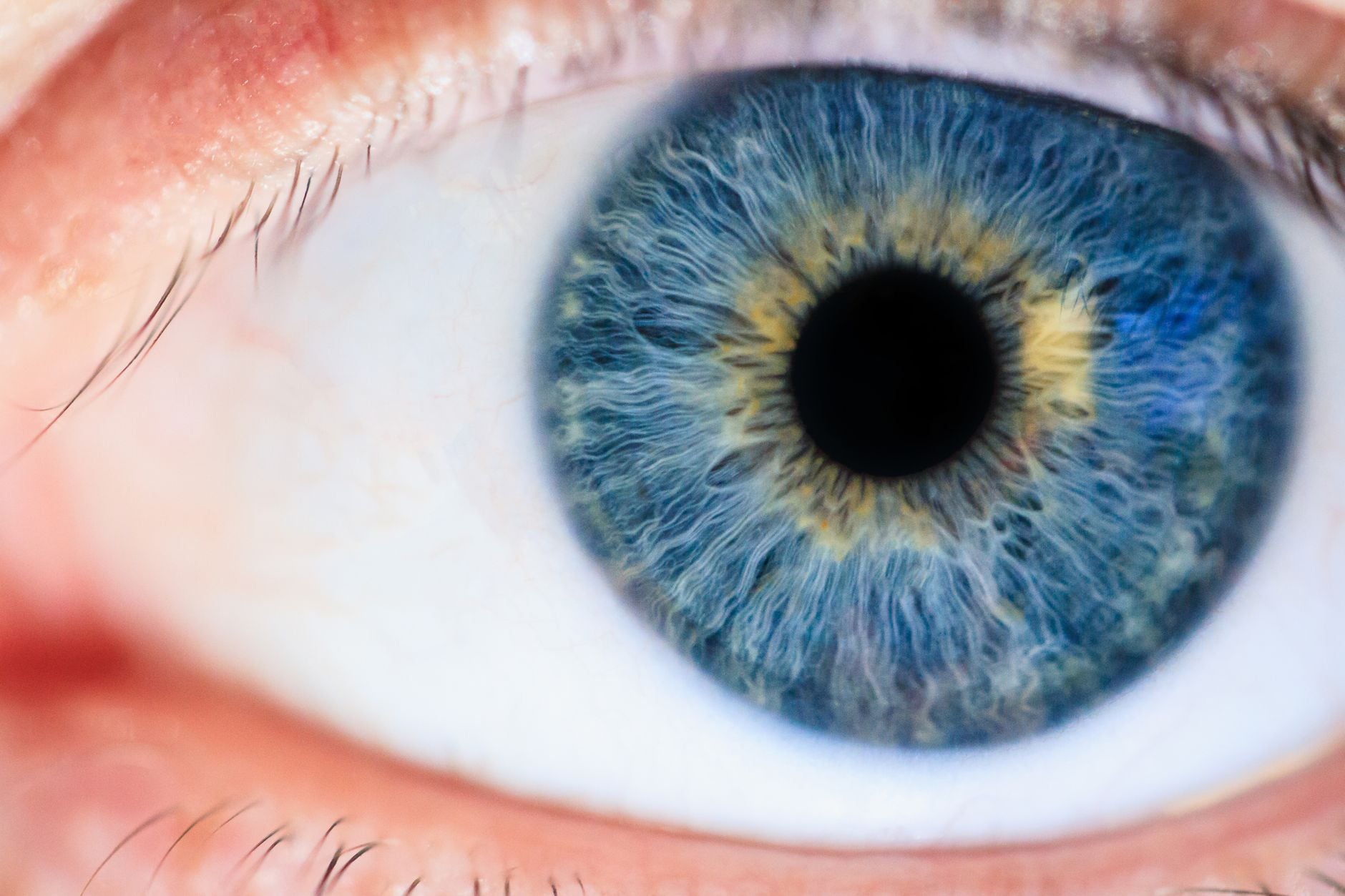
Human eyes do not look like other primates’ eyes. The sclera, the white, is unpigmented. The outline is elongated horizontally. A large amount of that white is left exposed on either side of the iris. The combined effect is that when a person’s eyes move, you can see it from across a room, without them turning their head.
The Artful Age
A weekly letter on aging well, family across generations, and the creative life after the kids leave home.
The cooperative eye hypothesis takes that anatomy and makes an argument out of it: an eye that advertises where its owner is looking is only an asset if you are mostly cooperating with the people who can see it. If you are mostly competing with them, broadcasting your attention is a liability. On this reading, the whites of our eyes are a piece of evolutionary evidence about what kind of animal we became.
It is a lovely story, and the interesting thing about it right now is that it is under attack from two directions at once, and both are worth knowing about.
Five-year-olds, and the difference between cute and trustworthy
Wouter Wolf, Julia Thielhelm and Michael Tomasello tested the social half of the claim on children. Over video calls, 48 five-year-olds were shown moving three-dimensional faces that had been altered in one respect only: the eyes. Some had ordinary human eyes with white sclera. Some had dark sclera. Some had enlarged irises that crowded the white out.
Children were asked which face they would rather share with, which one would help them, and, separately, which one was cutest.
With faces that had human skin, the children judged the white-sclera version more cooperative than either the dark-sclera version or the enlarged-iris version. That result is the one the authors lean on, and it is the one that survives their own caution, because in the studies using non-human “alien” faces the enlarged-iris comparison did not come out the same way.
The detail that makes this more than a preference for familiar-looking faces is the cuteness measure. Faces with enlarged irises were judged cuter than the human-eyed faces, and not more cooperative. Five-year-olds were pulling apart two things adults tend to conflate: whether you like the look of someone, and whether you would work with them.
The sample is small and particular, as the authors say. Forty-eight children, all about five and a half, mostly from higher-income households and predominantly white, with eight more excluded because they could not say what was different about the faces they were shown. And the authors flag a methodological catch that constrains their own earlier studies: children judge eyes differently depending on whether the rest of the face looks human, so the alien-face results should be handled carefully.
The premise the whole hypothesis rests on
Now the attack from the other side, and it is aimed at the foundation rather than the conclusion.
The cooperative eye argument only works if other primates’ eyes really do conceal their gaze. Chimpanzee sclera are dark, and the claim has always been that this hides where a chimpanzee is looking. Will Whitham, Steven Schapiro, Jolyon Troscianko and Jessica Yorzinski went and checked, and their method is the point of the paper.
They photographed captive chimpanzees at about ten meters, in artificial shade, on clear days, at a fixed aperture and focal length, photographing a gray concrete reference surface in the same light moments after each animal so the colors could be calibrated. Then, instead of asking whether a human looking at the photograph could see the eyes, they ran the images through perceptual models built for chimpanzee vision and for the vision of colobus monkeys.
Color alone turned out to distinguish nothing: a chimpanzee’s iris, sclera and pupil are not separable by color at any distance. Brightness is a different matter. On the model, a chimpanzee can tell the sclera from the pupil at around 20 meters, from the iris at around 24, and from the surrounding skin at around 29.
Mating, fighting, grooming, feeding and play all happen well inside those distances. And the colobus monkeys that chimpanzees hunt can make the same discriminations at roughly 21, 16 and 21 meters, which means the dark eye is not hiding a predator’s attention either.
Their methodological complaint is the part with the widest application. A great deal of the earlier work in this area used photographs of unknown origin, uncontrolled lighting, and image software tuned to human perception in order to decide what a non-human animal can see. That is the wrong instrument for the question, and it has probably been producing the wrong answer.
A field that has not settled
It would be tidy to say the hypothesis is therefore wrong. It is not that simple, and the honest report is that this argument is live.
One group found chimpanzee sclera conspicuous. Another tried the same method and failed to replicate it, reporting them cryptic after all. A third quantified pigmentation and eye shape across fifteen hominoid species and found three clusters, with humans alone in theirs. A fourth analyzed images of seven great ape species and concluded that ape eyes are broadly conspicuous rather than hidden, while human eye outlines and iris colors are far more visually distinct than any of them.
So the specific claim that other primates cannot read each other’s gaze is in trouble. The broader claim that human eyes are unusual, and unusually legible, is holding up. What is unresolved is whether that unusualness is an adaptation for cooperation or a side effect of something else.
What this leaves you with
Two limits worth stating. The chimpanzee study models what an animal could in principle discriminate, not what it actually attends to, and the animals were captive. The children’s study is 48 five-year-olds judging animations, which tells you something about how young humans read eye morphology and nothing at all about whether an adult can read a colleague across a meeting table.
What survives is not a technique. Eyes do not reveal what someone is hiding, and the confident reader of eyes is usually reading their own expectations. What eyes do carry, reliably and without permission, is the direction of somebody’s attention, in a face built so that the movement is visible from further away than the owner might choose.
That is a much smaller fact than the folklore promises. It is also the only part of it that is true, and the question of why our eyes work that way is still, genuinely, open.