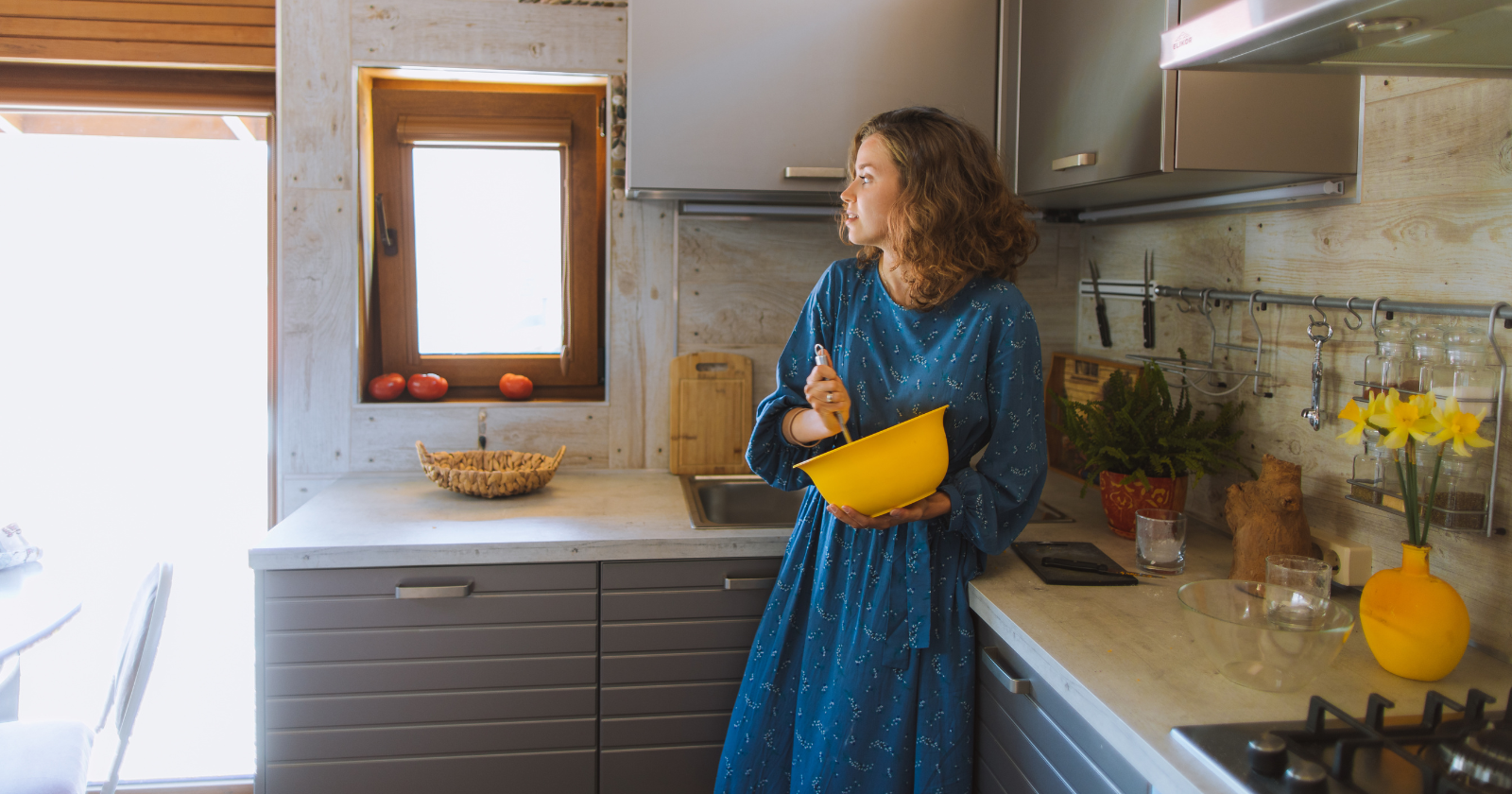

Six o’clock in the kitchen. The light is that particular flat gold that September afternoons get. I am making something unremarkable — chopping or stirring, something that gives my hands something to do — and somewhere past the hallway Megan has closed her bedroom door.
And Dylan is at the table. He has come in from school and found me the way he always does — by the sounds I make, the particular frequency of a parent who is home and present — and he has walked up and put his arms around my waist without preamble. No hello. No words. Just the weight of him, the solid particular warmth of a thirteen-year-old who still finds his center by finding mine.
The Artful Age
A weekly letter on aging well, family across generations, and the creative life after the kids leave home.
This is 6 pm most days: one door closing, one pair of arms opening.
I am trying to be two things at once. The mother who trusts her daughter enough to let the door close without knocking. And the mother who stays — the one Dylan is already counting on to stay right where she is.
What trusting her looks like in practice
Megan is seventeen. She is in the part of growing up where my presence is useful in specific, finite ways — when something has gone wrong, when she needs a signature, when she comes looking — and less useful the rest of the time. The job she is doing right now, the actual developmental work of this particular year, is learning to rely on herself. And the thing I have come to understand, slowly and against my instincts, is that I help her most when I am not in the room.
Dr. Lisa Damour, a clinical psychologist and author who writes about adolescent development, has described what parents ask of teenagers as something close to impossible: we expect them to become independent people while they are still living with us. The impossibility runs in both directions. Because what the teenager needs — the gradual accumulation of trust, the widening of the circle, the door that closes without consequence — also asks something nearly impossible of me.
The closed door is not a rejection. I know this. I have known it for years, have read it and been told it and worked hard to act in accordance with it even when the pull to knock is strong. What I have not gotten better at is the feeling. The feeling does not update with the knowledge. I can believe she is doing exactly what she should be doing — individuating, building, becoming — and still feel, for a moment, how close trust and loss can sit to each other.
What I do instead: I let the door close. I don’t knock unless there’s a reason. I am available without being present, which requires a specific kind of restraint that I have had to practice the way you practice anything — badly first, and then less badly, and then with something approaching ease.
What staying looks like
Dylan is thirteen. He is verbal but not conversant — he speaks in phrases rather than sentences, points and gestures and uses the AAC app on his tablet like a third hand, navigating toward what he means rather than stating it. He is gentle by temperament and self-regulates well in ways that took us years, together, to build. He is, in the taxonomy of people I have ever loved, one of the most direct to love back: you give him what he needs, which is mostly presence and routine and the knowledge that the people he has organized his world around are still where he left them.
The hug at the kitchen table is not nothing. It is arrived-home-and-you-are-here communication — the phrase-length equivalent of: I know where I am now. I have learned to receive it as such. I hold still. I don’t rush it or redirect it. I put down whatever is in my hands.
Research on how autistic people experience physical touch is more varied than most popular accounts suggest. Some people on the spectrum find unexpected contact disorienting; others seek it out as a reliable form of regulation. The difference is individual rather than diagnostic. I am not a therapist or a clinician, and what I know about sensory processing I have learned across thirteen years of close attention to one specific person. What I know from that attention is that when I hold still long enough, his breathing slows.
The research doesn’t tell you how to be in the middle
There is not, as far as I have found, a framework for this particular hour.
There is good writing about parenting teenagers — about how trust is built in the gap you leave, about how a parent’s job in adolescence is to be dependably available without being inescapably present. And there is good writing about parenting children with special needs — about attunement, about responding rather than anticipating, about how a parent becomes, over years, the most fluent reader of a particular human being.
What neither body of writing quite accounts for is the kitchen at 6 pm, when both of these things are happening at once and you are the only person standing between them.
Carl Pickhardt, a developmental psychologist and author of Holding On While Letting Go, describes the central paradox this way: “The greater loving, when parenting an adolescent, is fostering independence by keeping caring constant while letting the loved one go.” The phrase I keep returning to is “keeping caring constant.” Because what he is naming is not a choice between caring and leaving — it is the work of holding both at once.
Which is, as it turns out, exactly what I am doing.
With Megan, keeping caring constant looks like: she knows I am here. She does not need me to prove it by knocking. With Dylan, keeping caring constant looks like: I am here, concretely and without looking at my phone, for as long as he needs. These are not contradictory acts. They draw on the same thing — a steady willingness to pay attention to what is actually needed rather than what is easiest to give.
Where the two demands press hardest is not in the doing but in the simultaneity. It is entirely manageable to trust a teenager one evening and stay present for Dylan the next. The specific texture of 6 pm is that I am asked to hold both at once, in the same room, in the same hour. And there is no technique for that — only the practice of it.
The kitchen fills up with the evening sounds of the house. Megan’s music comes through her closed door, which is its own version of connection — she is in there, not invisible, just unavailable. Dylan has let go and settled back into his chair with his tablet, satisfied in the way he gets when the arrival has been received properly.
I go back to whatever was in my hands.