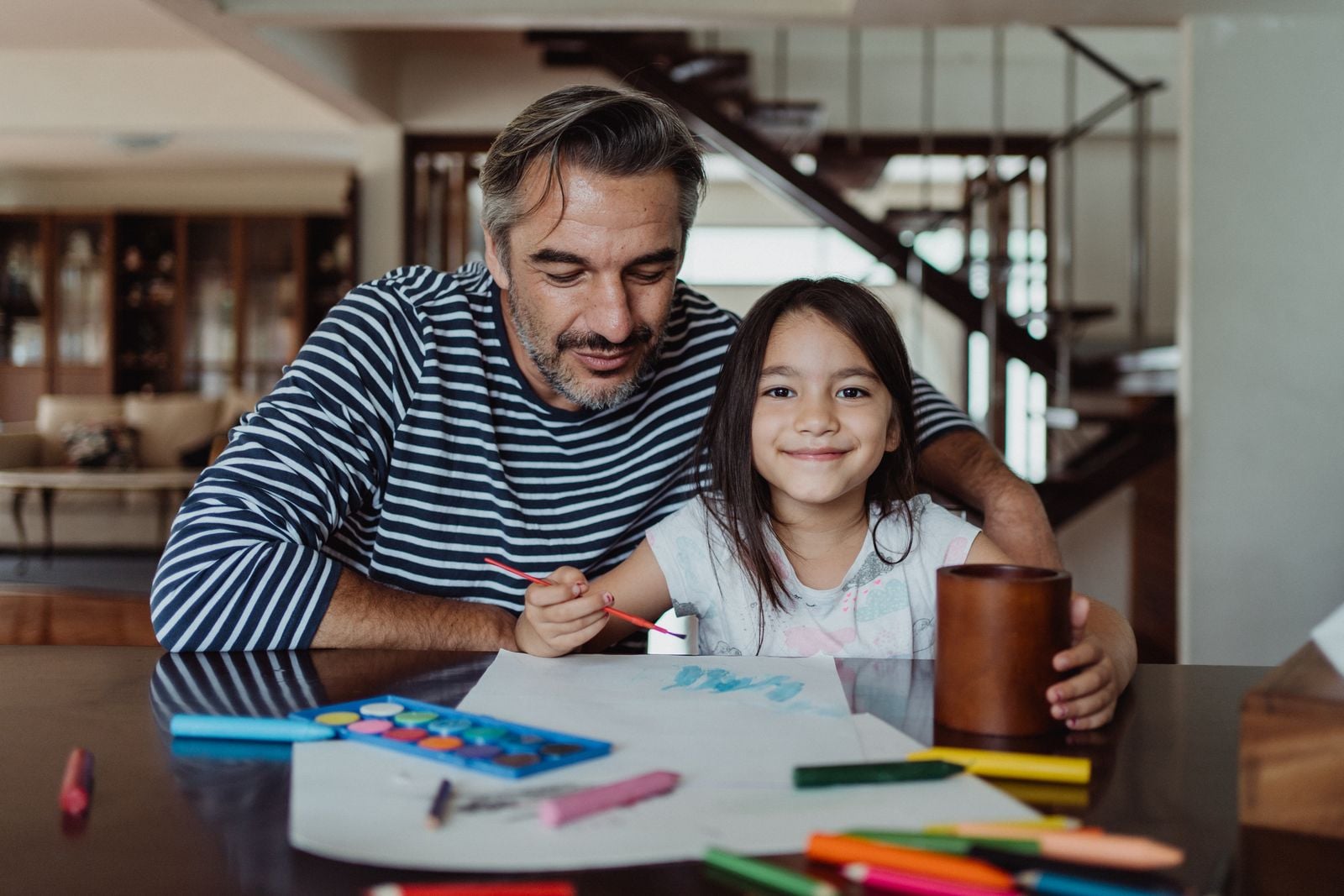
You can often spot it at a kids’ craft table. A dad who will happily spend an hour being a horse, throwing a kid in the air, or building an elaborate track, goes a little stiff when the paints come out. He hovers, he fetches water, he suggests what to draw, he tidies. What he tends not to do is sit down, pick up a brush, and make something bad next to his child for no reason at all. Being a bloke is not always easy, and the open-ended art table is a surprisingly sharp example of why.
We are parents and writers, not psychologists, and what follows is a reading of some research and a lot of afternoons, not advice about anyone’s mental health.
The point here is not that dads are worse at this. It is that the particular thing an art table asks for runs against a fair amount of how many men were raised, and that noticing this makes it easier to push through.
The Artful Age
A weekly letter on aging well, family across generations, and the creative life after the kids leave home.
How fathers tend to play
There is a real, documented difference in how mothers and fathers tend to play, on average, with young children. A 2020 systematic review by Amodia-Bidakowska, Laverty, and Ramchandani in Developmental Review, which screened hundreds of studies, found that fathers across many cultures engage in a higher proportion of physical, active play: the wrestling, chasing, and rough-and-tumble that children usually love. Mothers, on average, do relatively more of the verbal and pretend play, including the naming of feelings during play.
None of this is a rule about any individual parent, and neither style is the better one. Rough-and-tumble play has genuine value, and the review connects it to children learning to handle excitement and stay in control while things get boisterous. The physical stuff dads often gravitate to is not a lesser form of involvement.
But it does mean that for a lot of men, active play is the home turf and the quiet, expressive, make-a-mess-with-no-endpoint domain is the away game.
It is worth holding these patterns loosely. They are averages that hide enormous variation, and plenty of fathers are the ones covered in paint while a parenting partner prefers the wrestling. The tendencies also reflect how people were raised more than anything fixed, which is the encouraging part: a preference shaped by upbringing is one a person can decide to lean against.
Why the art table can feel harder
Look at what open-ended art actually asks of a grown-up. There is no goal, so you cannot win it or finish it well. There is no skill floor that protects you, so if you are not good at drawing, everyone at the table can see. And the whole thing is expressive rather than productive, which means the point is to reveal something rather than to build something.
That combination, being visibly not good at something, in public, with no way to succeed and nothing to show for it, is close to a list of the things many boys are taught to avoid. The lesson to be competent, self-reliant, and not caught struggling runs deep, and it does not switch off because the audience is a four-year-old.
There is research consistent with this being more than a personal quirk. A large 2017 meta-analysis by Y. Joel Wong and colleagues in the Journal of Counseling Psychology, pooling data from more than 19,000 men, found that stronger conformity to certain traditional masculine norms, self-reliance in particular, was modestly associated with worse mental health and, notably, with being less willing to seek help. This is correlational and it describes averages, not any one father. But it points at the same tension the craft table exposes in miniature: doing the visibly vulnerable, non-competent, help-yourself-to-the-glitter thing is exactly the kind of thing the culture quietly trains men to sidestep.
What tends to help
The fix is not to become an artist. It is to lower the stakes on purpose, which is a move dads are often good at once they see the game clearly.
Make something bad, out loud. Draw a wonky dog, laugh at it, keep going. A child watching a parent be cheerfully terrible at something, and carry on anyway, is getting a more useful lesson than they would from a competent demonstration.
Drop the goal. You do not need a project, a theme, or a finished thing to photograph. Scribble alongside them. Mix colors to see what happens. The absence of a point is the point, and it is the part that feels most foreign and matters most.
Let the child lead, and resist the urge to manage. The instinct to fetch, tidy, and suggest is often a way of staying near the activity without being in it. Sitting down and actually making something is the harder and better move.
What you are showing your kid
The reason this is worth the discomfort has little to do with art. A child who sees a father draw badly, mess about with no aim, and enjoy it is watching a man do the thing the wider culture often says men should not: be imperfect in the open, for its own sake, without a scoreboard.
That is a quietly big thing to model, especially for boys who are already picking up the same signals their fathers did. It says that making something, and being seen doing it clumsily, is allowed. It says the point of an afternoon can just be the afternoon.
Being a bloke is not always easy, and this is one of the small, low-cost places to make it a little easier for the next one. The paints are not a test. Nobody is keeping score. That is the whole reason to sit down.