
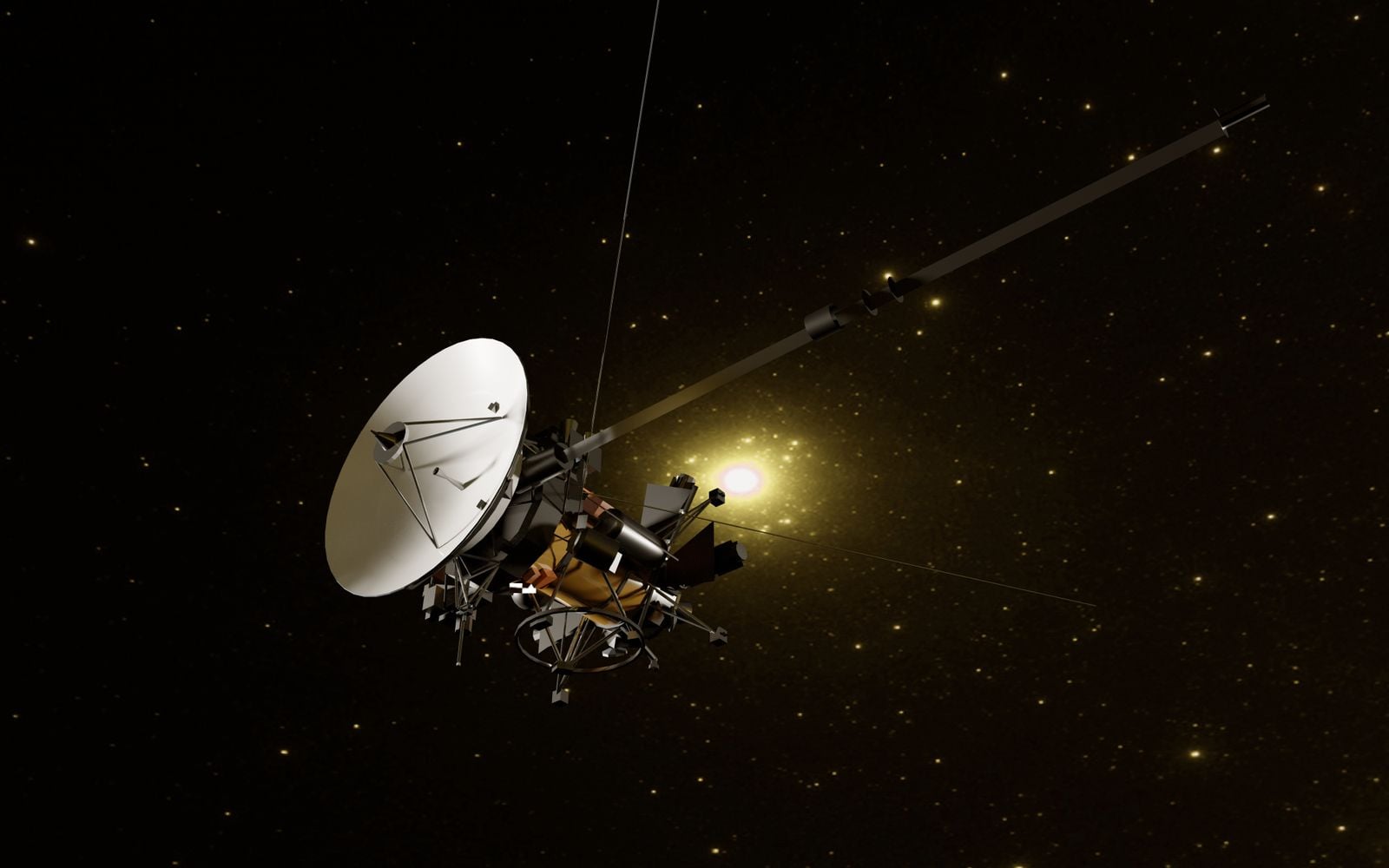
On 25 February 2025, engineers at NASA’s Jet Propulsion Laboratory sent a command more than 15 billion miles into the dark and switched off Voyager 1’s cosmic ray subsystem. Voyager 2’s low-energy charged particle experiment followed on 24 March. Two science instruments were retired within a month, on spacecraft launched in 1977, to buy more time against radioisotope generators that lose roughly four watts of electrical power each year.
The Voyagers are dying slowly, and the mission team is choosing which systems go first.
The plutonium is doing what plutonium does
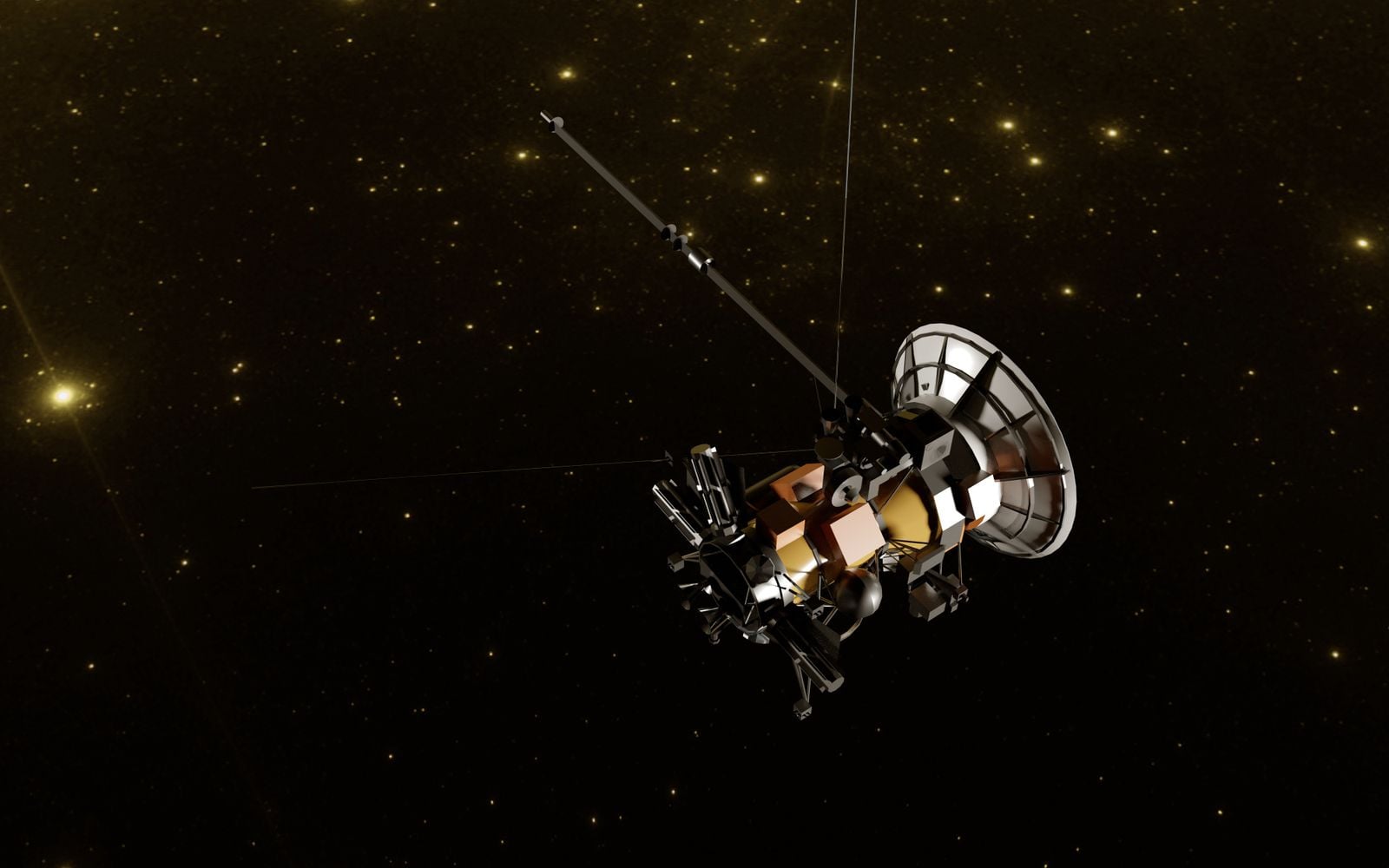
Each Voyager runs on three radioisotope thermoelectric generators, or RTGs, fuelled with plutonium-238. The isotope has a half-life of about 87.7 years, and heat from its decay is converted into electricity through thermocouples. The system was built for endurance, not permanence. The generators supplied roughly 470 watts at launch and have been producing steadily less power ever since.
The Artful Age
A weekly letter on aging well, family across generations, and the creative life after the kids leave home.
Four watts is not much. It is roughly the draw of a small LED nightlight. But repeated year after year on a spacecraft whose available electrical margin is already thin, those watts determine which heaters and science instruments can remain alive.
The engineers have known this constraint was coming for decades. Instruments used for the planetary encounters were retired after their work was finished, and the Voyager team has continued shutting down systems as available power declines. Years ago, the team established an order for retiring the remaining science instruments so that each shutdown could preserve the mission a little longer.
What the cosmic ray subsystem did before it stopped
The instrument switched off on 25 February 2025 had spent decades measuring high-energy particles, including galactic cosmic rays arriving from beyond the solar system. In August 2012, a sharp rise in galactic cosmic rays and a collapse in particles associated with the Sun became important evidence that Voyager 1 was crossing the heliopause. NASA’s account of the discovery makes clear that the final conclusion drew on several kinds of measurements, including later plasma-wave data, rather than the cosmic ray instrument alone.
Voyager 2’s low-energy charged particle experiment measured ions, electrons and cosmic rays across a lower-energy range. It remained productive long after the planetary encounters and continued operating until March 2025. Instruments built for a mission conceived in the 1970s had returned usable science for nearly half a century.
What is still on
After the two shutdowns in early 2025, Voyager 1 still had three operating science instruments. That changed on 17 April 2026, when engineers shut down its low-energy charged particle experiment. NASA’s current instrument-status table now lists two active instruments on Voyager 1: the magnetometer, which measures magnetic fields, and the plasma wave subsystem, which measures electron-density-related plasma waves.
Voyager 2 still has three active science instruments: its magnetometer, plasma wave subsystem and cosmic ray subsystem. The two spacecraft therefore no longer carry identical active instrument sets, but both continue returning measurements from interstellar space.
The distances involved are not really imaginable
By September 2026, Voyager 1 is about 16 billion miles from Earth and moving at roughly 38,000 miles per hour relative to the Sun. Its one-way radio time is now just under 24 hours. NASA says the spacecraft will reach 16.094 billion miles from Earth, exactly one light-day, on 18 November 2026. A command sent from Earth and the confirmation sent back therefore span nearly two days even before engineers begin interpreting the result.
Voyager 2 is more than 13 billion miles from Earth. Together, the two Voyagers are the only spacecraft ever to have operated outside the heliosphere, the protective bubble created by the Sun’s particles and magnetic field. No other operating spacecraft is returning measurements from that environment.
The antenna problem
Even the ground infrastructure can constrain what the mission team does. Deep Space Station 43, the 230-foot antenna at NASA’s Canberra Deep Space Communication Complex, is the only dish with enough signal power to send commands to the Voyagers. Beginning 4 May 2025, it entered a major upgrade period that ran into February 2026, with only limited periods of availability.
That forced the Voyager team to plan ahead. Before the long command pause, engineers tried to revive Voyager 1’s original roll thrusters, whose heaters had been considered inoperable since 2004. The backup thrusters that replaced them had developed residue buildup in their fuel tubes, raising concern that they could eventually become unusable.
The test worked. After allowing for the roughly 23-hour one-way signal time, the team saw the dormant thruster heaters begin warming within about 20 minutes of receiving the command. The hardware had been written off for more than two decades, yet it responded.
A brief history of accidental durability
The Voyagers were not originally expected to spend half a century returning data. Their planetary encounters culminated when Voyager 2 passed Neptune in 1989, after which the spacecraft continued into what became the Voyager Interstellar Mission. Their survival has depended on hardware built in the 1970s and on successive generations of engineers finding ways to stretch declining power and aging propulsion systems.
The contrast with earlier planetary missions is stark. NASA’s history of Mariner 1 records that the spacecraft lifted off from Cape Canaveral on 22 July 1962 but veered off course, forcing the range safety officer to destroy the launch vehicle 293 seconds after liftoff. Mariner 1 ended in the Atlantic. The Voyagers have now been flying for 49 years.
In April 2026, Voyager mission manager Kareem Badaruddin described the choice plainly after another instrument shutdown. NASA/JPL reported that the team remained focused on keeping both Voyagers operating for as long as possible. That is the ethic of the late Voyager mission: giving up one capability to preserve the rest.
What “Big Bang” means at JPL
In 2026, the team also tried a more ambitious power-saving procedure nicknamed “Big Bang.” Rather than retiring another science instrument, engineers reconfigured several spacecraft devices at once so lower-power hardware could take over necessary functions. On 4 August 2026, NASA reported that the procedure had successfully freed power on Voyager 2.
NASA said the change should allow Voyager 2’s three remaining science instruments to keep operating for at least an additional year without another instrument shutdown. Engineers also planned to make a similar swap on Voyager 1. The procedure does not stop the annual power decline, but it gives the team another margin to work with.
The arithmetic remains unforgiving. Radioisotope power continues to fall, and unforeseen failures can arrive before the power budget itself becomes decisive. Every successful conservation measure shifts the deadline; none removes it.
Why the losses feel personal
There is something particular about the pace of the Voyager shutdowns that makes them harder to read as pure engineering news. The spacecraft have outlived many of the people associated with their creation, including Carl Sagan, who chaired the committee that selected the contents of the Voyager Golden Record.
Suzanne Dodd has watched much of the mission’s late-life engineering from unusually close range. JPL announced her as Voyager project manager in 2010, after she had first worked on Voyager in 1984. Her tenure has covered years in which keeping the spacecraft alive increasingly meant deciding which pieces could be surrendered.
The February 2025 shutdown retired Voyager 1’s cosmic ray subsystem, one of the instruments that recorded the dramatic particle changes around the spacecraft’s 2012 passage into interstellar space. Voyager 2’s low-energy charged particle experiment was turned off for power conservation on 24 March 2025. Each shutdown removed a measurement capability that had survived since launch.
Four watts a year, and what it buys
The four-watt annual figure is an approximation used to describe the Voyagers’ continuing electrical decline. On spacecraft already operating with a narrow power margin, however, a few watts can determine whether another heater or science instrument remains available.
The February and March 2025 shutdowns were intended to give the mission roughly another year before another science instrument needed to be retired. When Voyager 1’s LECP was finally shut down in April 2026, NASA again described the move as giving the spacecraft about a year of additional breathing room. The successful Voyager 2 power reconfiguration has now added another margin without immediately sacrificing one of its three surviving science instruments.
These are small numbers against almost 16 billion miles. They are also the numbers that determine how long humanity keeps receiving direct measurements from beyond the heliosphere.
The signal is faint but still arriving
As of September 2026, both Voyagers are still transmitting. NASA notes that by the time Voyager’s radio signal reaches Earth, the power striking a Deep Space Network antenna is only about 10-16 watts. The antennas have to pull that whisper out of the background noise and recover measurements sent by hardware nearly half a century old.
The spacecraft are still pointed well enough for their high-gain antennas to communicate with Earth. Voyager 1 has not photographed the planet since 1990, when it captured the “Pale Blue Dot” during its final imaging sequence before its cameras were switched off.
No next science-instrument shutdown has been publicly scheduled. The mission team is watching the power budget and using the extra margin created by the 2026 changes. When another shutdown eventually comes, the command will take almost a day to reach Voyager 1, and almost another day will pass before Earth can receive confirmation of what happened.
Four watts a year. A plutonium half-life measured in decades. Two probes still whispering from outside the Sun’s protective bubble, with engineers buying their remaining science one careful watt at a time.