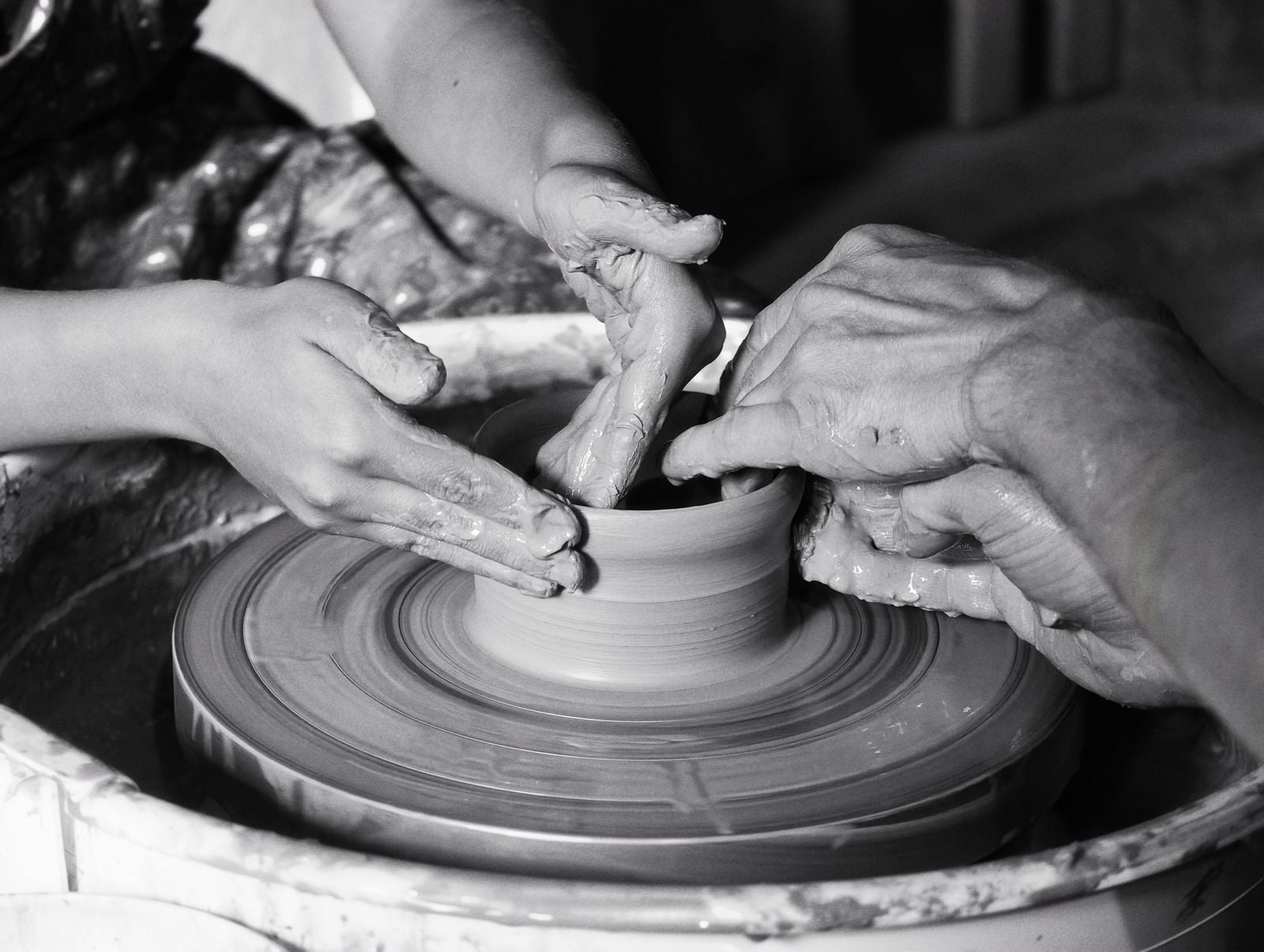
Roll a lump of clay too thin at the edges and too thick in the middle, leave it on the kitchen table overnight, and by morning the outer rim will have pulled itself apart into a fine map of hairline cracks. The centre still feels cool and damp under a fingertip. The edge is dry, pale, and splitting. Potters have a word for this failure — the clay has gone short — and it is one of the oldest documented problems in a craft that stretches back thousands of years, to the first clay vessels shaped by human hands.
The cracks are not a flaw in the clay. They are a flaw in the geometry. And the geometry is the entire lesson.
What is actually happening in the drying clay
Air-dry clay is a suspension of fine mineral particles held apart by a thin film of water around each grain. As the water evaporates from the surface, those particles pull closer together. The clay shrinks. A typical earthenware body loses somewhere between 5 and 12 percent of its volume between the wet stage and the fully dry stage, and almost all of that shrinkage happens before firing.
The Artful Age
A weekly letter on aging well, family across generations, and the creative life after the kids leave home.
Shrinkage is not the enemy. Uneven shrinkage is.
A thin edge has more surface area exposed to the air relative to the water it contains. It dries first. As it dries, it tries to contract. But it is physically attached to a thicker, wetter, still-plastic middle that has not yet begun to shrink. The rim is trying to become smaller against a centre that is still full-sized.
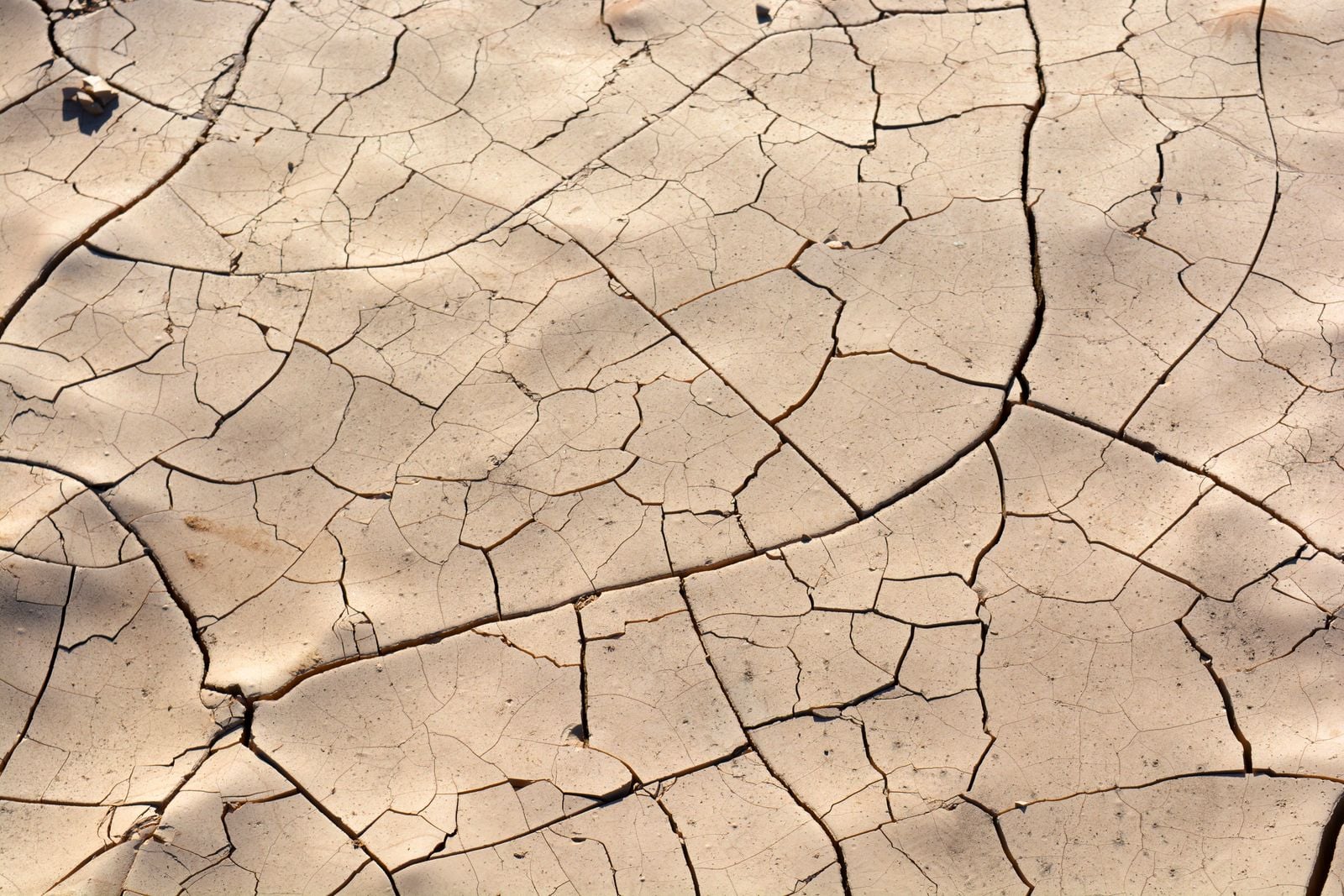
Something has to give. Since the dry clay at the rim has already lost most of its plasticity, it cannot stretch. So it tears. Those tears are the hairline cracks that appear along the edge of a badly rolled slab, and they radiate inward toward the wetter core like cracks in drying mud on a riverbank.
Why potters call it “short”
The word short in a pottery studio has nothing to do with height. It describes a clay body that has lost its ability to stretch and bend without breaking. Well-wedged, evenly moist clay is long — you can pull a coil of it out to a surprising length before it snaps. Short clay snaps almost immediately.
Clay becomes short when its water film thins out or becomes unevenly distributed. Wedging — the kneading process every potter learns first — exists mostly to make the water content uniform, to press out air pockets, and to align the flat plate-like clay particles so they slide against one another consistently.
A child pressing a lump between two palms is doing none of these things. The clay stays lumpy. Some parts hold more water than others. When it dries, those regions shrink at different rates, and the piece cracks along the seams where wet meets dry.
The same physics that limits jet engine ceramics
The uneven-drying problem in a nursery-school clay pancake is, at a much smaller scale, the same problem that has kept advanced ceramics out of most jet engines for fifty years. According to a Machine Design analysis, structural ceramics are brittle and hard to predict, and when they do fail, they fail suddenly and catastrophically rather than gracefully the way metals do. Engineers have spent decades trying to solve a version of the exact same puzzle: how do you get a ceramic part through processing, and later through firing, without hidden variations in the material becoming the point where it fails?
The industrial answer involves fiber reinforcement, controlled processing environments, and expensive precursors. The kitchen-table answer is simpler. Roll it out evenly.
Why the middle stays wetter than you think
Water in a clay body does not evaporate uniformly through the whole volume. It leaves through the surface. Any water trapped in the middle of a thick lump has to migrate outward through the clay before it can evaporate, and clay is not especially permeable once the outer layer starts to firm up.
What happens in practice is that the surface dries and stiffens quickly, and then acts almost like a skin around the still-wet interior. That skin is the layer that shrinks first. The interior water now has to push through a partially closed surface, which slows drying dramatically and locks in the moisture gradient.
If a slab is 3 mm at the edges and 10 mm in the middle, the edge can be bone-dry while the centre is still soft enough to dent with a fingernail. That is a recipe for tension. The edge wants to be 6 percent smaller. The middle is still the size it started at. The cracks appear at the boundary.
What actually prevents it
The old craft solutions are straightforward and physical.
Wedge the clay. Even for air-dry clay from a tub, a few minutes of kneading pushes water into the drier pockets and squeezes it out of the wetter ones. The goal is not to warm the clay or make it soft — it is to make every part of the lump equally hydrated.
Roll to even thickness. Two wooden slats of the same height, one on each side of the clay, act as guides for a rolling pin. A slab that is 5 mm thick everywhere will dry as one thing. A slab that varies from 2 to 10 mm will not.
Slow the drying. Loosely draping the piece with a plastic sheet for the first day lets moisture from the wetter core migrate outward before the surface locks. Potters call this equalizing. It is why professional studios dry work in cupboards rather than on sunny windowsills.
Score and slip joins. Where two pieces of clay meet — a handle attached to a mug, a leaf pressed onto a slab — the join must be roughed up and painted with a mud-like slurry so the two surfaces become physically continuous. A join between a wet piece and a leather-hard piece will almost always crack, because the two sides are on different shrinkage clocks.
Why children’s clay projects crack more than adult ones
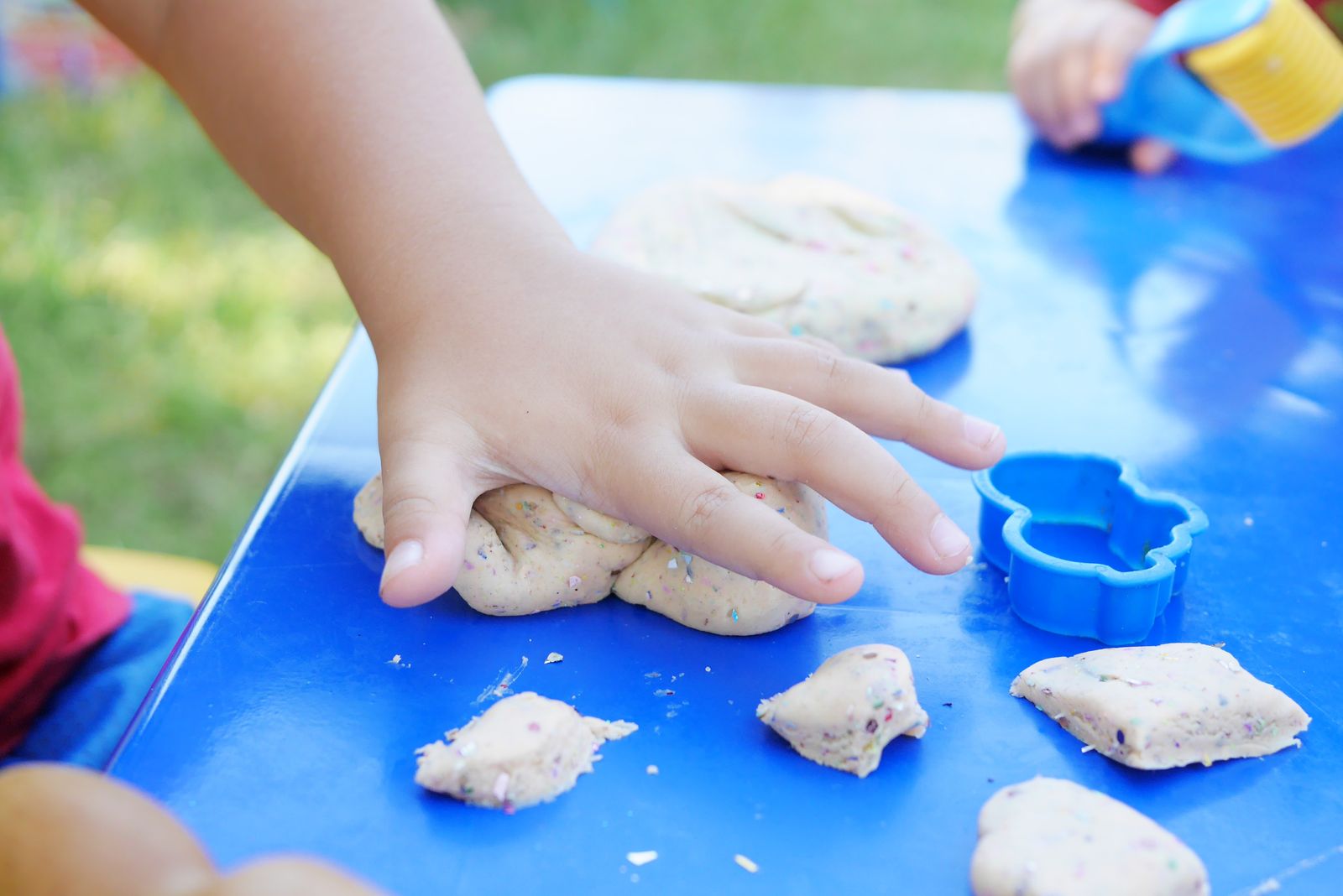
A four-year-old rolling clay does not press evenly, and could not be expected to. Grip strength is uneven, attention drifts, the middle of the slab gets the most force because it is directly under the palm. The edges thin out because they get pushed outward without being pressed downward. The result is almost the exact geometry that guarantees cracking.
There is also a working-time problem. Children take longer to finish a piece than adults, and clay dries the whole time it is being worked. By the time a small child has finished attaching a nose to a clay figure, the head may already be leather-hard while the nose is fresh from the tub. Two shrinkage rates, one join, and gravity working on both.
This is why the Play-Doh recipe — the flour, salt and water dough developed in the 1950s — took over children’s craft tables so completely. It does not dry meaningfully in a single session, so a child can spend forty minutes squishing without any of the uneven-shrinkage physics kicking in. The tradeoff is that Play-Doh does not preserve. Air-dry clay does, if it survives the first 48 hours.
The invisible skin and the sound of a crack forming
Cracks in drying clay do not appear all at once. They propagate. A stress point forms at the thinnest section of the rim, usually at a corner or a scored line, and the crack extends inward at the pace of the drying front. If you put your ear close to a fresh slab drying in a warm room, you can sometimes hear the faint tick of a crack extending — a sound potters compare to ice settling on a pond.
In high-performance ceramic materials, acoustic emission sensors can detect microcracks forming in engine components long before visible failure. Predicting when a ceramic will fail remains one of the field’s central challenges, precisely because tiny internal stress asymmetries — the industrial cousins of a lumpy hand-rolled slab — set the timing.
Why glaze cannot save a badly formed piece
Beginner potters often assume that a good glaze will hide or repair cracks. It will not. Glaze is essentially a thin coat of glass fused to the surface of the clay during firing, and glass has its own shrinkage rate, which is usually higher than the clay’s. A glazed piece with a preexisting crack will almost always split along that crack during firing, because the glaze contracting on the outside adds a fresh layer of tension on top of the existing weakness.
The rule that gets passed down in every studio — form first, glaze last — is not aesthetic. It is a load-order rule. The clay body has to be structurally sound before anything is added to its surface, because every subsequent step introduces more thermal or mechanical stress.
What this has to do with paying attention
There is a reason clay is one of the oldest materials still used with young children. It rewards a specific kind of attention: slow, hand-based, closed-loop. You feel the wetness of the clay in your fingers. You feel the seam where two pieces are not fully joined. You feel the thin spot before you can see it.
Developmental researchers who study early brain growth have found that back-and-forth interactions between a young child and a caregiver play a pivotal role in building the brain’s architecture. The same closed loop shows up when the back-and-forth is with a material instead of a person, which is part of why clay holds a young child’s attention the way it does. A clay piece that cracks after two days is not a failed project. It is a data point about geometry the child can now feel.
Interestingly, work published in Nature Human Behaviour by Francesco Margoni at the University of Stavanger and Francesco Nava at the London School of Economics found that young children given ten seconds to decide behaved differently than those given time to reflect — a reminder that pace shapes what small hands do with almost any task, clay included. Rushed children are not worse at making things. They just make different things, with different failure modes.
The 48-hour test
Any air-dry clay piece that is going to crack usually does so within the first 48 hours, while the moisture gradient between surface and core is at its steepest. A piece that has survived two days in a cool, dry room, with even thickness and no visible seams, is very likely to survive indefinitely. A piece that already shows a hairline at 24 hours is almost certain to extend that crack as it continues to dry.
The fix, if the piece is still slightly damp, is to press a small amount of slip into the crack, smooth it with a wet finger, and re-cover the piece loosely with plastic to slow the whole drying process down. What you are doing is buying time for the interior to catch up with the exterior.
If the piece is fully dry and cracked, the crack is structural. It can be filled cosmetically with glue or gesso before painting, but the piece will always be weaker along that line. Which is, in its own way, honest. The clay is telling you where the geometry went wrong. Twenty-five thousand years of potters have heard the same thing.