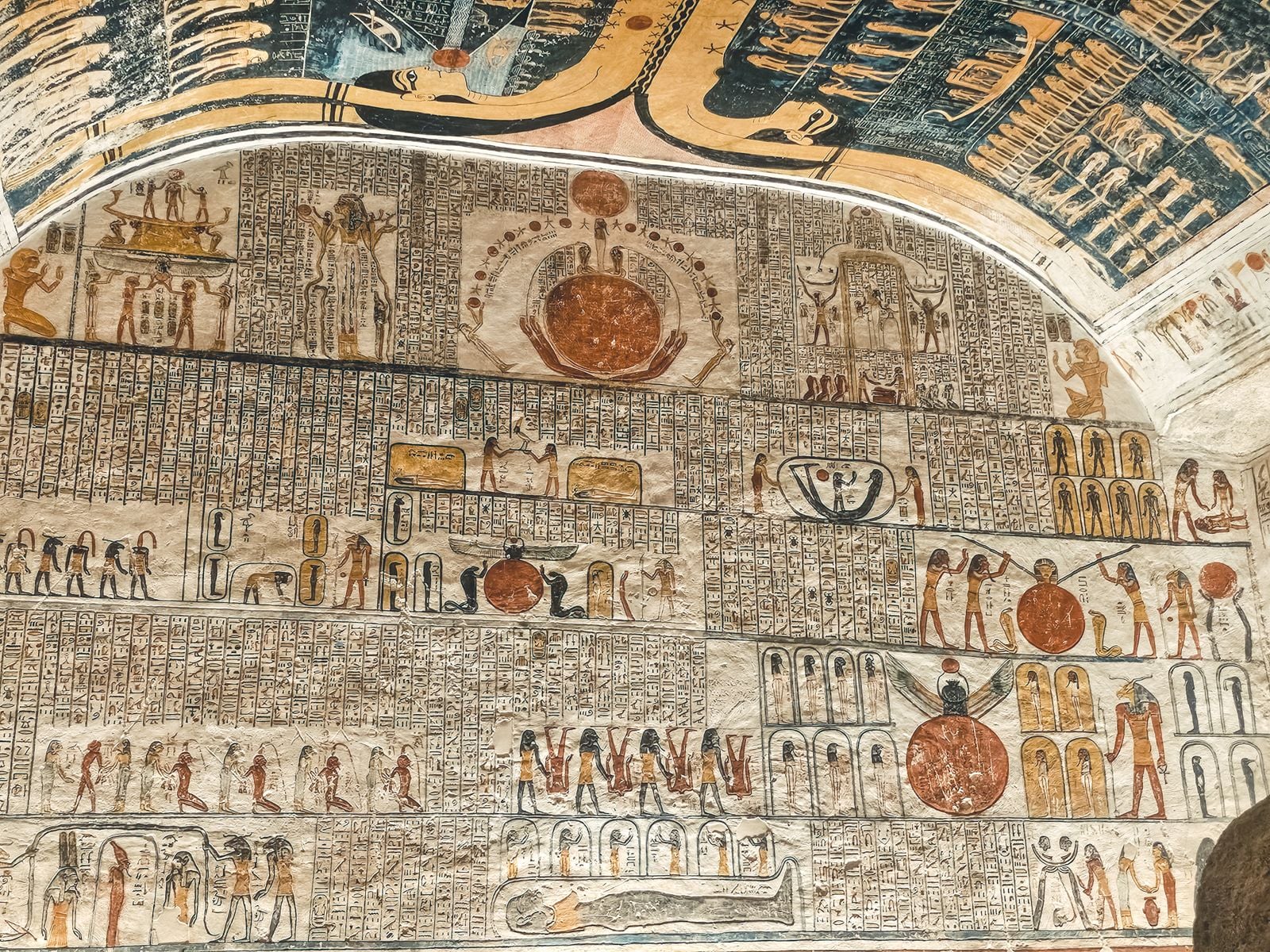
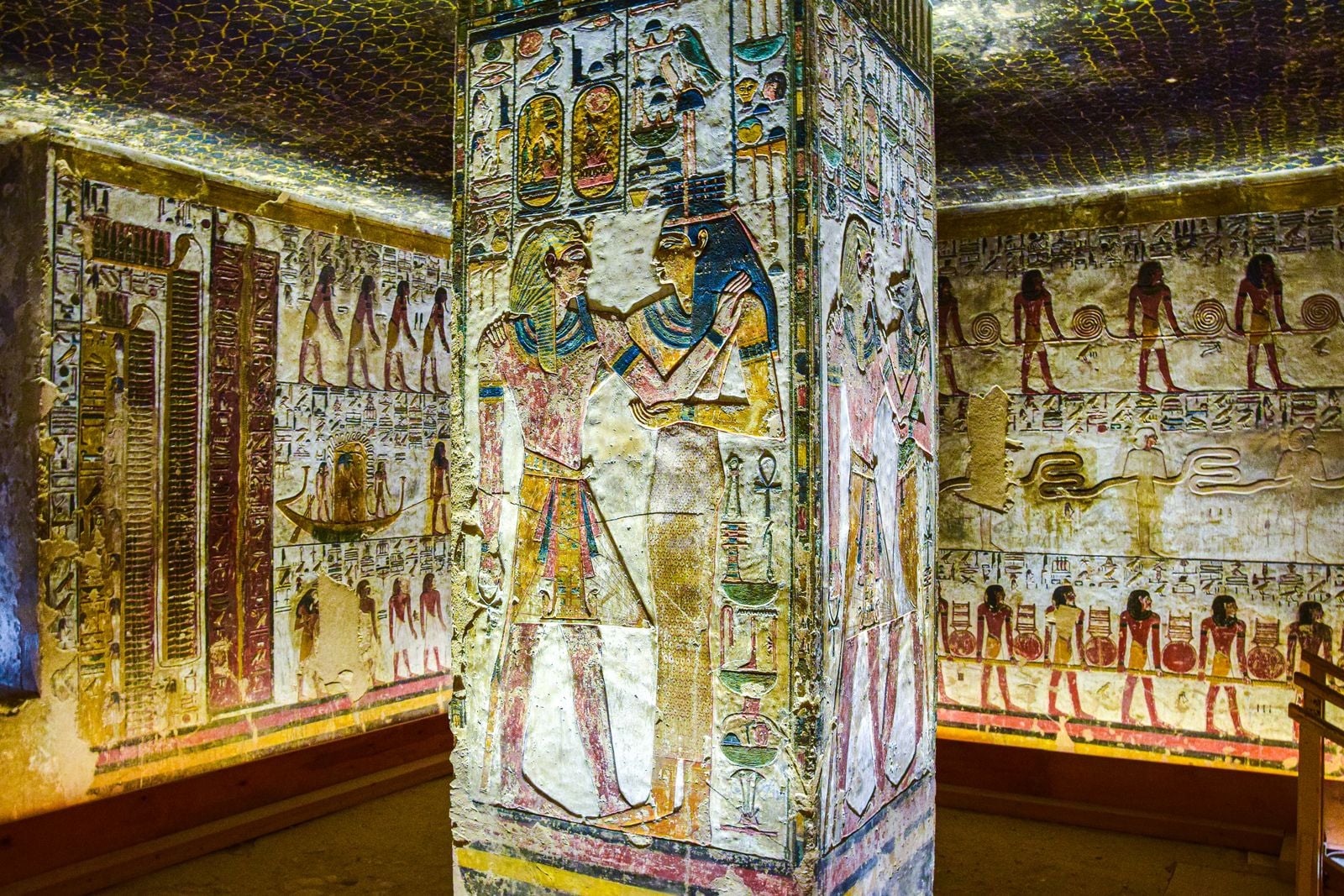
When Howard Carter’s team broke the seal on Tutankhamun’s burial chamber on February 16, 1923, they walked into a room where the paint on the walls looked as if it had been mixed the week before. Blues still saturated. Yellows still warm. Reds that had not dulled to brown. The pigment carrying most of that endurance was Egyptian blue — calcium copper silicate, the world’s first known synthetic colour — and it had been holding its wavelength for roughly 3,300 years.
The chemistry is the story. Egyptian blue is not a mineral scraped from a hillside. It is a manufactured compound, fired at temperatures between 850 and 950 degrees Celsius from a careful mix of silica sand, copper (usually from malachite or bronze scale), calcium carbonate, and a small amount of alkali flux. The result is a crystalline pigment — cuprorivaite — that is chemically almost inert. It does not oxidise. It does not fade in sunlight. It shrugs off centuries of humidity swings inside sealed limestone chambers.
The jar Carter lifted, and what was inside it
Carter had been searching the Valley of the Kings for more than five years, financed by George Herbert, the fifth Earl of Carnarvon. By early 1922, Carnarvon was ready to call the whole thing off. Carter talked him into one more season. In November of that year, workers clearing debris near the entrance of another tomb uncovered a stone step. Then another. Then a sealed door with a name on it.
The Artful Age
A weekly letter on aging well, family across generations, and the creative life after the kids leave home.
Inside were four rooms crowded with objects, among them dozens of alabaster jars carved from Egyptian calcite. Many were sealed. Many still held sticky, dark-brown, aromatic material at the bottom. The chemist Alfred Lucas, working with Carter’s team, analysed a small number of them in 1933 and concluded that most of the residues were not unguents or perfumes, as had been assumed. He could not say what they were.
The question sat untouched for ninety years.
The pigment that outlasted the pharaoh
Egyptian blue predates Tutankhamun by more than a thousand years. The earliest confirmed use appears on tomb paintings from the Fourth Dynasty, around 2500 BCE. By the time the boy king was buried in the late 14th century BCE, the recipe was mature and the pigment was being applied everywhere — coffin lids, faience amulets, the crowns of gods painted onto plaster, the hair of Nut spread across ceilings.
What makes cuprorivaite so peculiar is what it does after you stop looking at it. Under near-infrared light, Egyptian blue luminesces. It glows. The emission peaks at around 910 nanometres — invisible to the eye, but unmistakable to a modified camera sensor. A speck too small to see with the naked eye lights up like a tiny lamp on the screen.
That property is why conservators care about it now.
How the glow catches forgeries
Modern imitations of ancient Egyptian objects — the ones sold to museums and private collectors during the Tut-mania boom of the 1920s and the boom that followed every subsequent touring exhibition — usually use modern blue pigments. Cobalt blue. Ultramarine. Phthalocyanine. None of them luminesce in the near-infrared the way cuprorivaite does.
So the test is straightforward. Shine visible red light on the object. Photograph it with a camera that has had its infrared filter removed. If the blue areas glow bright white on the resulting image, the pigment is genuine Egyptian blue. If they stay dark, the paint is younger than the object claims to be.
The technique — visible-induced luminescence imaging — has been used at the British Museum, the Louvre, and the Getty Conservation Institute to map original pigment against later restoration and outright fakery. It can pick up a single grain of cuprorivaite on a surface that looks, to the eye, uniformly beige. Conservators have found Egyptian blue in places nobody expected: on Greek and Roman marbles that were assumed to be white, on the eyes of Parthenon figures, on a Roman-era plaster fragment where the visible pigment had weathered away entirely but the infrared signature remained.
Why the chamber survived
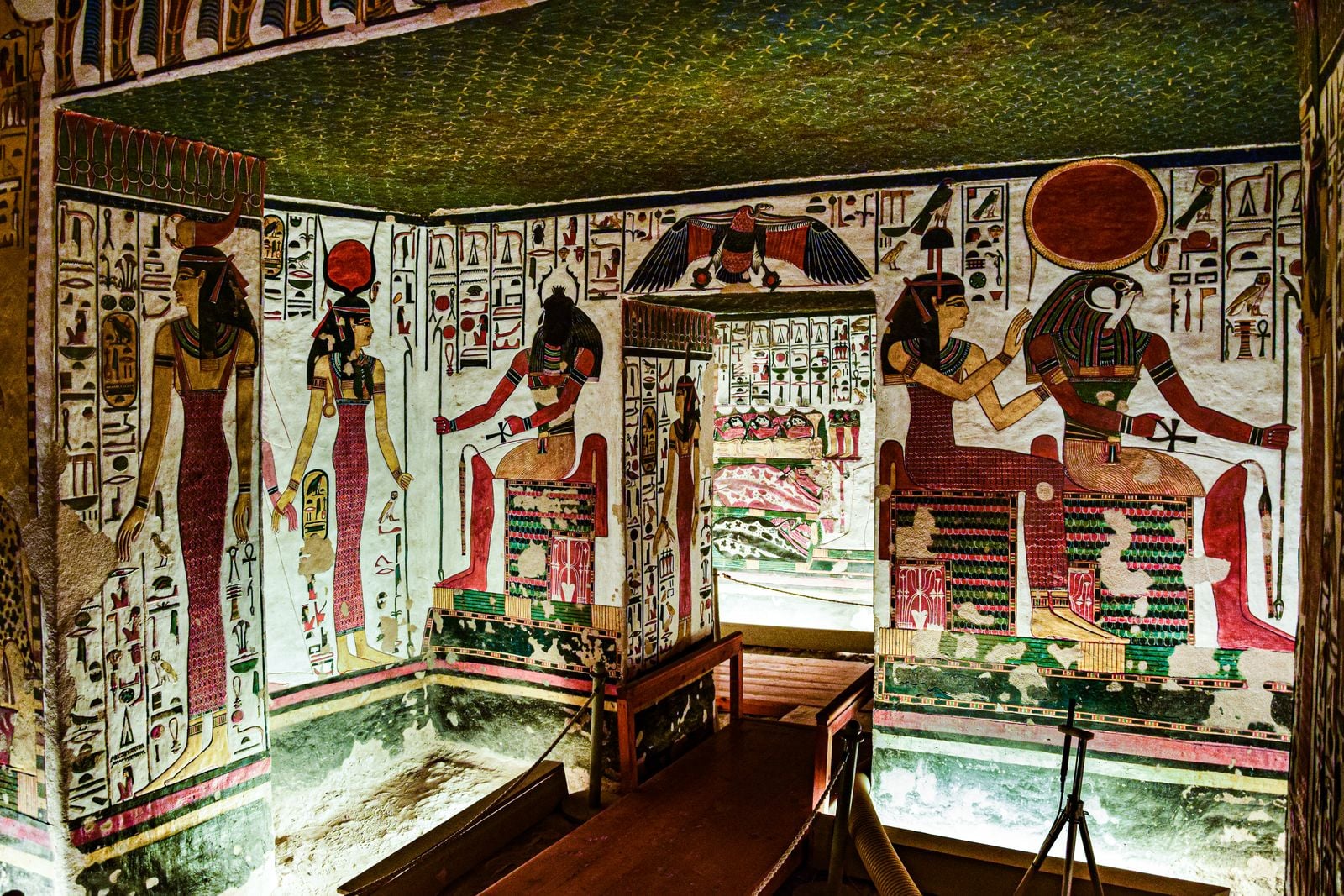
The tomb helped. KV62, as archaeologists label it, is small by royal standards — likely because Tutankhamun died young and unexpectedly, at around 18, possibly from malaria compounded by a broken leg according to research summarised in coverage of the enduring mysteries of the tomb. The burial chamber was cut into limestone, sealed with plastered walls, and remained at a stable temperature and humidity for more than three millennia. No sunlight. No microbial disturbance from repeated openings. The pigments had almost perfect storage conditions.
Even so, most organic paints degrade over that span. The reds shift toward brown as iron oxides transform. Yellows can darken. Greens made from copper compounds often turn brown or black as they react with sulphur compounds in the air. Egyptian blue does not. Its copper is already locked into a silicate crystal lattice, and there is nowhere for it to go.
The jars come back into the story
In 2025, researchers at the Yale Ancient Pharmacology Program returned to the question Lucas had left open. They examined an alabaster vase from the Yale Peabody Museum’s Babylonian Collection — inscribed in four ancient languages and dedicated to Xerxes I, who ruled the Achaemenid Empire from 486 to 465 BCE — and found chemical biomarkers of opium: noscapine, hydrocotarnine, morphine, thebaine, and papaverine.
The Yale vessel was carved from the same Egyptian calcite as the Tutankhamun jars, mined from the same quarries. Andrew J. Koh, the study’s lead author and a research scientist at the Peabody Museum, told YaleNews that the sticky brown residue Lucas could not identify in the 1930s may well have been the same substance. According to YaleNews, researchers at the Peabody Museum have suggested that alabaster jars found in King Tut’s tomb may have contained opium, pointing to an ancient tradition of opiate use.
The vessels — most of them — now live at the Grand Egyptian Museum in Giza. The residues are still inside some of them.
What the looters wanted
One of the strangest details Carter recorded about the tomb is that it had been robbed in antiquity, but the thieves seemed less interested in gold than in the jars. Finger marks inside several alabaster vessels show that people had reached in and scraped the contents out as thoroughly as they could. A small number of jars were left sealed and untouched, and those still hold their original material.
Koh’s interpretation is direct: whatever was in the jars was valuable enough to be worth risking a death sentence for. Ordinary perfume does not usually clear that bar. Opium does.
The colour that became a fashion
The 1922 discovery detonated across popular culture within weeks. On February 21, 1923, Women’s Wear Daily illustrated Egyptian motifs for its readers — sacred scarabs, royal headdresses, a profile of the seated king — and reported that manufacturers were already filing trademark claims on the pharaoh’s name. According to period reporting, one swimwear manufacturer planned to send models to Florida beaches wearing Tut-Ankh-Amen-themed bathing suits. Fashion designer Jean Patou reportedly complained that the discovery primarily benefited manufacturers of mothballs, as people rushed to open old wardrobes.
The blue was everywhere too. Enamelled jewellery, Art Deco tilework, the eyeshadow palettes advertised in the same pages of WWD. None of it was cuprorivaite. All of it was reaching for the effect.
What conservators do with a glowing speck
The forgery-hunting use of Egyptian blue’s luminescence is the most cinematic application, but it is not the only one. The same imaging technique is used to reconstruct what ancient objects originally looked like. Roman sculptures we picture as gleaming white marble were often painted in vivid colour, and the paint has almost entirely weathered away. Where a single grain of Egyptian blue survives in a crack or a hair follicle carved into stone, infrared imaging finds it. From those traces, researchers can rebuild the palette of an object that has looked monochrome for two thousand years.
The Smithsonian has documented similar cross-disciplinary detective work in its coverage of how medical imaging technology now examines historical tombs and artefacts, from X-ray fluorescence spectroscopy on the Black Prince’s armour to CT scans of mummies. The methods are borrowed from hospitals. The questions are ancient.
Why the recipe was lost
Egyptian blue continued in use through the Greek and Roman periods. Pliny the Elder describes it in his Natural History, calling it caeruleum and noting that the best came from Alexandria. Production dwindled after the fall of the Western Roman Empire and effectively vanished by around the 9th century CE. The knowledge of how to make it — the specific ratios, the firing temperatures, the flux — was gone.
It was not recovered until the 19th century, when Humphry Davy and later chemists analysed pigment samples from Pompeii and worked out the composition. Modern synthesis is now routine, and cuprorivaite is being investigated for uses that have nothing to do with art: security inks, biomedical imaging (its infrared glow is useful for tissue tracing), and dust-repelling coatings.
The paint that outlasts the empire
Tutankhamun ruled for about nine years and died young. The dynasty he belonged to ended within decades of his burial. The empire ran on for another five hundred years, then fractured, then was absorbed by Persia, then by Alexander, then by Rome. The tomb was quietly forgotten. Debris from later royal burials was piled over its entrance, which is why Carter’s team had to dig down through six metres of rubble to find the first step.
The blue was there the whole time. Fired once in a workshop kiln around 1330 BCE, brushed onto plaster, sealed behind a limestone door, and left. When Carter’s electric torch first threw light onto the burial chamber wall, the copper atoms in the pigment absorbed a photon, held it for a fraction of a second, and released it at 910 nanometres — a small, silent signal, invisible to him, that the paint was still working.