
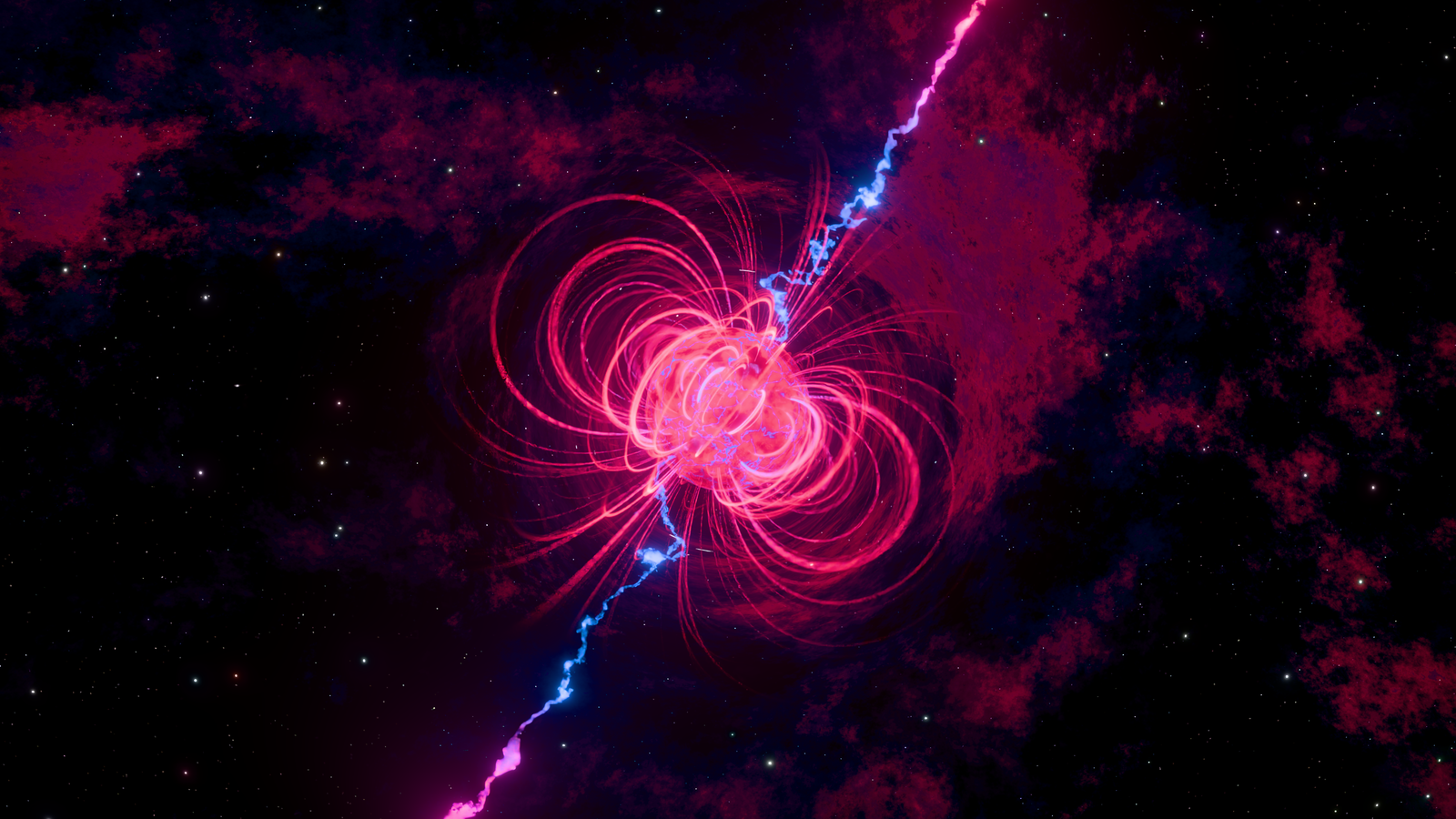
When a child sprinkles iron filings onto a sheet of paper laid over a bar magnet, the tiny slivers stand up and align along invisible curves. Each filing has briefly become its own magnet. The pattern they trace — those looping arcs running from one end of the bar to the other — is the same pattern Michael Faraday sketched in the early nineteenth century to argue something radical for his time: that empty space itself could carry force.
The filings do not touch the magnet. They do not need to. Something in the air between them is doing the work.
What is actually happening on the paper
An iron filing is a splinter of soft iron, maybe a millimetre long. Left alone on a table, it is magnetically neutral — the tiny magnetic domains inside it point every which way and cancel out. Slide a bar magnet underneath the paper, and those domains snap into rough alignment. Each filing becomes a temporary bar magnet, with its own north and south end.
The Artful Age
A weekly letter on aging well, family across generations, and the creative life after the kids leave home.
Because a filing is now a little magnet, it feels a torque. It rotates until its long axis lines up with the direction of the surrounding field. Then it feels a gentle pull toward its neighbour, whose south end is now facing its north. Filing links to filing. A chain forms. Thousands of chains, side by side, curve out from one pole of the bar magnet and loop back to the other.
What you are seeing is not the field itself. Fields are invisible. What you are seeing is the shape iron takes when the field tells it where to stand.
The physics writer at the ABC’s science desk called magnets “spooky” for exactly this reason — they make other things move without touching them, and the child pouring filings out of a paper cup is watching that spookiness happen in slow motion.
Faraday, the bookbinder’s apprentice
Michael Faraday came to this problem without a university education. He had been a bookbinder’s apprentice in London, reading the books he was stitching together, and he talked his way into the Royal Institution as an assistant. By the early 1830s he was running the laboratory, and during that period he made the discovery that turned physics inside out: a magnet moved through a coil of copper wire produced an electric current in the wire. Move it faster, get more current. Reverse the direction, reverse the current.
Electromagnetic induction. It is the reason a wall socket has anything to offer when you plug in a lamp. Every hydroelectric turbine, every wind generator, every alternator in every car on the road runs on the principle Faraday worked out in his laboratory.
But Faraday was after something stranger than a new machine. He wanted to know how a magnet could reach across a gap and grab a piece of iron, or push another magnet away, without any visible connection between them. Newton’s followers had answered this question by shrugging — action at a distance, they said, was simply how the universe worked. Faraday refused the shrug.

Why the sketches mattered more than the filings
Faraday could not do the mathematics. He had left school at a young age and his equations rarely went beyond arithmetic. What he had instead was a spatial imagination almost no one else in nineteenth-century science possessed. When he saw the filings arrange themselves into arcs, he did not see a pretty pattern. He saw lines. Real, physical lines, filling the space around the magnet, under tension like stretched rubber bands, capable of transmitting force from one object to another through the medium of the air itself.
This was heresy. The accepted view, inherited from Newton and refined for two centuries, was that forces acted instantaneously across empty space. Gravity pulled the Moon toward the Earth through nothing. Magnets attracted iron through nothing. The arc of that idea, from apples to gravitational waves, is really the story of Faraday’s stubborn refusal to accept that “nothing” could do work.
He drew the field lines in his notebooks and in his published papers. Curves streaming out of the north pole, sweeping around, plunging into the south. Where the lines crowded together, the field was strong. Where they thinned out, weak. It was a picture — and pictures, in the 1830s, were what children’s textbooks used. Serious physics used equations.
The Scottish mathematician who finished the job
James Clerk Maxwell read those notebooks in the mid-nineteenth century and did something no one expected. He took Faraday’s picture literally. He wrote equations for the lines — for their curvature, their density, the way they changed when a magnet moved. By the 1860s he had four equations that described every electric and magnetic phenomenon then known, and one prediction that no one had asked for: the lines themselves could ripple. A disturbance in the field could travel through empty space at a specific speed. Maxwell calculated that speed. It was the speed of light.
Light, in other words, was a wave in Faraday’s field. Radio waves, X-rays, the microwaves warming last night’s soup — all of them are ripples in the same invisible thing the iron filings had been drawing on the kitchen table.
The bookbinder’s apprentice had given Maxwell the concept, and Maxwell had given the concept its grammar.
What the demonstration teaches, and why it still works
Two centuries later, the iron filings demonstration is still one of the first experiments a child sees in a science classroom. It survives partly because it is cheap — a bar magnet, a sheet of paper, a shaker of filings — and partly because nothing else on Earth reveals a field so directly to the eye. Christa McAuliffe, the schoolteacher chosen for the Challenger mission in 1986, had planned demonstrations among the lessons she was going to broadcast from orbit. The demonstration travels because it needs no words.
The craft of the classroom demonstration rewards work that lets the student watch the abstract become physical in real time. The filings do exactly that. A concept — the field — is drawn by iron onto paper without a pencil.
A physical object that a child can arrange, disarrange, and arrange again lets the hands find the pattern before the vocabulary arrives.
Where the analogy gets misused
Field lines have become such a durable image that they turn up in places they do not belong. Marketers of therapeutic magnets, for instance, have long borrowed the language of Faraday’s field to justify wristbands and mattress pads. The claim usually runs that the iron in haemoglobin behaves like an iron filing — aligning with the field, streamlining blood flow, easing pain.
It does not. As the neurologist Steven Novella has laid out in detail, iron in haemoglobin is chemically bound and is not ferromagnetic the way a loose iron filing is. Oxygenated haemoglobin has a magnetic moment of zero. Deoxygenated haemoglobin is only weakly paramagnetic, and responds meaningfully only to fields on the order of an MRI scanner — roughly ten thousand times stronger than a refrigerator magnet. The wristband does nothing. The demonstration on the paper is real; the extrapolation to human biology is not.
That gap between what a demonstration shows and what a marketer implies is worth keeping in mind whenever field-line language creeps out of the physics classroom.
What Faraday could not have known
Faraday died in the late 1860s, after Maxwell published his equations and long before anyone could measure the electron, the photon, or the quantum nature of the electromagnetic field. He did not know that the lines he drew were the low-resolution smear of something granular — that the field is really a swarm of virtual photons, exchanged between charged particles at the speed of light. Some historians of science point out that early hints of a quantized world appeared in the writings of Roger Boscovich and other pre-quantum thinkers, but the modern picture took another century to arrive.
What Faraday had was the intuition that something was there, in the space between the magnet and the iron. He could not name it. He drew it.
The pattern in your hand
Pick up a strong magnet — one of the small neodymium discs sold for refrigerator use — and hold it under a sheet of paper. Shake a few iron filings on top. Tap the paper. The filings jump. They arrange. Curves appear where a second ago there was only a scatter of grey specks.
You are watching the same phenomenon Faraday watched by candlelight in a basement laboratory in London, the phenomenon that gave Maxwell his equations, and the phenomenon that eventually gave physics the idea of a field — the invisible fabric that carries light, holds atoms together, and underwrites almost every technology built since the steam age ended.
The filings will hold their shape as long as the magnet stays put. Lift the magnet away, and the pattern collapses back into randomness within a second. The lines were never in the iron. They were in the space.
A child aged six can do this experiment. Faraday was fourteen when he started reading the encyclopedia entry on electricity that would set the rest of his life in motion. The paper, the filings, and the magnet on the kitchen table are the same three ingredients he had. What comes next depends on whether the child, like Faraday, decides that the curves on the paper are asking a question.