
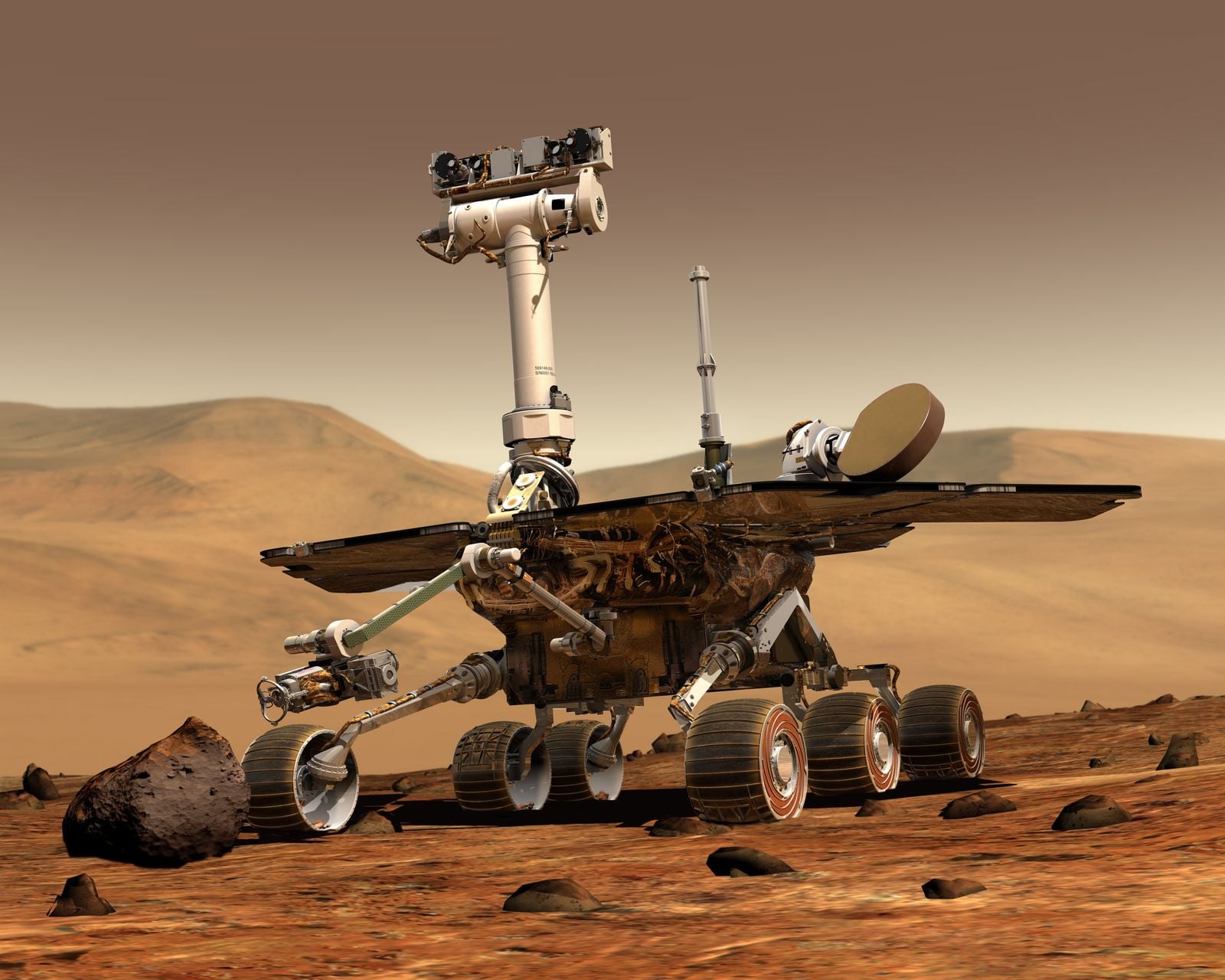
Fifty years ago, two NASA spacecraft touched down on Mars carrying hardware built to ask an unusually direct question: could anything living in the Martian soil reveal itself through biological activity? Viking 1 landed at Chryse Planitia on July 20, 1976. Viking 2 followed at Utopia Planitia on September 3.
The spacecraft themselves had launched from Earth in 1975, but their direct life-detection experiments began on Mars in 1976. NASA has sent increasingly sophisticated spacecraft back to the planet ever since, yet none has repeated Viking’s attempt to detect extant life through a dedicated biological experiment.
What the Viking landers actually did
Each Viking lander carried a robotic sampling arm and a biology package containing three experiments aimed at possible signs of life, alongside a gas chromatograph-mass spectrometer, or GCMS, that searched the soil for organic compounds.
The Artful Age
A weekly letter on aging well, family across generations, and the creative life after the kids leave home.
The Labeled Release experiment, led by Gilbert Levin, added nutrients tagged with radioactive carbon-14 to Martian soil and monitored the chamber for radioactive carbon dioxide that could indicate metabolism. The Pyrolytic Release experiment approached the problem from another direction, exposing soil to carbon-containing gases and looking for incorporation of the labeled carbon into material in the sample. The Gas Exchange experiment incubated Martian soil with nutrients and watched for changes in gases above it.
The GCMS asked a related but different question: were organic molecules present in the soil at detectable levels? That distinction became crucial, because Viking’s biological experiments produced chemical responses while the GCMS did not detect the organic material scientists expected to accompany living cells.
The result nobody could settle
The most famous result came from Levin’s Labeled Release experiment. After the labeled nutrients were added, radioactive gas was released from the Martian sample. Control procedures produced differences that Levin regarded as evidence that the response was biological rather than simply chemical.
NASA did not ultimately accept that interpretation as proof of life. Its current Viking mission history describes the biology experiments as having found unexpected and enigmatic chemical activity while providing no definitive evidence for living microorganisms near either landing site.
Levin continued to argue that the Labeled Release experiment had detected microbial activity. In a 2019 Scientific American essay, he described the initial LR result as positive and maintained that the data deserved to be treated as evidence for life. That remained his interpretation, not a settled conclusion accepted by the wider Mars science community.
Nonbiological explanations remained viable, including reactive chemistry in the Martian soil. The absence of detected organics complicated the biological interpretation further. Viking therefore left researchers with something more frustrating than a clean negative result: an experiment that reacted strongly enough to remain interesting but not cleanly enough to establish what caused the reaction.
Why nothing like it has flown since
Whatever role Viking’s ambiguity played in later planning, NASA’s Mars program moved toward a different set of questions. Instead of immediately repeating a direct metabolic test, later missions concentrated on geology, water history, organic chemistry and whether ancient Mars had environments capable of supporting life.
Sojourner characterized rocks and surface conditions in 1997. Spirit and Opportunity investigated evidence that liquid water had altered Martian rocks. Curiosity established that ancient Gale Crater contained a lake environment with conditions that could have supported microbial life. Perseverance has been exploring the ancient river-delta environment in Jezero Crater while collecting and caching rock samples.
Those missions have transformed what scientists know about Mars, but their central experiments are not equivalent to Viking’s. They can investigate habitability, organic molecules, mineral chemistry and potential biosignatures without placing a fresh soil sample into a chamber and asking whether something inside it is metabolizing.
What we’ve learned about extremophiles since 1976
One of the biggest changes since Viking is the expansion of what biologists know about the environmental limits of microorganisms. Researchers now study microbial life in intensely cold, salty, acidic, dry and high-pressure environments that provide useful analogs for thinking about possible habitats beyond Earth.
Mars makes that question especially complicated because its soil contains perchlorate salts. Those compounds can be hostile to organisms at sufficiently high concentrations, yet laboratory work has shown that their presence does not automatically make microbial survival impossible. Experiments reported by Space.com, for example, found that the Arctic permafrost bacterium Planococcus halocryophilus could still grow in a solution containing ten percent perchlorate by mass.
The same work also showed why simple statements about whether a Mars-like environment is “habitable” can be misleading. Survival depended on the type of salt, its concentration and temperature, and surviving an exposure was not the same thing as actively growing in it.
None of that establishes that Mars is inhabited. It does show why a biological possibility cannot be dismissed merely because the planet’s chemistry looks punishing by ordinary human standards.
The clean room problem
Viking’s direct biological experiments came with unusually demanding contamination controls. NASA’s historical account says the landers and aeroshells were enclosed in pressurized bioshields and heat-sterilized in nitrogen at 232 degrees Fahrenheit for 40 hours. Engineers had to ensure thousands of spacecraft components could tolerate that treatment.
That mattered because a terrestrial microbe carried to the landing site could have made a positive biological result extraordinarily difficult to interpret. Planetary protection still matters on modern Mars missions, even though different spacecraft, destinations and scientific goals can require different contamination-control approaches.
The distinction should not be exaggerated into a claim that later missions have already seeded Mars with terrestrial organisms. Reporting published for Viking 1’s 50th anniversary makes the narrower point: researchers value Viking’s stringent sterilization and regard contamination from Earth microbes on more recent missions as a growing concern.
That concern becomes particularly important if a future mission returns another ambiguous biological signal. Scientists would need evidence not only that something appeared alive, but that it was genuinely Martian.
The Viking archives are still working
The landers themselves have been silent for decades. Viking 2’s final data reached Earth in 1980, while Viking 1 continued operating until 1982. The scientific argument they started has lasted much longer.
Preserving those records matters because later discoveries change the context in which old measurements are interpreted. A signal that looked unusual in 1976 can be reconsidered alongside decades of additional knowledge about Mars chemistry, microbial survival and the limits of the instruments themselves.
Later rovers have also complicated the old assumption that organic chemistry on Mars should be simple to interpret. Curiosity has detected an increasingly diverse collection of organic molecules in Martian rock, while Perseverance has examined features that researchers classify as potential biosignatures rather than proof of life. Biological and nonbiological explanations still have to be separated carefully.
That does not retroactively turn Viking’s Labeled Release result into a discovery of life. It means one of the arguments that shaped the original interpretation now sits inside a much richer picture of Martian chemistry.
What a return trip would look like
A modern attempt to detect living organisms would not need to reproduce Viking experiment for experiment. The central lesson of the last half century is that a convincing result would need multiple independent measurements capable of separating biology from unusual geochemistry, backed by strict contamination controls and detailed information about the environment surrounding the sample.
Perseverance has already cached carefully selected Martian samples in sealed tubes, preserving the possibility that some material could eventually be examined with laboratory instruments on Earth. That remains scientifically attractive, although the specific NASA-ESA campaign previously known as Mars Sample Return should no longer be described as a settled active mission. NASA now describes that campaign as a proposed plan, and a 2026 U.S. Government Accountability Office assessment reported that the program had begun closeout activities after being proposed for cancellation.
A direct life-detection lander would answer a different question. Rather than bringing ancient rocks home and examining them for traces of past environments or possible past biology, it would once again put purpose-built instruments on Mars and ask whether evidence of living processes can be detected there now.
The half-century pause
That is what makes Viking unusual even after fifty years of increasingly capable Mars exploration. Its biology package did not merely ask whether Mars once had water, whether carbon-containing molecules were present or whether a rock preserved a potentially biological pattern. It tried to provoke a measurable response from the material beneath the lander.
NASA still maintains an active Astrobiology Program, and the agency’s current life-detection work continues to examine what would count as convincing evidence for extant life. Yet NASA’s own life-detection framework says direct detection of living organisms has not been attempted since the Viking missions.
The question Viking asked therefore remains unusually direct: is anything alive here? In 1976, the answer came back ambiguous enough to sustain an argument for half a century. Mars has been photographed, drilled, driven across and analyzed repeatedly since then, but NASA has not yet put the same direct question to another fresh Martian sample.
The next attempt will have fifty years of chemistry, microbiology and planetary protection experience behind it. The last one began when Gerald Ford was still president and disco was on the radio.