

A fair-weather cumulus cloud can contain about 500,000 kilograms of liquid water, or roughly 1.1 million pounds. Atmospheric scientist Peggy LeMone turned that enormous number into something easier to picture: about 100 elephants. Today, LeMone is a senior scientist emerita at the National Center for Atmospheric Research.
Strictly speaking, the famous calculation is the mass of the condensed water inside a representative cumulus cloud, not the mass of every molecule of air occupying the same volume. Even with that distinction, the answer is strange enough: hundreds of tons of liquid water can be spread through a cloud without crashing to the ground all at once.
The junior-high question
The story began long before LeMone became an atmospheric scientist. Mental Floss recounts that when she was in junior high, a friend’s father wondered how much a cloud weighed. She kept the question in the back of her mind for years and eventually had the knowledge to work through it.
The Artful Age
A weekly letter on aging well, family across generations, and the creative life after the kids leave home.
LeMone’s scientific career focused heavily on the atmospheric boundary layer, clouds, convection and the way the lower atmosphere interacts with Earth’s surface. She also developed a long record of education and public outreach, turning atmospheric science into explanations that nonspecialists could actually use.
That communication problem appears directly in a 2011 KNKX interview, where LeMone described how difficult it can be to explain a highly technical scientific idea to someone without a scientific background.
The cloud-weight calculation is a particularly memorable example because the method is simple enough to follow. You need two approximate values: the liquid-water content of the cloud and its volume.
A marble of water in a living room
Start with water content. Scientists use about half a gram of liquid water per cubic meter as a representative value for a fair-weather cumulus. That is only a tiny amount of water inside each cubic meter of cloudy air.
Half a gram per cubic meter sounds almost weightless.
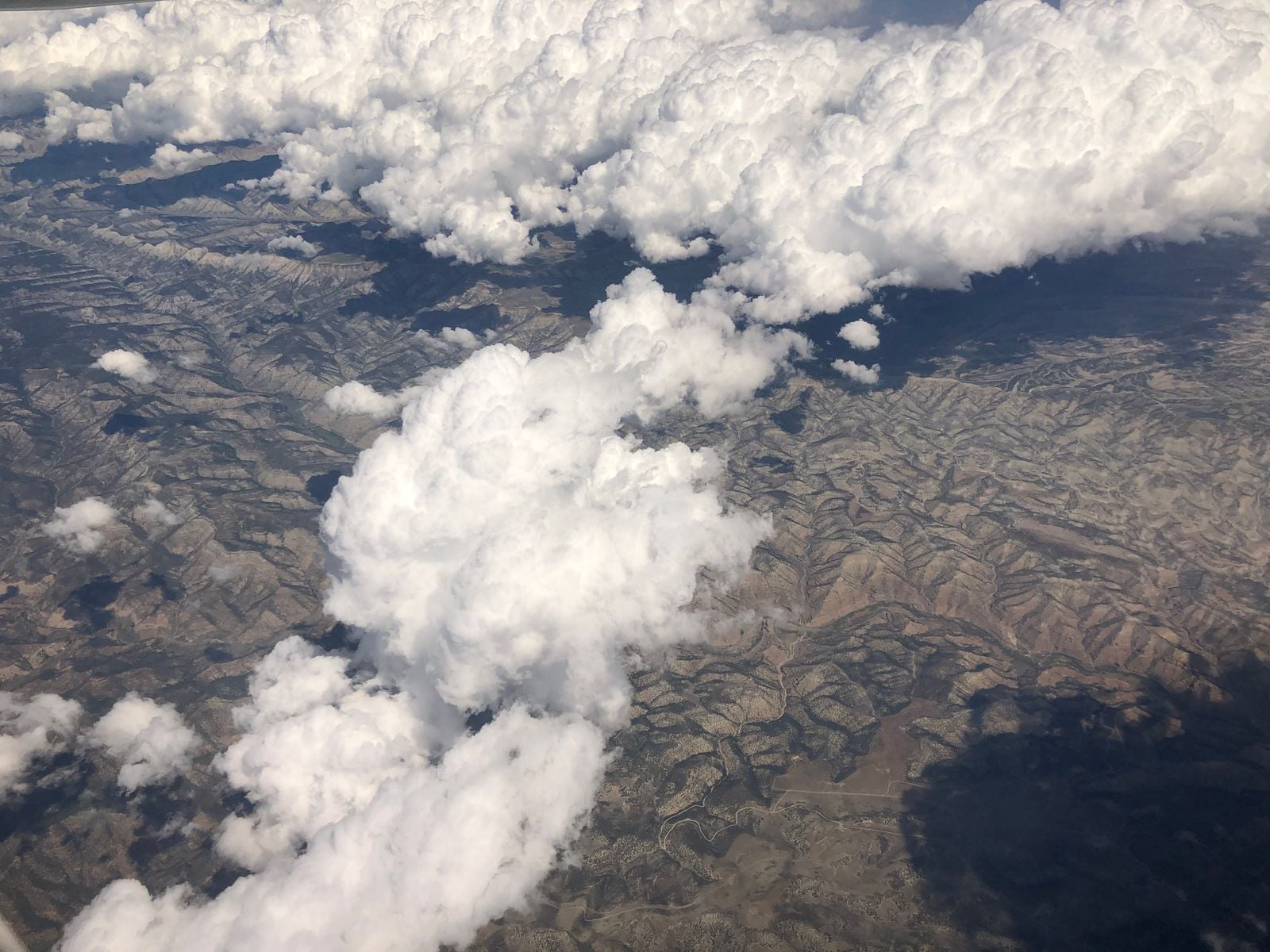
The surprise comes from the size of the cloud. LeMone’s example uses a cumulus about a kilometer across and roughly cubical. A kilometer by a kilometer by a kilometer gives a volume of one billion cubic meters. The same calculation has since appeared in science explainers describing a typical cumulus as containing roughly 500,000 kilograms of water.
Multiply half a gram by one billion cubic meters and you get 500 million grams. That is 500,000 kilograms of liquid water distributed throughout the cloud.
Why elephants
The arithmetic produces a number that is technically useful but hard to picture. Hundreds of thousands of kilograms do not give most people an immediate mental image.
Elephants do. Using an elephant weighing roughly six tons, the comparison comes out close to 100 elephants. The scale suddenly becomes visible: imagine the mass of a small herd, except divided among countless microscopic droplets across a cubic kilometer of sky.
That comparison is why the calculation has lasted. The number tells you the mass. The elephants make you feel it.
How a hundred elephants stay in the sky
If 100 elephants were somehow concentrated in one object above a field, gravity would bring them down immediately. A cloud behaves differently because its water is divided among enormous numbers of extraordinarily small droplets embedded in moving air.
The important point is not that gravity stops acting on those droplets. It does not. The droplets are simply so small that their terminal fall speeds are tiny because air resistance is large relative to their mass.
The National Weather Service explains that small cloud droplets can remain suspended for long periods, especially when they are in rising air currents. Its training material gives an average cloud-droplet terminal fall velocity of about 1.3 centimeters per second in still air.
Cumulus clouds form in rising parcels of air. Surface heating can make air buoyant, and as that air rises and cools, water vapor condenses into droplets. Continued upward motion can easily compete with the very slow settling speed of tiny cloud droplets.
So the more useful picture is not 100 elephants magically floating. It is hundreds of tons of water divided into tiny particles whose downward motion is slow enough to be offset by the moving air around them.
When the elephants come down
The suspension is temporary. Cloud droplets collide and combine, while other precipitation processes can also make particles grow. As drops become larger, their fall speeds increase until the upward air motion can no longer keep them suspended.
That is when cloud water begins reaching the ground as rain.
A large storm cloud can contain vastly more water than LeMone’s fair-weather example, and a hurricane is on another scale again. ABC News reported LeMone’s estimate of roughly 40 million elephants’ worth of water in a hurricane, using the same basic idea of estimating water content over an enormous volume.
The scale jumps from about 100 elephants in the small cumulus example to tens of millions in the hurricane estimate. At that point, elephants stop being an intuitive unit and become another very large number.
Clouds that do things nobody expected
Clouds and atmospheric plumes are not just collections of water. They can also become laboratories for chemistry that is difficult to reproduce anywhere else.
The January 2022 eruption of Hunga Tonga-Hunga Ha’apai sent material extraordinarily high into the atmosphere. In May 2026, researchers writing in Nature Communications reported unusually strong methane oxidation inside the eruption’s stratospheric plume. They estimated methane oxidation at 900 ± 220 megagrams per day and said the observations suggested at least 330 gigagrams of volcanic methane had been injected into the stratosphere.
The result was unexpected because the researchers found evidence of chlorine chemistry capable of driving methane oxidation high in the atmosphere. It is a much more precise finding than saying the plume simply removed methane from all of the surrounding air.
The atmosphere can also create extraordinary optical effects. National Geographic reported on viral 2015 footage that appeared to show a “floating city” over China. Experts quoted in the article cautioned that they could not be certain the video itself was genuine.
If the imagery was authentic, the experts said a superior mirage, potentially a Fata Morgana, could explain the effect. Layers of air at different temperatures can bend light so that distant objects appear displaced vertically, sometimes giving ships, coastlines or buildings the appearance of floating above the horizon.
The math is the easy part
LeMone’s cloud calculation is memorable partly because the final arithmetic fits comfortably on a sheet of paper. Half a gram per cubic meter multiplied by one billion cubic meters gives 500 million grams, or 500,000 kilograms.
The harder scientific work is deciding which numbers belong in the calculation in the first place. Researchers need defensible measurements of cloud water content, dimensions, temperature, motion and other properties before a simple multiplication can mean anything.
The same principle applies to weather prediction. Forecast skill has improved dramatically over decades, but no single ingredient deserves all the credit. ECMWF attributes its progress to better Earth-system models, finer resolution, improved observations, data assimilation and advances in supercomputing.
A forecast therefore rests on much more than a computer performing arithmetic. It starts with observations from satellites, aircraft, balloons, ground stations and other instruments, then depends on data assimilation and increasingly sophisticated models to turn those measurements into a picture of what the atmosphere is doing and what it may do next.
Questions that wait
Perhaps the most memorable part of LeMone’s story is still how ordinary the original question was. A friend’s father wondered aloud about the weight of a cloud when she was in junior high. LeMone remembered the question for years, then eventually found a way to answer it.
That is one of the useful things about curiosity. A question does not stop being interesting simply because the answer is not immediately available.
The next time a cumulus drifts across a summer sky, the arithmetic is there. About half a gram of liquid water per cubic meter. Roughly a billion cubic meters in the example. Around 500,000 kilograms of water.
About 100 elephants, not packed together but divided into tiny droplets moving inside rising air. Eventually some droplets grow large enough to fall. The cloud changes shape, rain reaches the ground, and an apparently weightless patch of white sky reveals just how much water it had been carrying all along.