The faintest sound a young, healthy ear can detect moves the eardrum by less than the diameter of a hydrogen atom. That is not a metaphor. At the threshold of hearing — set by international convention at 0 decibels sound pressure level, or 20 micropascals — the air pressure fluctuations reaching the eardrum are so small that the membrane’s displacement is smaller than a single atom of the lightest element in the universe. And yet that same ear, minutes later, can stand at the front row of a rock concert where sound pressure is roughly a million times greater in amplitude and a trillion times greater in power, and keep working.
The range is almost absurd. Engineers built the decibel scale logarithmically because the linear numbers were unusable.
What “threshold of hearing” actually means
The reference point — 0 dB SPL — is not silence. It is the quietest 1,000-hertz tone a young adult with unimpaired hearing can just barely detect in a controlled laboratory. Some people hear below it. Microsoft’s anechoic chamber in Building 87 on the Redmond campus measures a background level near -20 decibels, below the conventional threshold and close to the theoretical floor set by air molecules bumping into one another.
The Artful Age
A weekly letter on aging well, family across generations, and the creative life after the kids leave home.
Inside that room, visitors report hearing their own heartbeat, their own breath, the faint click of joints in a shoulder or knee. The ordinary masking noise of the world — traffic, refrigerators, distant conversation, the hum of the room itself — is gone. What remains is the body.
The chamber sits on springs. Its foundation is separated from the rest of the building so that footsteps in the corridor cannot leak through the concrete. Sound-absorbing wedges line every surface. It was built for measuring microphones and speakers, not for testing human endurance, and the widely repeated claim that nobody lasts more than 45 minutes inside is not a documented scientific limit — it appears to be a viral misattribution from a different chamber, the one at Orfield Laboratories in Minneapolis, which held the world-quietest title before Microsoft took it.
Why the scale is logarithmic
Consider the numbers in linear form. A whisper measures about 30 dB SPL. Normal conversation, 60 dB. A vacuum cleaner, 75. A motorcycle at close range, 95. A chainsaw, 110. A jet engine at 30 metres, roughly 130. The rupture threshold of the eardrum sits around 185–190 dB SPL, a level reached only by explosions and large rocket engines.
Because the decibel scale adds 10 for every tenfold increase in power, the jump from a whisper to a jet engine is a factor of ten billion in acoustic power. The jump from the threshold of hearing to the threshold of pain, roughly 120–130 dB, is a factor of one trillion in power and about a million in pressure amplitude. The ear handles this without a switch, a fuse, or a gain knob the listener controls.
It handles it with hair cells.
The mechanical trick inside the cochlea
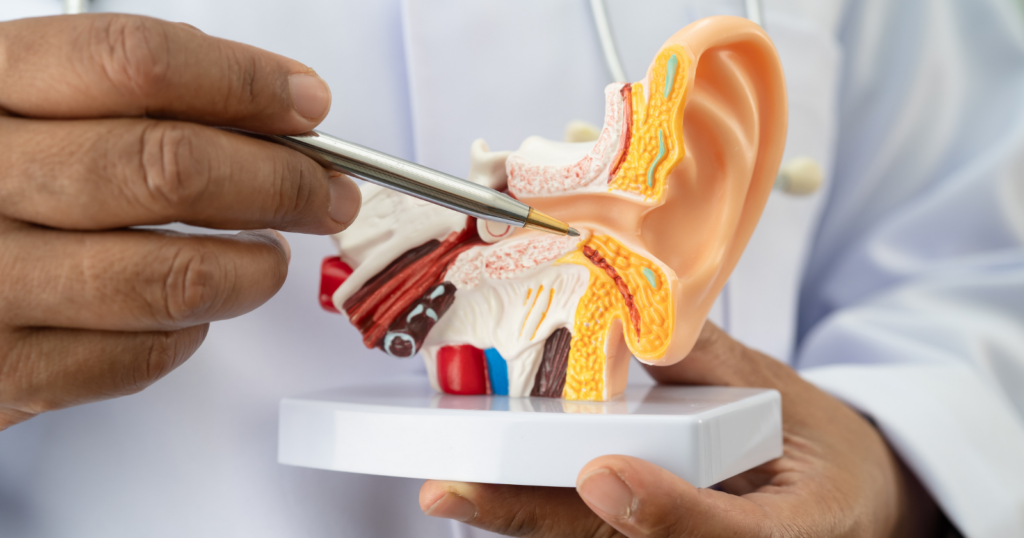
The cochlea is a fluid-filled spiral about the size of a pea. Running along its length is the basilar membrane, and sitting on that membrane are roughly 15,000 sensory hair cells arranged in rows. When sound enters the ear canal, the eardrum vibrates, three tiny bones in the middle ear amplify the motion, and a piston-like footplate pushes on the fluid inside the cochlea. The basilar membrane ripples. The hair cells bend. Each bend opens ion channels at the tip of the hair bundle, and a nerve signal fires.
The outer hair cells do something stranger. They actively contract and expand in time with the sound wave, pumping energy back into the basilar membrane to sharpen the response to quiet signals. At low volumes, the cochlea is essentially amplifying itself. At high volumes, that active amplification shuts down and the system runs passively, which is part of why the ear can span such a range without saturating.
This is compression built into biology. A microphone with the same dynamic range would need an engineer riding the fader.
Where the trillion-fold range breaks down
The system is not indestructible. Push it hard enough, long enough, and the hair cells that made the amplification possible begin to die. They do not grow back. Noise-induced hearing loss is almost entirely a story of these cells being worn down by exposure that the ear was never evolved to handle: engines, amplified music, industrial machinery, headphones held close.
A 2020 review in Frontiers in Neurology, led by researchers at Massachusetts Eye and Ear and Harvard Medical School, gathered the published evidence on what happens when people are exposed to acoustic energy outside the conventional hearing range — infrasound below 20 Hz, ultrasound above 20,000 Hz. The reported symptoms include dizziness, tinnitus and aural fullness. The authors were careful about how much weight the evidence bears: most of it comes from case series and small cohorts, and the underlying mechanism is not settled.
At the other end of the spectrum, a study published in Scientific Reports in January 2026 followed 42 young adults through large-scale music festivals, with personal dosimeters recording an average exposure of about 100 decibels across roughly ten hours. Only one of them showed a clinically significant drop in hearing sensitivity on a standard audiogram. But five showed reductions in electrophysiological markers of synaptic damage within 24 hours of the event, and in two of those the reduction was still measurable two weeks later, with normal hearing thresholds throughout.
That is the uncomfortable part. The trillion-fold range is real. The margin for using the top of it repeatedly is not — and the damage does not always show up on the test most people are given.
A public health problem hiding in the wonder
The World Health Organization warns that over one billion young people globally are at risk of permanent hearing loss from prolonged exposure to loud music through personal listening devices and noisy venues. In the WHO African Region, about 40 million people live with hearing loss, a prevalence of 3.6 percent, and the failure to address it is estimated to cost African economies US$27.1 billion a year. On current trends that figure reaches 54 million by 2030.
Most of that damage is preventable. The WHO notes that more than 60% of childhood hearing loss can be avoided with basic public health measures: vaccination against meningitis, treatment of ear infections, safer listening habits, and screening. In adults, the leading modifiable causes are noise exposure and ototoxic medications.
Children are especially vulnerable because their ear canals are shorter, which can amplify certain frequencies, and because damage accumulates over a lifetime. Toys, headphones and ordinary public environments — arcades, sporting events, film screenings — regularly cross into the range where an adult would think about ear protection, and rarely does anyone hand a child a pair of plugs on the way in.
What changes as the ear ages
Hearing does not fade uniformly. The highest frequencies go first, often decades before anyone notices in conversation. A 2024 study in Scientific Reports looked at what that loss does to the experience of an ordinary sound: the whine of a dental drill. Testing 62 people aged 12 to 67, the researchers found hearing sensitivity above 8 kilohertz falling sharply with age — the gap between teenagers and older adults at 14 kHz exceeded 65 decibels — and found that younger and older listeners diverged significantly in how they rated the sound. Part of the drill’s unpleasantness lives in a band that older ears no longer register.
The consonants of speech live in those upper frequencies too. The soft sibilance of s, f, and th. When those go, vowels remain clear but words blur into one another, which is why a person with age-related hearing loss can insist, honestly, that everyone around them is mumbling.
Even occupational noise, long assumed to be a leading cause of adult hearing damage, is more complicated than the headline suggests. A 2022 study in Frontiers in Neuroscience compared 40 young factory workers exposed to occupational noise in Zhejiang province, China, against 40 unexposed controls, all with normal hearing thresholds, and found no effect of that exposure on auditory brainstem response or on speech perception in noise. Within that cohort, at least, damage patterns appear to depend on the specific type, intensity and duration of exposure rather than on any single threshold being crossed.
The ear as a listener from birth
The dynamic range is present almost from the beginning. Newborns can distinguish their mother’s voice from a stranger’s within days. By six months, an infant’s auditory cortex is already sorting the phonemes of whatever language is spoken around them — a process that continues through the first year. By twelve months, the ear has already narrowed toward the sounds that matter and away from the ones that do not.
That narrowing is not a loss of range. It is a tuning. The trillion-fold dynamic window remains open. What changes is which patterns inside that window the brain treats as meaningful.
What silence sounds like
The people who spend time in anechoic chambers describe the experience in remarkably consistent terms. Blood in the ears sounds like a distant ocean. Swallowing sounds like a thud in a cave. Turning the head produces a soft crackle from the joints of the neck. None of these sounds are new. They are always there. The ear only hears them when the room stops adding its own signal.
The threshold of hearing, then, is not a wall. It is a floor set by the physics of air itself — by how quietly molecules can move before they stop moving in a coherent wave at all. Below that, there is nothing to hear because there is nothing happening.
Above it, across twelve orders of magnitude in power, the ear does its work. A held breath. A whisper. A voice across the room. A door closing. A truck outside. A helicopter overhead. A demolition charge two streets away. All of it processed by the same two cochleae, each the size of a pea, spiraling behind the temporal bone, moved by pressure changes measured in millionths of an atmosphere and by ripples that can, at their upper limit, tear tissue.
Cup a hand behind an ear, in a quiet room, and listen. The faint hiss is not the room. It is largely the sound of the auditory system itself, alive and listening for something quieter than it will ever hear.