
In July 1904, Piero Ginori Conti used heat from the ground at Larderello, Tuscany, to generate electricity and light five bulbs. An academic engineering history of the experiment explains an important detail that is often lost in retellings: the natural geothermal steam did not enter the engine itself. Instead, it heated a separate boiler containing clean water, and the steam produced in that boiler drove a one-cylinder engine connected to a 10-kilowatt dynamo.
The demonstration is widely recognised as the first production of electricity from geothermal heat. A 2024 report marking its 120th anniversary records the five illuminated bulbs and the commercial geothermal plant that followed in 1913. What began as a workshop-scale experiment became the starting point for an entire branch of electricity generation.
A kettle offers only a partial comparison. Both involve water changing into vapour, but an ordinary kettle does not turn that vapour into sustained mechanical work or electricity. Conti’s achievement was to make steam push an engine, make the engine turn a dynamo, and make the dynamo send current through a wire.
The Artful Age
A weekly letter on aging well, family across generations, and the creative life after the kids leave home.
The Devil’s Valley had been steaming for centuries
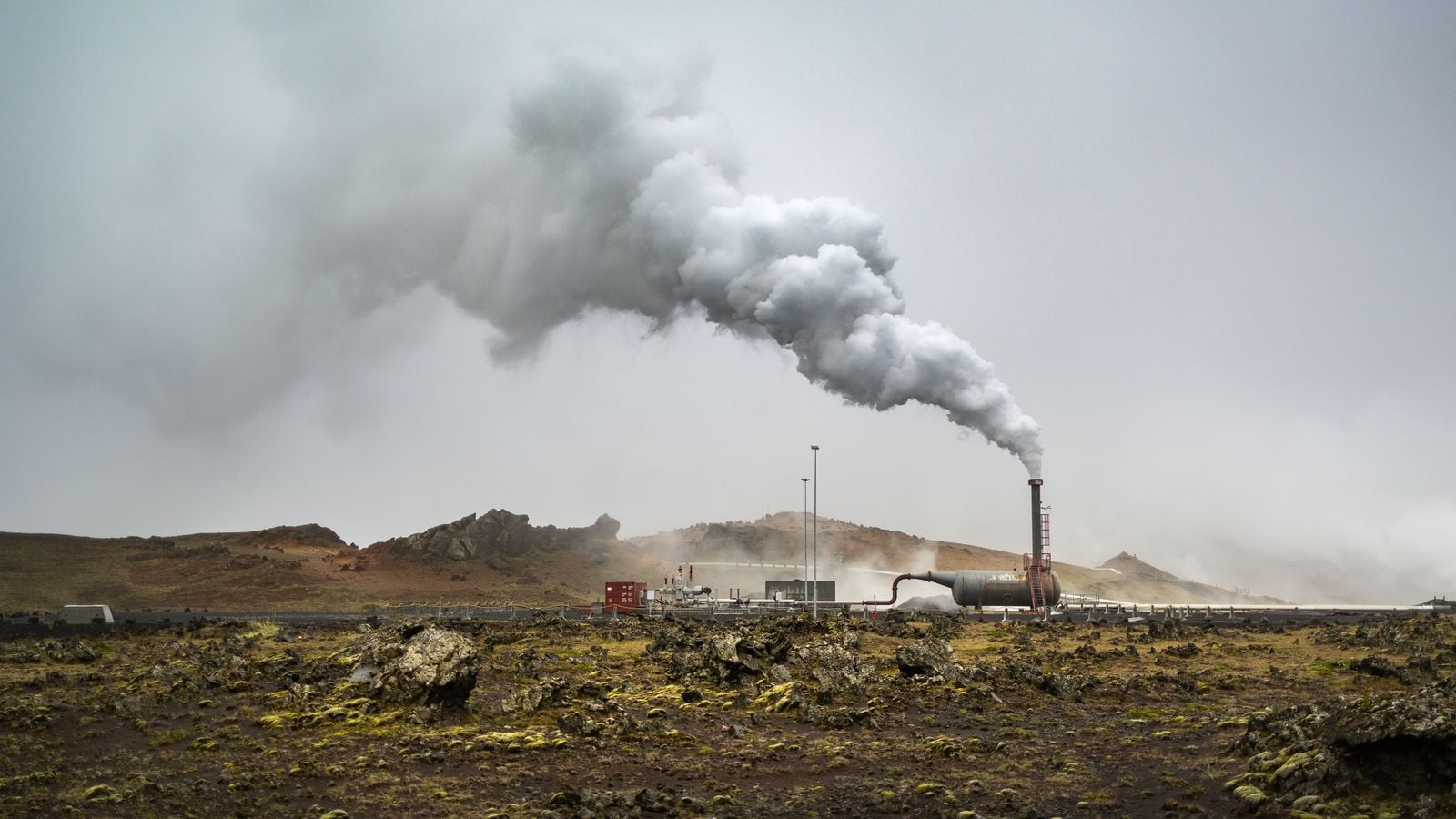
Larderello lies in a Tuscan landscape traditionally known as Valle del Diavolo, or the Devil’s Valley. A 2024 National Geographic report on the region describes natural cracks releasing steam and gases, fumaroles and geysers throwing white plumes into the air, and the long-repeated suggestion that the landscape helped inspire Dante’s vision of the Inferno. It also describes a reservoir of steam and water extending from roughly 1,600 to 14,000 feet below the surface.
People exploited the valley’s heat long before anyone attempted to generate electricity. The local boric-acid industry used geothermal vapour as an industrial heat source, replacing some of the wood previously burned during processing. By the beginning of the twentieth century, steam was already a familiar part of the factories around Larderello.
The aristocrat who entered the boric-acid business
Conti’s connection to Larderello came through his marriage to Adriana de Larderel, whose family owned the boric-acid works. The Treccani biographical record says Conti joined his father-in-law’s company and was appointed its general director in 1904. It dates his title of Prince of Trevignano to 1907, meaning that “Italian aristocrat” is the historically accurate description for the moment of the 1904 experiment.
Conti had studied social sciences rather than engineering, but he worked closely with technical and scientific specialists. His contribution was partly organisational and partly conceptual: he recognised that the geothermal heat already supporting chemical production could also become a source of mechanical power. That observation opened a new direction for the family business.
Five bulbs and a 10-kilowatt dynamo
The experiment’s dynamo was rated at 10 kilowatts, not 4 kilowatts. The five bulbs therefore did not represent the machine’s full output, and there is no reliable basis in the cited sources for assigning each bulb a particular wattage, filament type, or colour. Those details are best left out rather than reconstructed from what lamps of the period might have looked like.
The more important development came in 1913, when the first commercial-scale geothermal unit began operating at Larderello with a rating of 250 kilowatts. It supplied the boric-acid works and nearby communities, including Volterra and Pomarance. By then, geothermal electricity had moved beyond a demonstration and into practical service.
How steam becomes electricity
Steam can do mechanical work because it expands as it moves from a region of higher pressure toward a region of lower pressure. If that flow is directed through an engine cylinder or across turbine blades, it pushes moving parts. A shaft connected to a generator then converts that rotation into electrical energy.
Conti’s early arrangement used geothermal steam as the heat source for a separate clean-water boiler. Modern dry-steam plants at Larderello can send suitable geothermal steam from production wells through steel pipelines and into turbines. The machinery has changed enormously, but the energy conversion remains heat to moving steam, moving steam to rotation, and rotation to electricity.
This is the useful distinction when explaining the idea with a kettle. The kettle shows that heat can turn liquid water into vapour, but it does not complete the power-generation cycle. A geothermal plant captures the vapour’s energy and makes it turn a machine.

From five bulbs to 34 plants
Larderello is now part of a much larger Tuscan geothermal complex operated by Enel Green Power. According to Enel’s current Valle Secolo plant page, the area contains 34 plants, 37 generating units, and approximately 800 megawatts of total capacity. Valle Secolo itself has an operating capacity of 117.6 megawatts and average annual production of 854 million kilowatt-hours, which Enel describes as equivalent to the electricity needs of 316,000 households.
The 2024 anniversary reporting put the Tuscan complex’s contribution at approximately 34 percent of the region’s electricity needs. It also recorded direct uses of geothermal heat for around 13,000 users, greenhouses, and local businesses. Electricity is therefore only one part of the resource’s local value.
Larderello is no longer the largest geothermal complex in the world. A June 2026 update from The Geysers identifies the northern California site as the world’s largest operating geothermal complex and records the completion of a 25-megawatt expansion. That status is more useful than an uncertain comparison built from outdated capacity figures.
The heat is useful after electricity generation
Geothermal systems can continue supplying useful heat after the electricity-generation stage. In the communities around Larderello, hot water and residual heat support district heating, food production, greenhouses, and other businesses. This improves the amount of useful energy obtained from the geothermal resource.
The National Geographic reporting cited above documents several examples. Farmer Mario Tanda connected his cheesemaking operation to geothermal heat in 2007 and uses it while processing milk from 800 sheep into pecorino. Brewer Edo Volpi and greenhouse grower Giacomo Anterminelli also use heat supplied by nearby geothermal facilities.
What geothermal does well, and why it remains limited
One of geothermal power’s strongest advantages is its availability. Unlike solar and wind generation, it does not depend directly on daylight or the immediate weather. ThinkGeoEnergy’s report on Italy’s slow geothermal development cites industry data describing geothermal plants as having nearly constant availability throughout the year.
Traditional geothermal development is geographically constrained because a viable site needs accessible heat, fluid, and permeable rock. Larderello contains those conditions naturally, but most places do not. Exploration and drilling are also expensive, and a developer can spend heavily before discovering whether a reservoir will produce enough hot fluid at a useful pressure.
Newer geothermal methods may loosen that geographic restriction. The International Energy Agency’s geothermal assessment says developers are adapting horizontal drilling and hydraulic-fracturing techniques developed by the oil and gas industry. The same assessment estimates that, with continued technical improvements and lower costs, geothermal could supply as much as 15 percent of the growth in global electricity demand through 2050.
The underground fluid must be managed
The Earth’s heat is vast, but an individual geothermal reservoir’s fluid and pressure are not unlimited. National Geographic reported Bruno Della Vedova, president of the Italian Geothermal Union, as saying that Larderello’s productive capacity declines by about 20 megawatts annually as reservoir pressure and flow fall. More efficient plants compensate for much of that decline, but they do not eliminate the need for careful reservoir management.
Reinjection is part of that management. Enel says around 40 percent of the geothermal steam condensate from Valle Secolo is returned to the geological formation, with microseismic monitoring used across its geothermal areas. Reinjection helps return fluid underground, although it cannot be assumed that every unit of extracted fluid will immediately restore the same pressure or productivity.
Other Italian regions are not simple copies of Larderello
Italy has geothermal resources beyond Tuscany, but their technical characteristics differ. A history of geothermal exploration in Campania describes promising temperatures in areas including Campi Flegrei and Ischia. It also records problems involving highly saline fluids, low flow rates, corrosion, and changing energy-policy priorities, all of which contributed to electricity projects being abandoned.
This makes “the rest of Italy sits on the same potential” too broad. Underground heat may be present without the combination of fluid chemistry, pressure, permeability, community acceptance, and economics needed for a successful power station. Concerns about gases including hydrogen sulfide and mercury also require monitoring and effective emissions controls.
What the kettle can teach
A kettle remains a useful visual starting point because it makes the change from liquid water to vapour easy to see. The whistle of a stovetop kettle also demonstrates that moving steam can create pressure differences and sound. What it does not demonstrate is the controlled extraction of mechanical work through an engine or turbine.
That controlled conversion was the importance of Conti’s experiment. Heat from underground helped produce clean steam, the steam moved an engine, the engine turned a dynamo, and electric current illuminated five bulbs. Each step mattered.
Conti died in 1939 after seeing geothermal electricity grow from an experiment into an industrial network. The equipment used in 1904 has been superseded, but Larderello remains an operating centre of geothermal power 122 years later. The kettle is a metaphor; the lasting invention was the machinery that captured steam’s energy instead of letting it escape.