
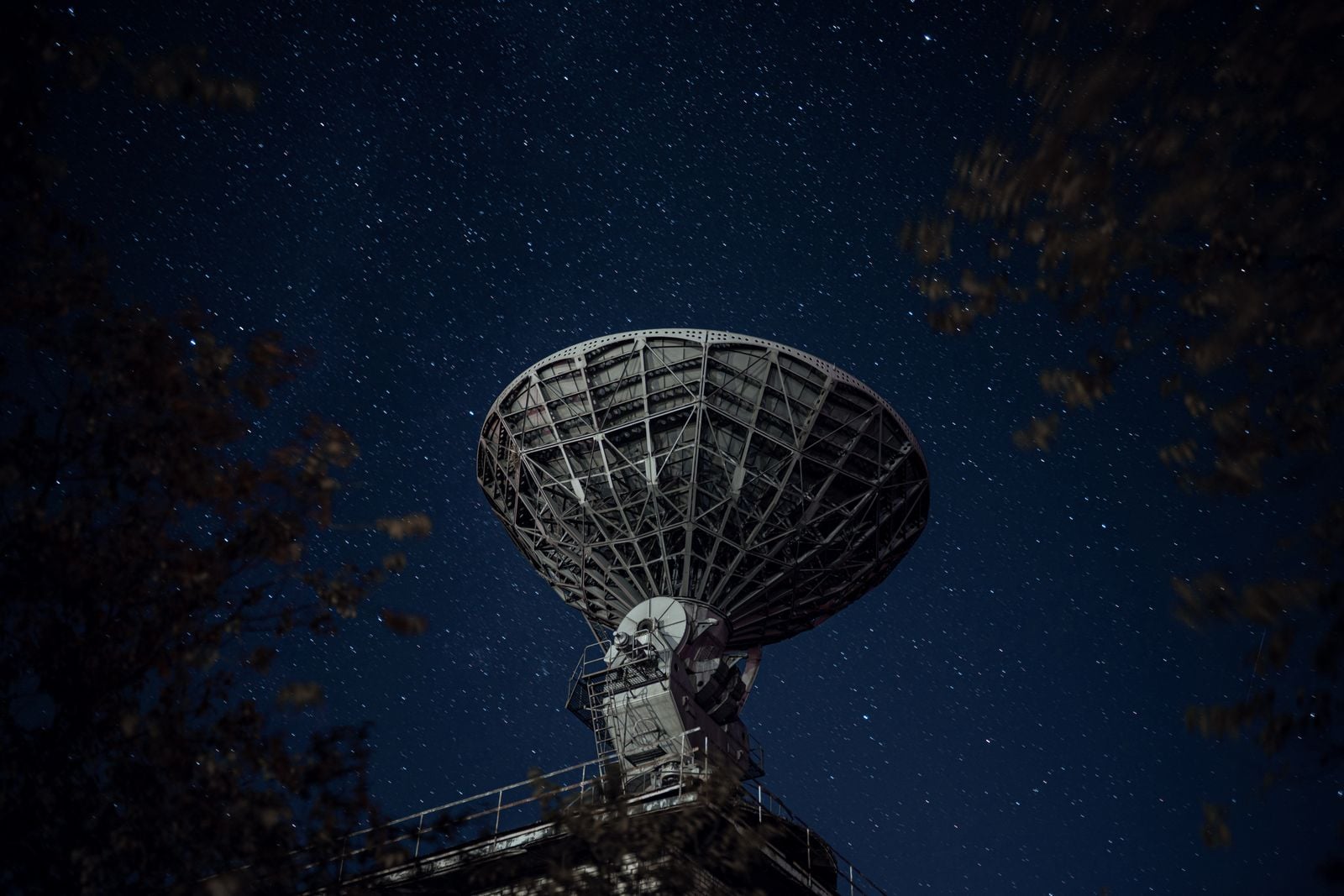
On the afternoon of 16 November 1974, a remodelled radio dish tucked into a karst sinkhole in Puerto Rico warbled at the sky for two minutes and 49 seconds, and when it went quiet the audience gathered under a tent below had just witnessed the most ambitious deliberate radio message humans had ever aimed beyond the solar system — a signal built, unlike anything sent before it, to travel all the way to another star system. (Twelve years earlier, Soviet scientists had bounced three words of Morse code off Venus from a radar station in Crimea; that earlier transmission never left the solar system.) The signal was aimed at Messier 13, a globular cluster of several hundred thousand stars in the constellation Hercules, roughly 25,000 light-years from Earth.
The people who pressed send knew something strange about their own gesture. Any reply, travelling at the speed of light, could not possibly reach Earth for about 50,000 years. Every scientist standing under that tent would be dust. So would their great-great-great-grandchildren, thousands of times over.
They sent it anyway.
The Artful Age
A weekly letter on aging well, family across generations, and the creative life after the kids leave home.
A dish the size of a small town
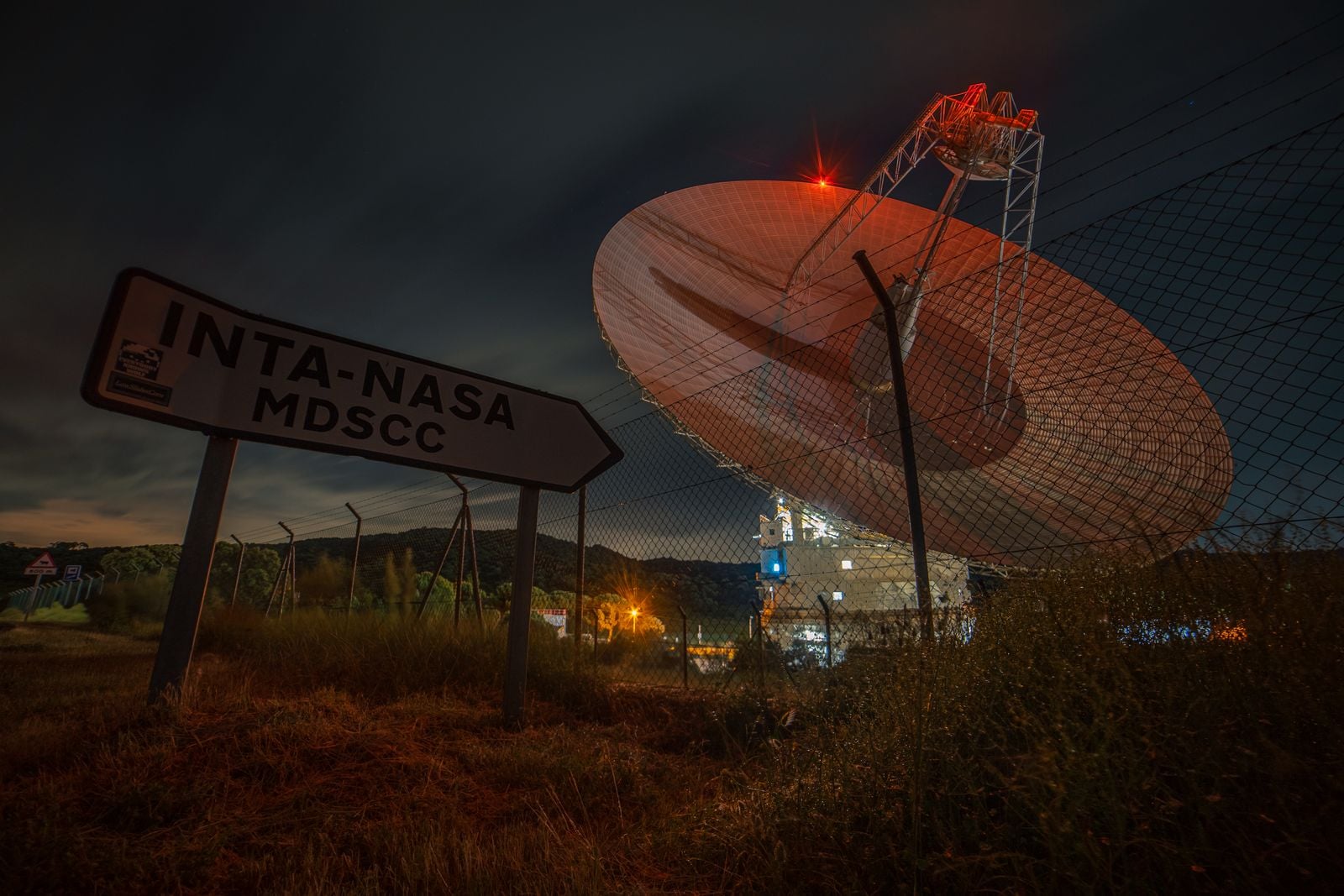
The instrument doing the transmitting was the 305-metre radio telescope at the Arecibo Observatory, built into a natural limestone bowl in the hills of northwestern Puerto Rico. When it was completed in the 1960s with money from the U.S. Defense Department, part of a Cold War push to develop anti-ballistic missile defenses, it was the largest single-dish radio telescope on Earth. It stayed that way for half a century, until China finished a larger one in 2016.
The reflector dish covered about 20 acres. Suspended 137 metres above it, held by steel cables strung from three concrete towers, hung a 900-ton receiver platform the size of a small building. From below it looked like a spaceship parked over a valley.
By November 1974 the dish had just been resurfaced with more accurate aluminium panels, sharpening its ability to send and receive high-frequency radio waves. The dedication ceremony marking the upgrade was the occasion for the broadcast. Someone had to do something dramatic. Frank Drake, the astronomer who had run the first modern search for extraterrestrial intelligence in 1960, decided the something would be a letter.
What the message actually said
Drake wrote the message with input from Carl Sagan and a handful of colleagues at Cornell, which then managed the observatory. It was 1,679 bits long — a deliberately chosen number, because 1,679 is the product of two prime numbers, 23 and 73. Any recipient clever enough to notice would arrange the bits into a rectangle 23 columns wide by 73 rows tall. Do it the other way and you get gibberish.
Arranged correctly, the ones and zeros form a crude pixel image. From top to bottom it shows the numbers one through ten in binary, the atomic numbers of the elements that make up DNA (hydrogen, carbon, nitrogen, oxygen, phosphorus), the chemical formulas of the nucleotides, a stylised double helix, a stick figure of a human with an average height marked beside it, a rough map of the solar system with Earth nudged up out of line to indicate the sender, and a small pictogram of the Arecibo dish itself.
The signal was transmitted at 2380 megahertz, with a power of about one megawatt. Focused by the dish, its effective radiated power was roughly 20 trillion watts — briefly making it the brightest artificial radio source in that part of the galaxy. For a few minutes in 1974, if you had been listening on the right frequency from a planet in the right direction, humanity was louder than the Sun.
Why M13
The target was chosen partly for beauty and partly for convenience. Messier 13, discovered by Edmond Halley in 1714, is a dense ball of stars packed into a sphere roughly 145 light-years across. It contains, by most estimates, a few hundred thousand suns. From Earth it appears as a fuzzy patch of light in Hercules, faintly visible with binoculars on a dark summer night.
Crucially, M13 would be directly overhead of Arecibo at the appointed hour. The dish, sitting in its fixed limestone bowl, could not swivel. It pointed where the Earth pointed it. M13 happened to be there.
The choice also had a certain generosity to it. A globular cluster is a shotgun target — hundreds of thousands of stars in a single pointing, rather than one lonely candidate. If even a small fraction hosted planets, and even a smaller fraction hosted anyone listening, the odds crept upward.
There was a catch nobody dwelled on at the dedication. M13 orbits the centre of the Milky Way. In 25,000 years, the cluster will not be where the message is heading. The photons are aimed at the empty patch of space where M13 used to be. Astronomers understood this at the time. The point of the broadcast was symbolic, a demonstration of the new telescope’s power, not a serious attempt at first contact.
The Nobel science that happened next door
The Arecibo message tends to get remembered as the observatory’s showpiece, but the dish spent the next 46 years doing far more consequential work. It tracked near-Earth asteroids and mapped their orbits. It measured the rotation of Mercury. It found the first planets ever detected outside our solar system, orbiting a pulsar called PSR B1257+12, in 1992. Its data contributed to two Nobel Prizes, including the 1993 prize for the discovery of a binary pulsar that offered the first indirect evidence of gravitational waves.
Qihou Zhou, a space physicist at Miami University who worked at Arecibo for more than a decade before joining the university in 2002, has probably logged more hours on the telescope than any other living scientist. He is now using a $703,703 grant from the National Science Foundation to reanalyse decades of archived ionosphere data with modern AI techniques.
According to Zhou, the Arecibo radar was the most powerful radar ever built, and he believes its capabilities are unlikely to be surpassed in the near future. Zhou noted that the quality of data collected at Arecibo is exceptional and unlikely to be matched by other facilities for years to come.
One of Zhou’s experiments, according to a former colleague, was the last radar run the telescope ever performed before it collapsed.

The night the platform fell
The dish endured a lot in 57 years. Hurricanes. Tropical humidity that rusted anything not sealed. A string of earthquakes in 2019 and 2020. It kept working through all of it, drawing about 90,000 visitors a year and training generations of Puerto Rican graduate students in radio astronomy.
Then, in August 2020, an auxiliary cable slipped out of its socket and tore a 100-foot gash in the dish. A main cable snapped in November. Engineers concluded the remaining cables could fail at any moment, and the National Science Foundation announced plans to decommission the telescope in a controlled way. Before that could happen, on 1 December 2020, the receiver platform tore loose and plunged more than 400 feet into the reflector below, destroying it.
A report published in October 2024 by the National Academies of Sciences, Engineering and Medicine identified the culprit as something no one had ever seen before in more than a century of engineering practice. The zinc inside the sockets that anchored the cables had slowly deformed under load — a process called zinc creep — and lost its grip on the steel strands. According to committee chair Roger L. McCarthy, this type of failure had never been documented before despite more than a century of successful use of zinc spelter sockets.
The committee’s best hypothesis for why the creep accelerated at Arecibo was low-current electroplasticity: the constant flow of electric current through the sockets, part of routine operation, may have made the zinc behave in ways no textbook predicted.
In 2022 the NSF announced it would not rebuild the telescope. The observatory site now hosts a STEM education centre.
A message that outlives its senders
The physical telescope is gone. The signal it launched in 1974 is not. Radio waves do not decay in the way sound does. They spread and weaken, but the photons keep travelling. Right now, in September 2026, the Arecibo message is roughly 52 light-years from Earth — farther out than most of the stars visible to the naked eye, though it isn’t spreading in every direction. Its narrow beam is still headed exactly where it was aimed, toward Hercules. It is a whisper moving outward at 299,792 kilometres per second, and it will keep moving until something absorbs it or the universe ends.
In roughly 25,000 years, if the trajectory calculation still held, the leading edge of the signal would arrive at the coordinates where M13 sat on that November afternoon. The cluster itself will have drifted. But the signal will keep going, into the halo of the galaxy, and eventually out.
The Arecibo broadcast was not the only message humans have flung outward. Small metal plaques rode on the Pioneer 10 and 11 spacecraft in the early 1970s, showing a naked man and woman and a map of pulsars pointing back to Earth. Golden records with greetings in 55 languages, whale song, and music by Bach rode on both Voyager probes in 1977. As a recent piece on Mariner 1 traced, the early decades of the space age were full of gestures like this, half science and half poem.
The search for signals coming the other way has been running just as long, though it has produced nothing conclusive. The SETI@home project, which ran on volunteers’ home computers from 1999 to 2020, collected about 12 billion candidate detections. Researchers spent the following decade winnowing that list down to roughly 100 signals worth a second look, and have been re-observing them with China’s FAST telescope since mid-2025 — so far without turning up anything that looks like it came from beyond Earth.
What the Arecibo message really documented was a moment in the mid-1970s when a small group of people decided that the appropriate response to owning the largest radio dish on Earth was to write a letter to strangers who might not exist, in a language they had invented, aimed at a place that would have moved by the time it arrived, knowing they would never know if it worked. As a recent piece on Pierre Janssen’s 1868 discovery of helium showed, some of the strangest gestures in the history of science are the ones made without knowing what will come of them.
In the year 26,974, if anything is listening on the right frequency in the right corner of Hercules, the signal will arrive. It will last two minutes and 49 seconds. Then it will pass, and keep going, into whatever comes next.