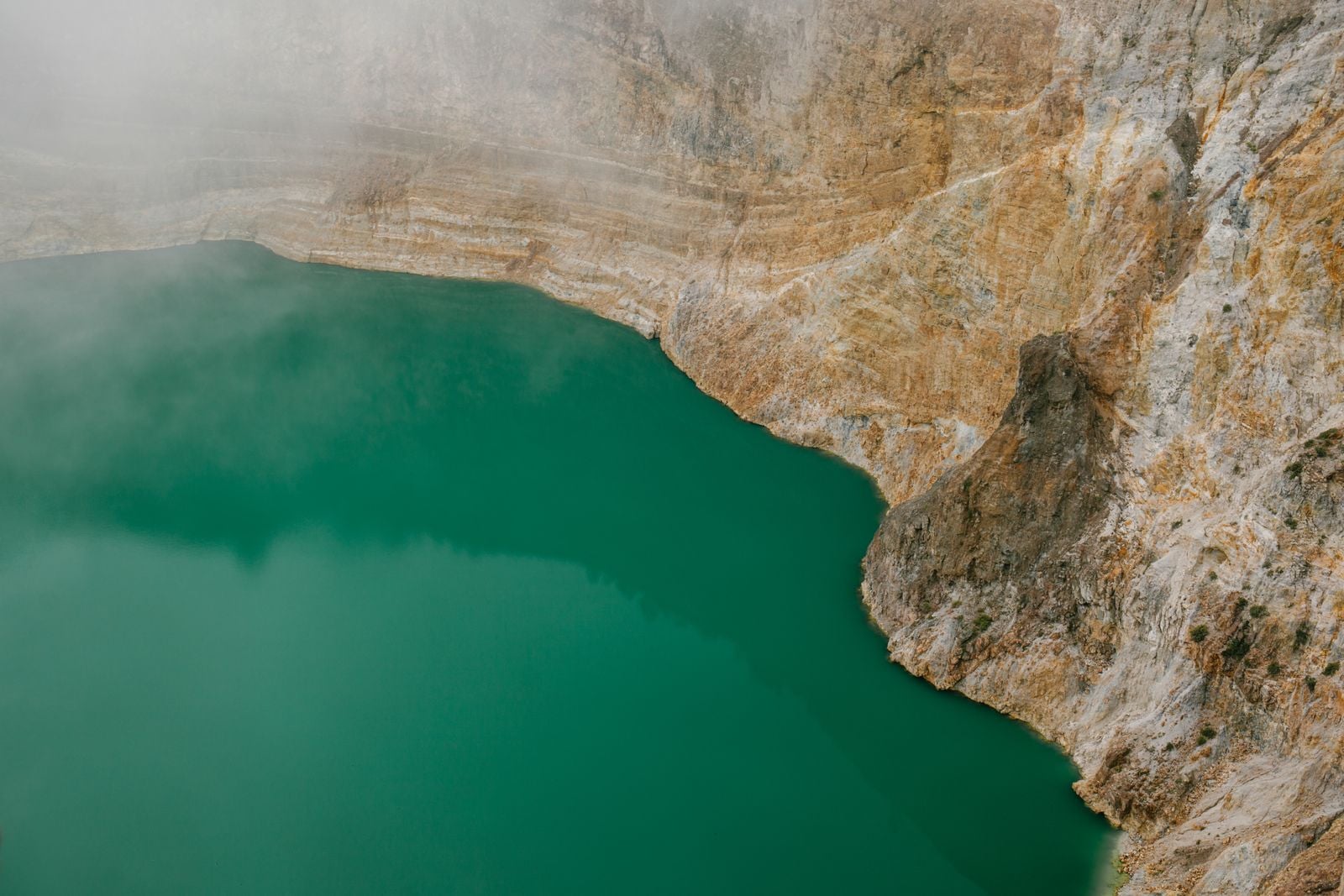
Lake Nyos in north-west Cameroon fills an old volcanic crater roughly 210 metres deep, sitting at 1,091 metres altitude, and for centuries it worked like a giant sealed bottle of soda. Carbon dioxide from a magma pocket roughly 80 kilometres below the surface seeped up through the rock, dissolved into the cold pressurised water at the bottom, and stayed there. On the night of 21 August 1986, something shook the bottle. By dawn, more than 1,700 people were dead.
They died in their beds. They died walking out to check on cattle. They died without ever seeing what killed them.
The bottle, and why it stayed sealed for so long
Nyos is a maar — a broad, shallow crater blasted out when groundwater met hot magma and flashed to steam. It is geologically young. Radiocarbon dating of the crater’s own eruption deposits, published by the US Geological Survey, found that the maar probably formed about 400 years ago, while the wider volcanic line it belongs to traces back to continental rifting around 110 million years ago. The lake that fills the crater is small on a map and enormous in depth, and its water column barely mixes.
The Artful Age
A weekly letter on aging well, family across generations, and the creative life after the kids leave home.
That refusal to mix is the whole story.
At 200 metres down, the water is cold and under roughly 20 atmospheres of pressure. Carbon dioxide dissolves into cold, high-pressure water the way it dissolves into a sealed can — generously, invisibly, and without complaint. The warmer surface layer sat on top like a lid. Gas kept pooling at the bottom for years, possibly decades, with nothing to release it.
A bottle of Coca-Cola holds around 2 to 3 grams of dissolved CO₂. Lake Nyos, by 1986, was holding enough to release more than a cubic kilometre of gas in a single night.
The night of 21 August 1986
The villages around the lake — Nyos, Kam, Cha, Subum — went about an ordinary Thursday. People finished cooking. Cattle were penned. Children slept. Sometime between 9pm and 10pm, witnesses on higher ground heard what several described as a rumble like distant thunder, or a landslide.
Scientists still argue about the trigger. A small landslide into the lake. A minor earthquake. A cold rain squall cooling the surface and starting a slow tumble. Some researchers think no trigger was needed at all — the lake was so saturated that a single rising bubble could have started the cascade.
Whatever the nudge, the deep water rose. As it rose, pressure fell. As pressure fell, dissolved CO₂ came out of solution the way it does when you crack a warm can — except this can was 210 metres tall. A fountain of water and gas erupted from the surface, driving a wave across the lake and stripping the vegetation off one side of the shore. Roughly a cubic kilometre of carbon dioxide unspooled into the night air in a matter of minutes.
An invisible avalanche at 60 kilometres an hour
Carbon dioxide is about 1.5 times denser than air. It does not rise and dissipate. It falls, and it flows downhill like water, seeking valleys, filling low ground, pushing breathable air out ahead of it.
The cloud that came off Lake Nyos that night flowed over the crater rim and poured down the mountainside at somewhere between 60 and 100 kilometres per hour, following the natural drainage of the land. It reached villages more than 20 kilometres from the lake. It was odourless. It was colourless. At ground level, in the sleeping huts, it displaced the oxygen entirely.
A human being in an atmosphere of pure CO₂ loses consciousness within one or two breaths. Death follows within minutes. Victims that night were asphyxiated so quickly that most never left the position they had been sleeping in.
What survivors described afterwards was the terror of the invisibility. There was no warning of danger until people started collapsing.
What the morning looked like
Survivors on higher ground — those whose homes sat above the flow line of the cloud — woke on 22 August into a landscape with nothing moving in it. Cattle lay in the fields where they had been standing. Birds had dropped from trees. Insects were absent. In the village of Nyos itself, of an estimated 800 residents, only a handful survived. The final toll stood at 1,746 people and 3,500 animals.
The lake itself had changed colour. Iron-rich water from the depths had been dragged to the surface and oxidised on contact with air, staining the whole lake a deep rust-red. The waterline had dropped by about a metre.
A phenomenon nobody had a name for
Before Nyos, the idea that a lake could suffocate a region was not in any textbook. Volcanologists, geochemists and pathologists flew in from around the world in the weeks after. What they described eventually got a name: a limnic eruption, or lake overturn.
Two years earlier, in August 1984, something similar had killed 37 people at nearby Lake Monoun, also in Cameroon. At the time, Cameroonian authorities suspected a chemical weapon attack. Nobody had connected it to the lake itself. Only after Nyos did the Monoun event get reclassified as the same phenomenon, in miniature.
The search then widened. Researchers began surveying deep, stratified lakes in volcanic regions worldwide. They found one other that qualified as a serious threat: Lake Kivu, on the border between Rwanda and the Democratic Republic of the Congo, which holds an estimated 256 cubic kilometres of dissolved carbon dioxide — more than a hundred times what Nyos held — plus tens of cubic kilometres of methane, with roughly two million people living in its basin.
The pipe that opens the bottle slowly
The engineering solution is almost absurdly simple. Drop a pipe from a raft on the surface down to the gas-rich deep water. Prime it once with a pump. Deep water, saturated with CO₂, starts rising through the pipe. As it rises, pressure falls, gas bubbles out of solution, and the mixture becomes lighter than the surrounding water. It self-siphons. The pipe becomes a permanent, slow-motion fountain.
The first pipe was installed at Nyos in 2001, reaching down about 203 metres. Two more were added in 2011. The fountains at the surface, visible in photographs from the site, shoot water and gas tens of metres into the air continuously, releasing the pressure that a single catastrophic overturn would otherwise release all at once.
Measurements collected since have shown a steady drop in deep-water CO₂ concentration. Fifteen years into the programme, the volcanologists D. Rouwet, G. Tanyileke and A. Costa wrote in Eos in 2016 that the lake is now “considered relatively safe” — a careful phrase, and the strongest one the science supports.
The seepage from the magma below has not stopped. It never will, on any human timescale. But the pipes are now removing gas faster than the earth is delivering it.
Why the villages were never simply rebuilt
After the disaster the Cameroonian government moved survivors out of the valleys below the lake, and they did not go back quickly. By 2013, some 12,000 people were still living in camps in the Menchum area of the North-West Region. The lake itself sits inside a security zone under military surveillance, established to protect the degassing rafts and their infrastructure, with a community of only around 200 people living nearby.
The natural dam holding the lake in its crater is a wall of volcanic rock, and geologists have warned since the 1980s that it is erodible. If it failed, the lake would drain catastrophically down the Katsina-Ala river valley and on into Nigeria. Work to strengthen the weak natural dam has been discussed for decades and only partially carried out.
What Nyos taught the rest of the world
The disaster changed how scientists think about quiet lakes in volcanic country. Before 1986, a lake sitting in a dormant crater was considered geologically boring — a landscape feature, a tourist stop, a place to water cattle. After 1986, deep tropical lakes over magma became a distinct hazard category, monitored, drilled, and in the case of Kivu, commercially tapped. On the Rwandan side of Lake Kivu, the KivuWatt plant now pulls methane from the deep water to generate electricity, turning the same physics that killed the villagers of Nyos into power for homes and hospitals.
It is the mirror image of the usual disaster story. Not a system that failed suddenly, but one that worked exactly as physics said it would, quietly, for centuries, invisibly loading itself, and then released everything it had in a matter of minutes.
The lake today
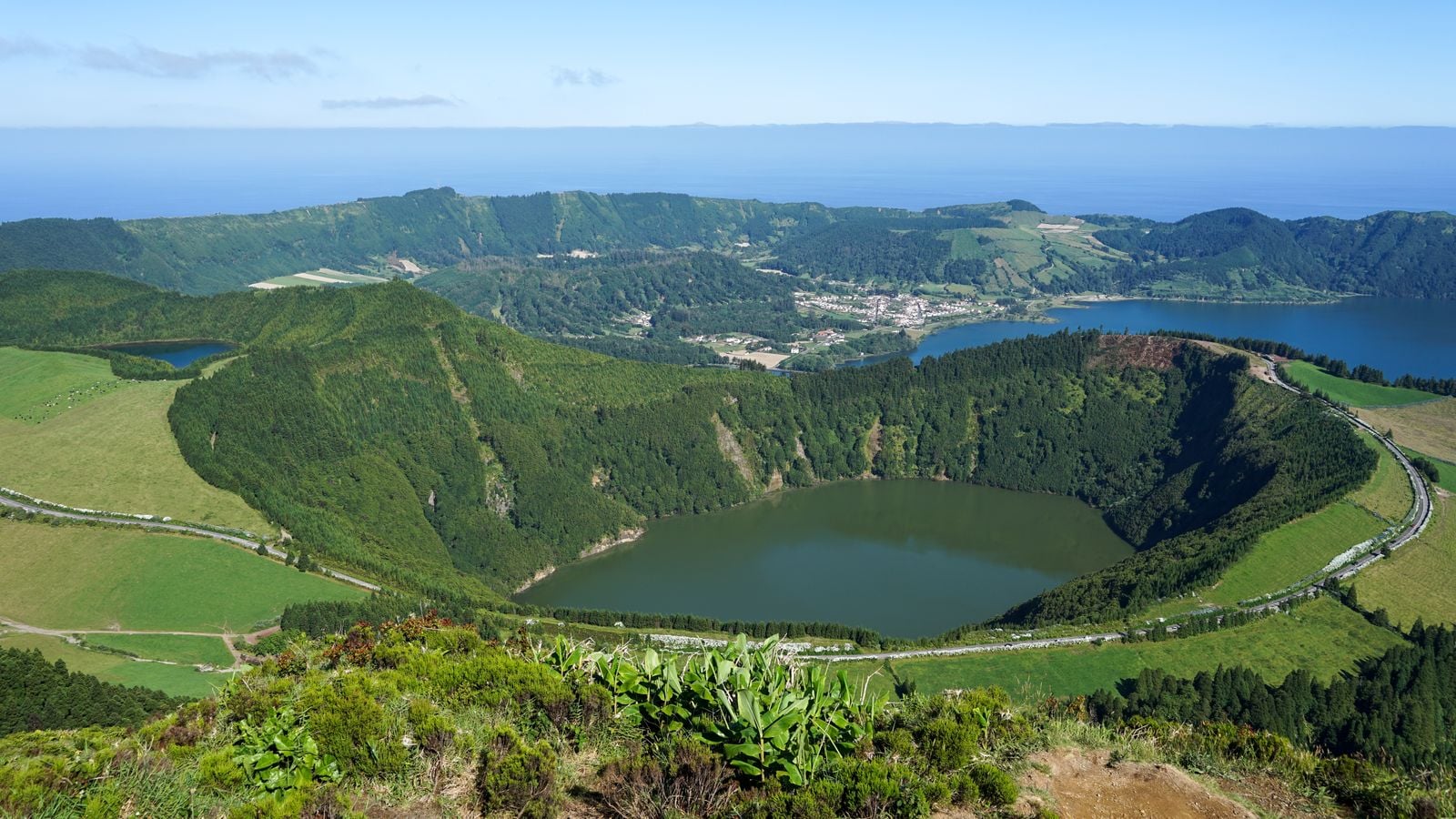
If you flew over the crater now, you would see three thin white plumes rising from rafts on a dark green lake, ringed by grassland and low forest. The plumes never stop. They are the sound of a bottle being uncapped, very slowly, for as long as anyone can foresee.
And somewhere 200 metres beneath the surface, in water that has not seen sunlight in centuries, carbon dioxide is still seeping up from the magma, still dissolving into the cold, still being pulled patiently out through a pipe before it can gather into anything the wind can carry.