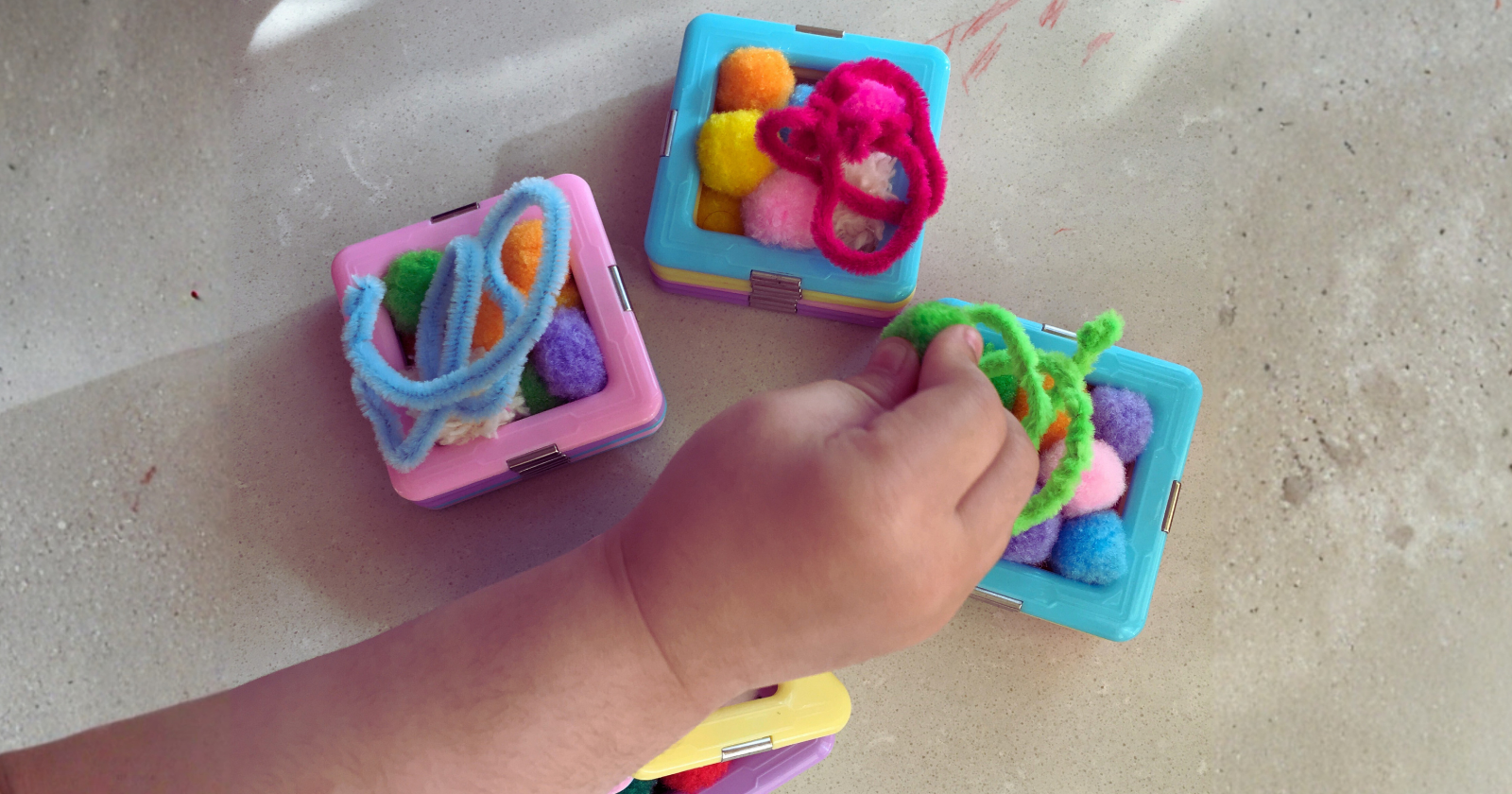
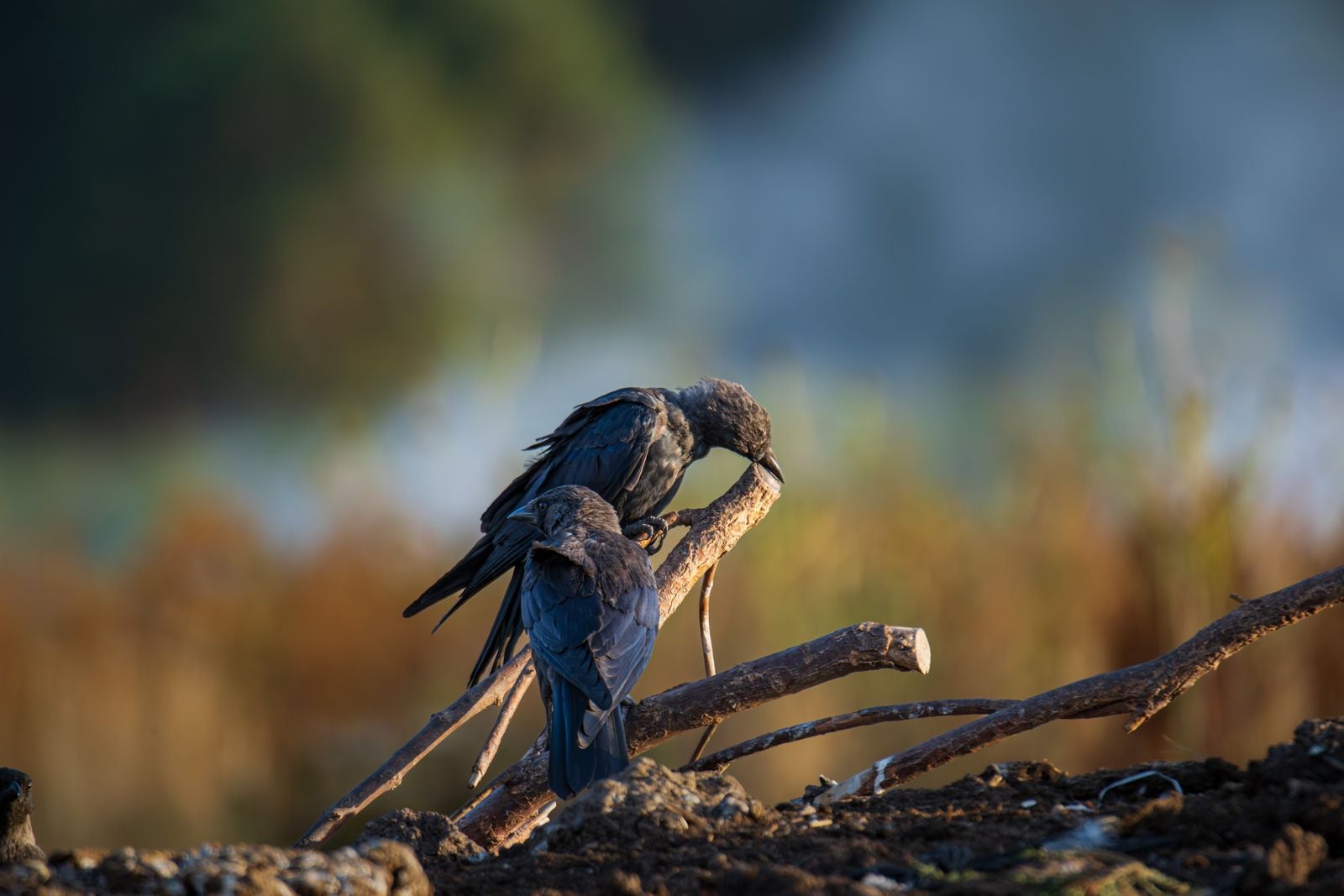
On the island of New Caledonia, a crow lands on a fallen tree, tears a strip from a spiny pandanus leaf, and produces — in a few practised movements — a hooked probe with a tapered end and a serrated edge, sized to fit the beetle grub tunnel it is about to raid. The bird has just solved a problem in materials science with a beak and a memory. A five-year-old bending a pipe cleaner into a hook to fish plastic beads out of a jam jar is running through the same short list of steps: pick a bendable strip, judge its length, make the working end narrower than the mouth of the container, hook the target, lift.
The comparison is not sentimental. It is structural.
The pandanus tool, described precisely
The tool the crow makes is specific and repeatable. Pandanus leaves are long, narrow, palm-like, and edged with tiny backward-facing barbs. The crow works along that serrated edge, cuts into one side of the leaf, moves further down, cuts again, and then rips out the strip in between. The result is a stiff, tapered probe with a row of hooks running down one flank — the barbs of the leaf, now doing the work of gaffs.
The Artful Age
A weekly letter on aging well, family across generations, and the creative life after the kids leave home.
Corina Logan, the behavioural ecologist who led the work and was then at the University of Cambridge and UC Santa Barbara’s SAGE Center for the Study of the Mind, described the sequence plainly in comments reported by Sci.News: the crow cuts into one side of the leaf, makes a second cut further down, and rips off the part in between, producing a tool it can push into a rotting log to lever out a grub.
Three shapes turn up in the wild — wide, narrow, and stepped. The stepped tool, which tapers in defined jumps from a wider handle end to a narrow working tip, is the one seen almost everywhere on the island. All three cluster at the southern end. Nobody has fully explained the geography.
Why the taper matters
A taper is not decoration. A probe that is too wide will not fit into a grub burrow. A probe that is uniformly narrow will bend under load and fail to lever the grub out. The stepped design — thick where the beak grips, thin where the hooks catch — is a solved engineering trade-off between stiffness and reach. It is the same principle behind a dental pick, a crochet hook, or the pipe cleaner a preschooler flattens at one end so it will slide between beads.
The crow does not know the word cantilever. It knows, apparently from a mix of watching and doing, that the tool has to be this shape.
How the knowledge gets passed on
For a long time the assumption was that a young crow watched an older crow cut a leaf and copied the actions. That would be imitation in the technical sense, and it would be the kind of learning that supports what researchers call cumulative culture — the ratcheting-up of technology across generations that, in humans, gets you from a hand axe to a Ferrari.
Logan and colleagues tested this directly, in a study published in Learning & Behavior in August 2015. They gave New Caledonian crows a novel non-tool foraging puzzle with multiple access points. If a crow watched a companion push its beak through a specific door and pull out a piece of boiled egg, the observer would head straight for that same door on either apparatus — but then it would ignore whatever the demonstrator had done next and work the door out by trial and error.
The technical term is stimulus enhancement. The bird’s attention is drawn to the object, not to the action. As The Wire Science summarised the result, the crows learned where to find food by watching others, but did not copy the trick that got it out.
That is very close to how a five-year-old learns to make a hook from a pipe cleaner. An adult holds up the finished object — look, a hook — drops it back in the craft box, and the child works out the bending on their own, usually badly at first, then better.

The mental template
The stranger finding came in 2018. A team led by Sarah Jelbert, by then a postdoctoral psychology researcher at the University of Cambridge, trained New Caledonian crows to drop pieces of paper of a particular size into a slot for a food reward. Then the researchers took the templates away and handed the birds a larger sheet. The crows tore it into pieces roughly the right size — either the large-reward size or the small-reward size, depending on what they had been trained on — without any model to copy in the moment.
As Inverse reported, this suggests the birds can build a tool from memory even when they have only ever seen the finished object, never its manufacture. A crow that has never watched another crow make a tool could, in principle, see a finished tool lying on a branch, form an image of it, and later reproduce something close to that shape from scratch.
That is the mechanism cumulative culture needs. You do not have to copy the action. You have to remember the object.
Handedness and the beak
The crows even have a preferred side. Gavin Hunt, of the University of Auckland, collected the leaves left behind by the manufacture of 3,700 pandanus tools at 19 sites along Grande Terre and found that the birds worked the left edge of a leaf far more often than the right — including on trees whose spiral made the right edge the easier one to reach. Science News covered the finding when it appeared in Nature in December 2001. Hunt’s team proposed that the left hemisphere runs the sequence of cuts, and that the bias might be the ornithological equivalent of human right-handedness — the first side preference of this kind demonstrated across a whole species rather than in a handful of individuals.
Preschool teachers know the equivalent from the craft table, where a hand preference shows up early and tends to hold. The parallel is loose — the crow result is a population pattern, not a tracked individual habit — but the underlying point survives it. Fine motor work settles onto a side, in feathers or in fingers.
The Aesop test
New Caledonian crows also pass a version of the ancient fable in which a thirsty bird drops stones into a pitcher to raise the water level. In aviary tests on Grande Terre, the crows dropped sinking objects rather than floating ones into a water-filled tube to bring a floating treat within reach; they preferred solid objects over hollow ones; they chose water over sand, and the tube with the higher starting water level. They failed two harder versions — one that turned on the width of the tube, and a U-shaped apparatus with a concealed connection between tubes.
Sarah Jelbert, then a doctoral student at the University of Auckland, walked National Geographic through the design. The paper itself, published in PLOS ONE in March 2014, concluded that the birds’ grasp of water displacement was sophisticated but incomplete, and rivalled that of five- to seven-year-old children.
That number — five to seven — keeps showing up. It is the age at which a child stops needing to be shown every step of a craft and starts inferring the middle from the ends.
What the child is actually rehearsing
Bend a pipe cleaner into a hook and lift a bead. It sounds like a game because it is one. But the sequence is the same one the crow is running.
Select a material with the right stiffness. Pipe cleaners work; string does not. Judge length against the depth of the jar. Shape a working end narrower than the neck. Add a curve so the target catches on the way up. Test. If the bead slips, adjust the curve. If the pipe cleaner bends under the weight, choose a stiffer one or double it.
Each of those steps is a small hypothesis. Each failure updates the model. This is what people mean when they call early childhood craft play a rehearsal for engineering thought — not because the child is being trained to be an engineer, but because the loop of make, test, adjust is the loop.
A related mechanism runs under other kitchen-table activities. Watercolour beading off wax-crayon lines is a child discovering hydrophobicity without the word for it, in the same way a crow discovers cantilever loading without the word for it.
Who learns from whom
One of the more surprising findings from Logan’s group was about the direction of learning. The assumption had been that juveniles pick up tool skills from adults, and that adults, once expert, stop paying attention. The apparatus experiments showed something looser. Adults learned from juveniles. Juveniles learned from juveniles. Adults learned from other adults. If a bird had the chance to watch another bird succeed at a puzzle, it took the information, regardless of who was demonstrating.
The constraint, in the wild, is social geometry. New Caledonian crows live in tight family groups, so the pool of demonstrators is small. It is not that the birds refuse to learn from strangers. It is that they rarely meet any.
Human households run on a similar geometry. A five-year-old at the craft table learns pipe-cleaner geometry from whoever happens to be there — a parent, a sibling, a grandparent visiting for the weekend. The demonstrator pool is whoever is in the room.
The barb, the burr, the hook
Look closely at a finished pandanus tool and the working end is not smooth. The barbs of the leaf edge — those tiny backward-pointing teeth — are what grip the grub. The crow has essentially built a barbed spear, using a plant that was already pre-armed with barbs, and oriented them the correct way for retrieval.
A pipe cleaner does the same trick with fuzz. The wire core gives stiffness; the polyester bristles catch on bead holes, on yarn, on the rim of a jar. A child who hooks a bead and lifts it out is exploiting the same principle a crow exploits with a leaf barb — a working surface that is slightly grabby in one direction and slick in the other.
Neither the child nor the crow chose the material for that reason. They chose it because it was there, and it worked.
What the taper says about time
The stepped pandanus tool, with its neat shoulder between the wider handle and the narrower tip, is the shape most consistent across the island. It is also the shape that would be hardest to arrive at by accident. Something has kept it stable across generations of birds who do not, as far as anyone can tell, sit down and teach each other how to cut a leaf.
The best current guess, drawing on Logan’s social-learning work and Jelbert’s mental-template study, is that a juvenile crow sees a finished stepped tool — dropped by a parent, wedged in a log, carried past — forms a memory of the shape, and then, over months of trial and error on its own leaves, converges on something close to that shape. The tool teaches the tool.
A jar of beads on a kitchen table does the same thing. The finished hook, left on the counter after an older sibling walks off, is a template. The younger child picks up a pipe cleaner. Nobody demonstrates. In twenty minutes there is a lopsided hook, then a better one, then a bead on the floor.
The crow’s log is older than the kitchen table by a very long margin. The sequence is the same.