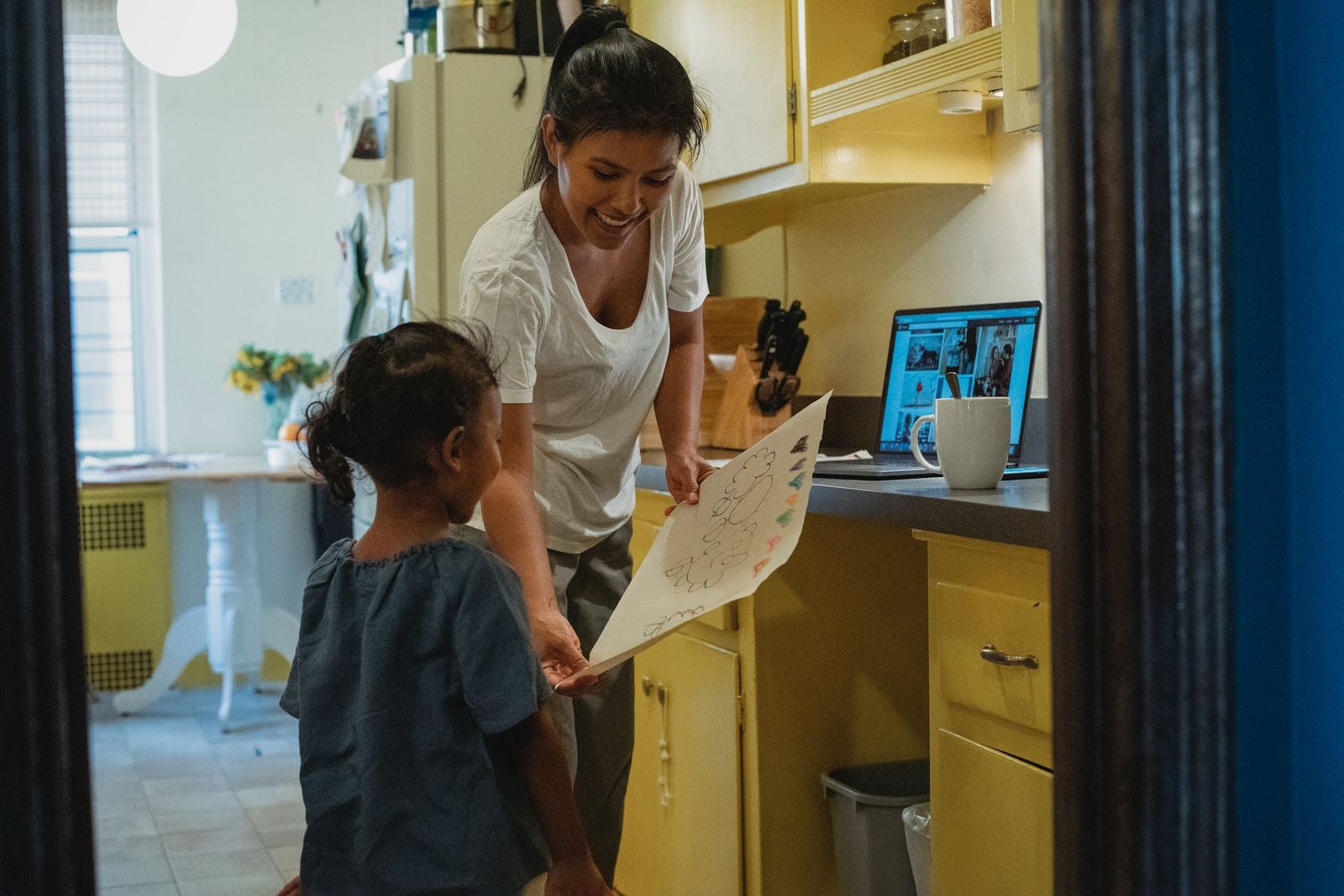
Anyone who spends time around a four-year-old knows the running commentary. Look what I made, watch me, I did this, I have a red one, at my house we, and on it goes, a near-constant broadcast from the center of their own world. It can prompt a small worry in a parent: is all this me, me, me a sign of something self-centered taking root? The reassuring answer from the research is that constantly talking about yourself is one of the most ordinary things a human being does, and in a young child it is a stage rather than a flaw.
We are writers and parents, not psychologists, and what follows is a reading of the research, not a diagnosis of anyone.
It helps to start with how normal self-talk is for all of us, adults included.
The Artful Age
A weekly letter on aging well, family across generations, and the creative life after the kids leave home.
Talking about ourselves is a near-universal pull
In a 2012 paper in the Proceedings of the National Academy of Sciences, Diana Tamir and Jason Mitchell looked at why people disclose so much about themselves. They noted that humans spend something like a third to 40 percent of everyday speech simply telling other people about their own experiences, thoughts, and feelings. That is not a quirk of a few self-absorbed individuals. It is roughly how conversation works.
Their experiments went further. People found disclosing information about themselves genuinely rewarding, and in one part of the study they were willing to give up small amounts of money for the chance to talk about themselves rather than answer questions about someone else. You can read the study for the details.
Set against that backdrop, someone who talks a lot about themselves looks less like an aberration and more like a person doing an ordinary human thing with the volume up. That reframing matters before anyone reaches for a heavier explanation.
In young children, it is a stage, not a trait
With children there is a second, developmental reason not to worry. Very young children are genuinely still building the machinery for taking someone else’s point of view.
Psychologists study this through what is called theory of mind, the understanding that other people have their own thoughts, knowledge, and beliefs that differ from your own. A large 2001 review by Henry Wellman and colleagues, published in Child Development and drawing together 178 studies, traced how this ability develops. Across many countries, preschoolers move from failing to passing tests of this understanding over roughly the same stretch of early childhood, a genuine shift in how they grasp other minds rather than a trick of the testing.
A child in the thick of that development is not being selfish when they narrate their own world back to you. They are operating from the only vantage point that is fully switched on yet, their own. Expecting a three-year-old to naturally balance the conversation, ask after your day, and read that you are tired is asking for a skill that is still under construction. It arrives, unevenly, with time.
So what does it usually mean
Put the two things together and the honest reading of constant self-talk, in a child or an adult, is usually mundane. In a young child it is developmentally expected and tends to ease as perspective-taking matures. In an adult it is most often driven by ordinary things: enthusiasm about something, nervousness that fills silence with autobiography, loneliness that has been short of a listener, or simple habit. Talking about yourself feels good, and some people have had more practice and fewer brakes than others.
What it usually does not mean is narcissism in the clinical sense. That is a specific and relatively rare personality pattern, and it is not something you can read off from the fact that someone dominated a dinner conversation. Using the word as a label for anyone talkative flattens a real condition into an insult, and applied to a child it is simply a mistake. A preschooler cannot be a narcissist; they are a preschooler.
What actually helps a child broaden out
None of this means self-focus in a child is nothing to gently shape. Perspective-taking grows partly through experience of the give and take of conversation, and parents are the first place that happens.
The useful moves are small and warm rather than corrective. Modeling the thing you want to see helps most: asking your child about their day and actually listening, then letting them see you take an interest in other people too. Naming feelings, yours and theirs and other people’s, gives them the raw material for imagining an inside world in someone else. Turn-taking games and simple prompts, like asking what a sibling might want, invite the skill without shaming its absence.
What tends not to help is telling a young child they are being selfish. It attaches a heavy word to a stage they cannot yet think their way out of, and it teaches shame rather than perspective. The child narrating their block tower is not failing at empathy. They are showing you exactly where they are, which is the most useful thing they could do.
Perspective comes later, and it comes more reliably to a child who felt genuinely listened to first. The running commentary is not a problem to be corrected so much as a stage to be accompanied, and mostly, quietly enjoyed while it lasts.