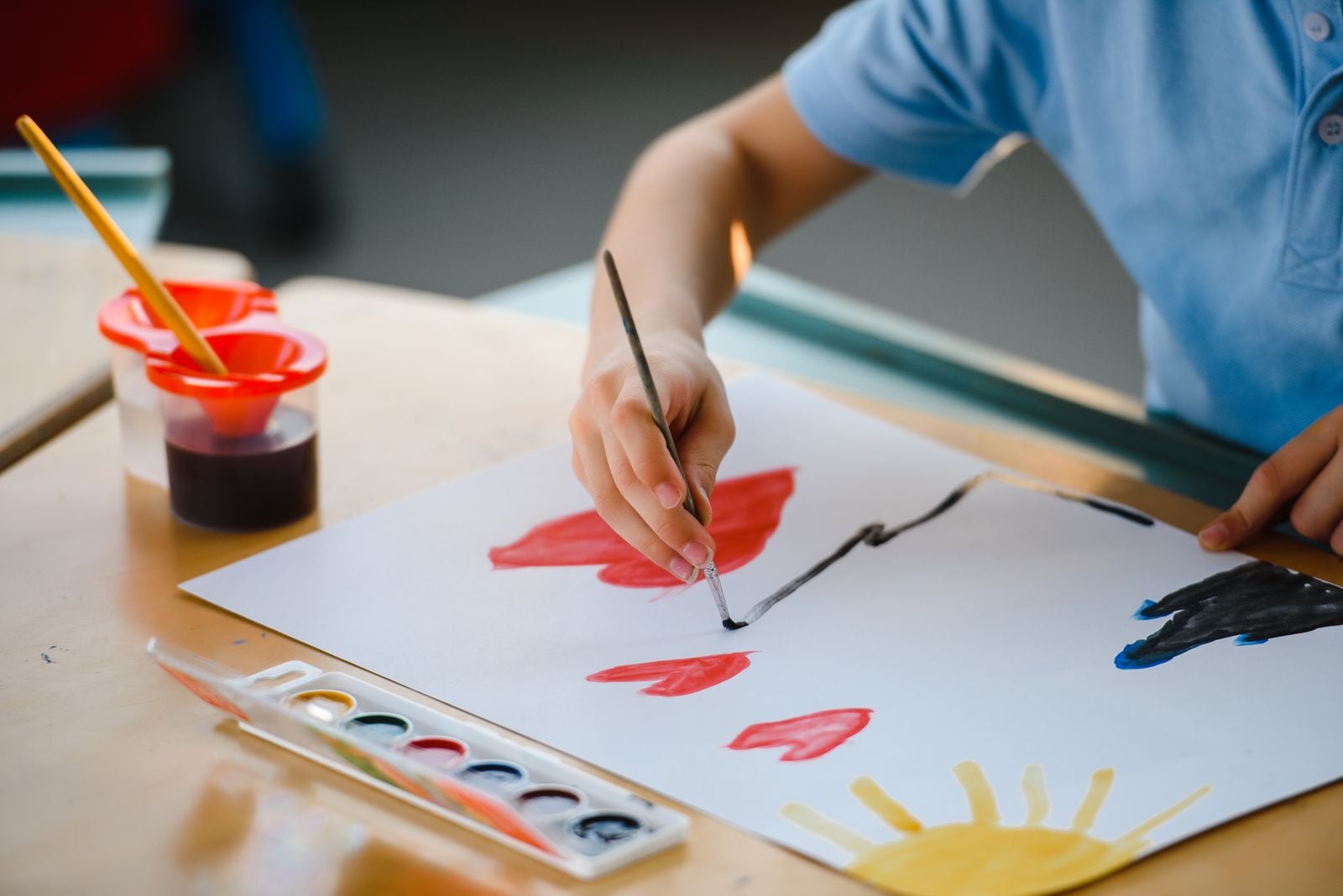
The sun is purple and floating in the wrong corner of the sky, the house is bigger than the tree it sits next to, and the person in the doorway has one leg. Your hand is already moving. You can see exactly how to make it better, and it would take ten seconds, and the child would probably not even mind. That small reach across the table, the one that fixes the picture, is one of the most ordinary moments in family life. It is also where a lot of the actual growing up happens, and most of it is yours to do.
We have set up enough art with children to know that the urge to help is not really about the drawing. It is about the discomfort of watching something come out worse than it could. Letting that discomfort sit there, unfixed, is harder than it sounds.
The reach across the table
The help usually arrives in small, well-meaning forms. Turning the paper the right way up. Drawing a light pencil line for the child to follow. Suggesting the sky should probably go at the top. Taking the scissors to make the cut cleaner. None of it feels like taking over. Each move feels like teaching.
The Artful Age
A weekly letter on aging well, family across generations, and the creative life after the kids leave home.
What the child registers, though, is subtler than the instruction. They learn that their version needed correcting. They learn that the grown-up has a picture in mind and theirs is not quite it. Do this often enough and a child stops reaching for the odd purple sun, because the safe move is to wait and find out what you wanted.
The mistake we see most often is not harshness. It is enthusiasm. A parent who cares a lot, sitting very close, quietly running the whole thing.
What the research on control keeps finding
There is a line of research that speaks to this, even though it was not about art at all. In 1989, the psychologists Wendy Grolnick and Richard Ryan published a study in the Journal of Educational Psychology looking at how parents shape children’s ability to manage themselves. They interviewed the parents of children in roughly third through sixth grade and looked at several things a parent can offer, including what they called autonomy support: encouraging a child to start things on their own and make real choices, rather than leaning on pressure and rewards.
The children of more autonomy-supportive parents tended to regulate themselves better and were rated by teachers as more competent and better adjusted at school. It is one study from one group of families, and it measured associations, not causes, so it cannot tell us that stepping back produces a well-adjusted child on its own. It fits a wider body of work on autonomy that has grown up around it, but it is a piece of the picture, not the whole thing.
Still, the shape of the finding is worth sitting with. Giving a child room to steer, in the ordinary small ways, seems to be part of how they learn to steer at all. The art table is one of the lowest-stakes places to practice that. Nobody’s grades ride on the purple sun.
Letting go is not the same as checking out
Here is where the idea gets misread. Stepping back does not mean leaving the room, handing over the paints, and scrolling on the couch while the table gets destroyed. In the same research, autonomy support sat alongside two other things children needed, structure and genuine involvement. A child still needs the paper set out, the limits made clear, the sense that you are interested and nearby.
The distinction is between being involved and being in charge of the outcome. You can sit right there, warm and attentive, and still keep your hands off the picture. You can answer “how do I make green” without taking the brush. You can say “you worked on that for ages” without saying “it’s beautiful,” which is a small verdict a child learns to fish for.
What we keep coming back to is that letting go is an active thing, not an absence. It takes more attention to hold back well than to jump in.
The grown-up part is yours
The maturity in all of this belongs mostly to the adult. A young child drawing a lopsided house is not failing at anything. They are doing exactly what four-year-olds do. The person who has to grow is the one who can see the better version and chooses, over and over, not to impose it.
That choice asks something real of a parent. It asks you to tolerate imperfection you could easily fix. It asks you to let your child be separate from you, with their own strange sense of where the sun goes. It asks you to stop treating their output as a reflection of your taste or your effort. Those are not small things to give up, and most of us give them up slowly, one purple sun at a time.
The reward is quiet and slow. A child who is not being corrected keeps going longer, tries stranger things, and starts to trust their own hand. And the parent, in the practice of sitting on their own certainty, gets a little wiser about the difference between helping a child and managing them. That difference turns out to matter well past the art table.
Next time your hand starts to move, you can just leave it in your lap and see what the child does with the wrong-colored sky. Usually they were not asking. Usually they are fine.