
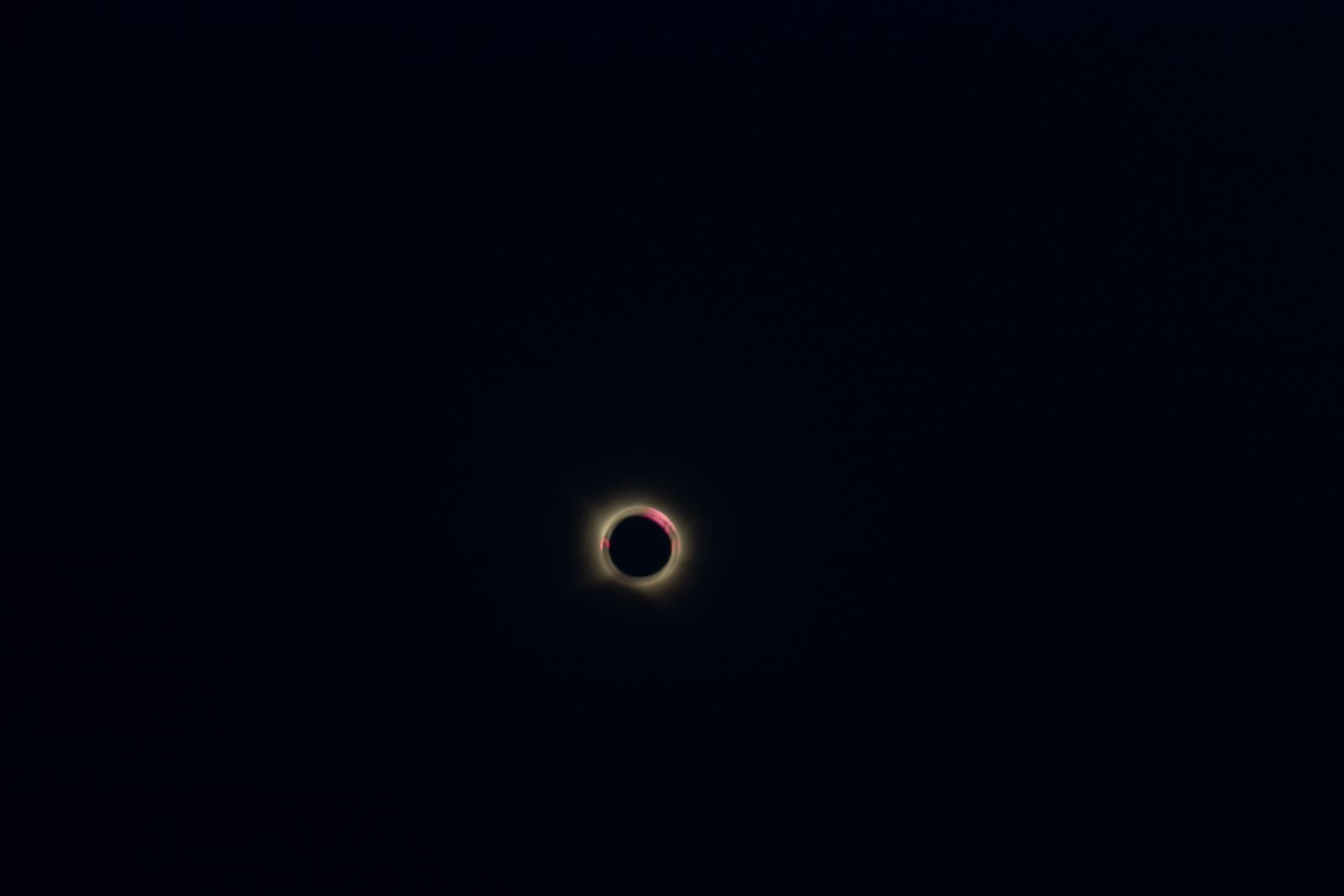
On the morning of 18 August 1868, a French astronomer named Pierre Janssen stood in the town of Guntur, on India’s southeast coast, and waited for the Moon to swallow the Sun. When the disc went black, he pointed a spectroscope at the glowing rim and saw a bright yellow line sitting where no known element belonged. He had just read a new substance out of the light of a star ninety-three million miles away. It would be another twenty-seven years before anyone held that substance in a flask on Earth.
The gas was helium. To this day it remains the only element on the periodic table discovered in space before it was found underfoot.
The instrument that turned starlight into chemistry
The trick that made 1868 possible was the spectroscope. A prism spreads white light into a band of colour; a spectroscope does the same, but finely enough to measure the exact wavelength of every line inside that band. In the mid-nineteenth century the German researchers Gustav Kirchhoff and Robert Bunsen showed that every heated element glows in its own fixed set of colours. Sodium gives a specific yellow. Hydrogen gives a specific pattern of lines, always in the same places. Burn something unknown and its spectrum tells you what it is.
The Artful Age
A weekly letter on aging well, family across generations, and the creative life after the kids leave home.
This was the discovery that flipped astronomy into chemistry. If a distant flame produces the same pattern as sodium in a lab burner, the flame contains sodium. It does not matter whether the flame is a candle in Heidelberg or a star in Orion.
By the 1860s astronomers were doing exactly that — reading the composition of the Sun and stars from nothing but their light. What they still could not do easily was study the chromosphere, the thin ring of hot gas that clings to the Sun’s surface. The disc itself is too blinding. Only during a total eclipse, when the Moon covers the disc, does that rim become visible.
Why Guntur, and why August
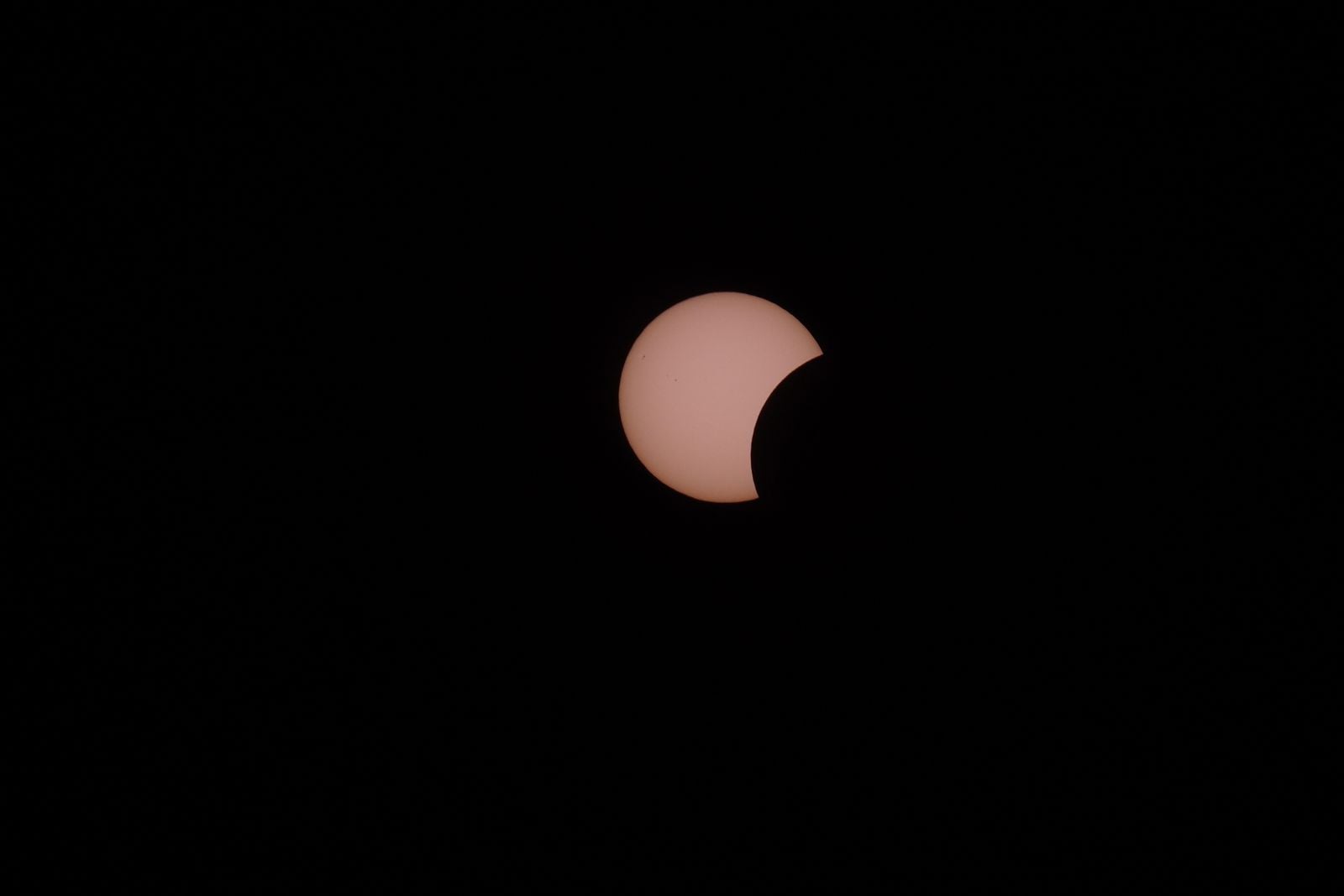
The 1868 eclipse crossed India, and the French Academy of Sciences paid handsomely to send Janssen there. He set up at Guntur, in what is now Andhra Pradesh, along a coast where the totality would last more than five minutes — an unusually long window for the observation he wanted. As Science Friday recounts, he was one of many astronomers converging on the path of totality, all of them hoping to test Kirchhoff’s theory that the chemistry of unreachable bodies could be read from their light.
Janssen was a determined eclipse chaser by temperament. He would later escape besieged Paris by hot-air balloon during the Franco-Prussian War to reach another eclipse. The Guntur expedition was the kind of long, expensive gamble that only pays off if the sky behaves. On 18 August the sky behaved.
When totality began, Janssen swung his prism onto the chromosphere and watched the spectrum bloom. Among the familiar lines a yellow one blazed through — close to the pair of sodium lines already labelled D1 and D2, but not identical to either. It was so bright that Janssen suspected, correctly, that he could catch it again on an ordinary day if he tuned his instrument carefully enough. He worked out how to do so within weeks.
Two men, one line, one envelope
Thousands of miles away in England, the astronomer Norman Lockyer had been chasing the same idea. Later that year he saw the same yellow line without needing an eclipse at all, and wrote it up. His paper and Janssen’s reached the French Academy of Sciences at nearly the same time. The Academy, faced with two independent discoveries of the same phenomenon, gave both men credit. A commemorative medal was later struck bearing both their faces.
Lockyer went further than Janssen in one respect. Working with colleagues, he argued that the yellow line belonged to an element that existed in the Sun and nowhere in any earthly mineral. He named it helium, after Helios, the Greek word for the Sun. The idea of naming an element that no chemist could produce struck most of the scientific community as a stretch.
For more than a decade helium lived in an odd limbo. Named. Placed. But never held.
Twenty-seven years in a jar of ore
The confirmation came almost by accident, in a laboratory in London in 1895. The Scottish chemist William Ramsay was hunting for argon, a gas he had recently helped identify in air. He treated a uranium-bearing mineral with acid, collected the gas that bubbled off, and ran it through a spectroscope to see what he had.
A bright yellow line stared back at him. Ramsay thought at first it might belong to argon, but the wavelength was slightly off. He sent samples to Lockyer and to other spectroscopists for a second opinion. The line first spotted in the Sun’s chromosphere over Guntur was sitting in a lump of Norwegian ore, produced slowly by the radioactive decay of uranium.
Ramsay went on to win the 1904 Nobel Prize in Chemistry for his work isolating the noble gases.
The messier version of the story
The clean version — Sun 1868, Earth 1895 — smooths over a genuinely tangled process. Nobody in 1868 announced a new element. What was recorded that August was an unexplained yellow line. The leap from an unfamiliar spectral feature to a substance the Earth has never contained was an interpretation, made gradually, resisted by careful chemists, and only settled once Ramsay produced the gas in a flask.
The 1895 date is also less final than it sounds. Years earlier, observations of the same spectral line had been reported in other contexts, but these claims were never confirmed or developed, so Ramsay still holds the credit. But the tidy phrase found on Earth in 1895 papers over a contested, drifting process rather than a single moment of discovery.
There is also a small Indian coda. The coastal town of Machilipatnam, a short distance up the same coast from Guntur, hosted parallel British and Indian observers on the same day. Multiple teams, multiple prisms, one Moon-shadow. The yellow line was seen more than once.
An element named for a Sun god, rare only on Earth
The name turned out to be a small historical irony. Helium is the second most abundant element in the universe, forged in enormous quantities in the first minutes after the Big Bang and cooked steadily inside stars ever since. It is rare only here, on the surface of one small planet, where each atom is light enough to drift up through the atmosphere and leak away into space. Earth has no way to hold on to it.
What does exist here is fossil helium — atoms produced by the decay of uranium and thorium deep in the crust, trapped over hundreds of millions of years in the same geological formations that trap natural gas. Current use has outrun that ancient supply: demand has grown substantially in recent years, and the price of helium has climbed considerably. Party balloons are the visible part. The invisible part is MRI machines, semiconductor fabrication, optical-fibre manufacturing, and the superconducting magnets inside CERN’s Large Hadron Collider, all of which need liquid helium cooled to about four degrees above absolute zero and have no easy substitute.
What Guntur made possible
The helium story is often told as a piece of trivia. It was also a turning point. It proved that the light arriving from objects nobody could ever visit carried reliable, testable information about what those objects were made of. Every claim modern astronomy makes about the chemistry of distant worlds — the iron in ancient stars, the water vapour in the atmospheres of planets orbiting other suns — rests on the principle that a spectrum can be trusted.
The same reasoning shaped the century of space missions that followed. Science Blog has written before about how Mariner 1 carried no camera in 1962, only radiometers and a plasma spectrometer, because the plan was to measure Venus rather than photograph her. That instinct — that instruments reading light and particles can tell you more than a portrait — began in earnest with a French astronomer’s prism on an Indian coast.
Eclipses still draw that same instinct out. A calendar of solar and lunar eclipses for 2026 lists a total solar eclipse crossing Iceland and northern Spain on 12 August, almost exactly 158 years after Janssen’s observation. Modern instruments will read the chromosphere in wavelengths Janssen could not have imagined — ultraviolet, X-ray, radio — but the underlying method is his.
The line that is still there
Point a decent spectroscope at the Sun on any clear afternoon and D3 is still there, sitting between the sodium lines, exactly where Janssen saw it. It has been there for the entire age of the Solar System. It was there when the first fish crawled onto land, when the last mammoth died, when the pyramids were new. On the morning of 18 August 1868, for the first time, somebody looked at it and understood that it belonged to something the Earth did not yet know it contained.
Twenty-seven years later, a chemist in London dissolved a Norwegian mineral in acid and the same yellow glow came out of the flask. The Sun had been right the whole time.