
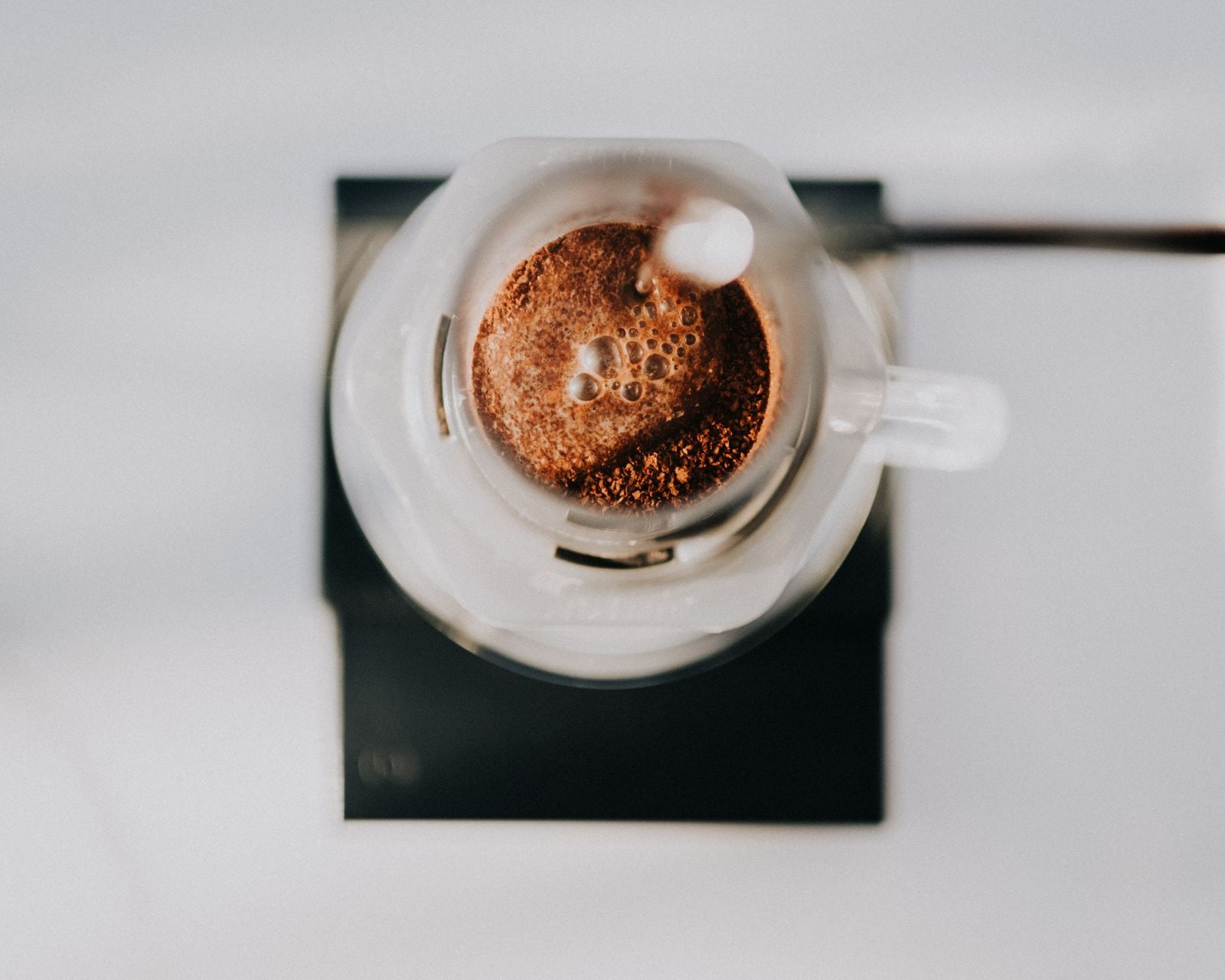
A South Korean research team has shown that wet coffee grounds can be turned into a high-calorific biochar in about 90 seconds without a separate drying step. Led by principal researcher Park Tae Jun at the Korea Institute of Geoscience and Mineral Resources, the team used flame plasma at roughly 800–900°C; after 90 seconds, the treated grounds showed solid-fuel properties similar to typical anthracite and a calorific value about 33 percent higher than the untreated material.
The potential waste stream is large. One report on the research cites at least 18 million tonnes of spent coffee grounds each year. Much of that material is wet when discarded, which is exactly what makes conventional thermal processing awkward: before the useful carbon can be concentrated, a large amount of water normally has to be dealt with.
Why wet coffee grounds are such an awkward fuel
The Korean experiments started with spent grounds containing roughly 55 percent moisture. That matters because heating wet biomass usually means spending energy on evaporation before the material reaches the temperatures needed for carbonisation or pyrolysis.
The Artful Age
A weekly letter on aging well, family across generations, and the creative life after the kids leave home.
Other coffee-waste processes solve different problems and use different chemistry. A University of Sharjah patent filed on March 13, 2025, for example, describes combining spent coffee grounds with PET and potassium hydroxide to make activated carbon for CO₂ capture, with co-pyrolysis below 500°C and activation below 700°C. That is a useful route, but it is not the same job as rapidly converting wet grounds into solid fuel.
What the flame plasma actually does to a coffee particle
The crucial correction is that this system is not a conventional electric-arc plasma torch running an argon or nitrogen jet at several thousand degrees. In the reported KIGAM setup, LPG and compressed air are burned to generate an atmospheric flame plasma in the 800–900°C range.
That heat reaches the wet particles quickly enough for moisture inside them to flash into vapour. The sudden pressure increase produces what the researchers call a “popcorn effect,” opening the structure of the particles while carbonisation is taking place. Instead of removing the water beforehand, the process uses its rapid evaporation as part of the treatment.
Under the reported optimum conditions, conversion took 90 seconds and the material lost 83.3 percent of its mass. The result was a porous, carbon-rich biochar rather than a wet organic residue.
How anthracite-grade fuel compares to what you already know
The researchers’ comparison with anthracite is based on fuel performance, not on the coffee-derived material literally becoming geological coal. In testing, its calorific value increased by about one-third from the untreated grounds and reached the range the team compared with anthracite.
That is an unusually high energy density for a fuel made from wet food waste. It is also important not to jump ahead of the evidence: demonstrating anthracite-like heating performance in a laboratory does not by itself show that the biochar can be dropped into every boiler, kiln or power plant that currently burns anthracite.
Why coffee, of all things, keeps ending up in the lab
Spent coffee grounds contain more than just cellulose and lignin. Research from the Universitat Rovira i Virgili, summarized by Bioenergy Insight, found that the waste contains roughly 15 percent lipids and tested ways of recovering that oil as a possible biodiesel feedstock.
The URV team found that extraction at 45°C for 60 minutes, using 35 millilitres of hexane per gram of dry residue, recovered about 90 percent of the oil yield produced by conventional Soxhlet extraction. The resulting extract also contained substantially fewer impurities, while the remaining lignocellulosic material was deliberately kept available for further processing.
Other researchers are pursuing biological routes. A 2026 study in Frontiers in Energy Research used un-pretreated spent coffee grounds in a process involving Clostridium thermocellum and generated biohydrogen in a co-substrate system.
A separate 2024 paper in Scientific Reports tested adding spent coffee grounds to existing anaerobic food-waste digestion. Methane production increased across the tested low co-feeding ratios without destabilising the process, but the benefit did not keep increasing indefinitely; at a much higher coffee-to-food-waste ratio, the process failed without trace-element supplementation.
Where the 18-million-tonne figure comes from
The 18-million-tonne number should be treated as a published estimate rather than a direct global count. The 2026 Frontiers in Energy Research paper describes global spent-coffee-ground production in 2021 as an estimated 18 million wet tonnes and says the majority was disposed of in landfills rather than recovered for useful applications.
The word “wet” matters. Coffee production figures generally describe beans before brewing, while spent-ground estimates may describe material after brewing water has been absorbed. That is why a wet-waste estimate can be substantially larger than the mass of dry coffee entering the system without the figures necessarily contradicting each other.
What plasma changes about the economics
The obvious process advantage is the missing pre-drying stage. In the KIGAM experiment, moisture-heavy grounds went directly into the flame-plasma treatment, so the system did not need a separate dryer or oil-removal step before carbonisation began.
That does not yet establish the commercial cost or carbon footprint of producing the fuel at scale. The reported system consumes LPG and compressed air, and any industrial assessment would also have to account for reactor throughput, fuel consumption, emissions, equipment costs, product handling and the value of avoiding disposal. The laboratory result shows that the conversion can happen extraordinarily quickly; it does not yet answer every question about a commercial plant.
The wider hunt for a use for the coffee that gets left behind
Fuel is only one possible destination. RMIT University researchers heated spent grounds without oxygen at about 350°C to make biochar for concrete, and later reporting from the university noted that replacing 15 percent of the sand with the coffee-derived material increased 28-day strength by about 30 percent in earlier laboratory trials.
Taken together, the experiments show why coffee waste attracts so much attention. The same spent material contains oils that can be extracted, carbohydrates that microorganisms can work on, and a carbon-rich skeleton that can be converted into biochar for fuel, adsorption or construction materials.
What happens when the flame goes out
What comes out of the Korean reactor is a porous biochar with substantially more concentrated fuel value than the wet material that went in. The important result is not that coffee grounds have suddenly become a proven drop-in replacement for coal everywhere, but that researchers were able to skip one of wet biomass processing’s most stubborn stages and complete the conversion in a minute and a half.
The next questions are industrial ones: how efficiently the process scales, how much LPG it consumes per tonne, how consistently the resulting biochar performs and where that material makes the most sense to use. For now, the striking part is simpler. In this experiment, the water inside a soggy pile of coffee grounds was not merely something to remove. Under an 800–900°C flame plasma, it became part of the mechanism that transformed the waste.