

Astronauts returning from six-month stays aboard the International Space Station step off the recovery capsule measurably taller than when they left, sometimes by as much as three percent of their height — up to two inches on a six-foot frame. The stretch is real and it can be measured with a tape. The popular explanation is that the twenty-three cartilage cushions between the vertebrae, the intervertebral discs, quietly rehydrate and expand once the crushing daily load of Earth’s gravity is switched off — though, as the sections below explain, the best direct evidence from astronauts’ actual spines complicates that tidy story.
Then the person hugs a child, or lies down on a firm bed, or simply stands under 9.8 metres per second squared for a few days, and the spine packs itself back down.
The spine is a stack of sponges
The human spinal column is not a solid rod. It is 33 vertebrae separated by discs made of a tough outer ring, the annulus fibrosus, wrapped around a soft, gel-like core called the nucleus pulposus. That core is roughly 80 percent water in a young adult. Under gravity, standing and sitting all day, those discs are compressed like wet sponges under a hand.
The Artful Age
A weekly letter on aging well, family across generations, and the creative life after the kids leave home.
You already know this from Earth. You are noticeably taller in the morning than at bedtime — usually by about half an inch. Sleep flat for eight hours and the discs drink water back in. Stand up, and by evening they have squeezed some of it out again.
Now remove gravity entirely for six months.
What the flight surgeons actually measure
NASA and its partner agencies have tracked astronaut height for decades. The change is not a rumour and it is not small. Crew members typically gain around three percent of their standing height in microgravity. For a 5’11” astronaut, that is about two inches. The gain shows up within the first week in orbit and holds steady until re-entry.
Flight surgeons care about this for a practical reason: spacesuits and Soyuz seat liners are fitted on the ground. A crew member who arrives at the launch pad one height and returns another has to be accommodated in hardware that assumes a fixed body. The Russian Soyuz descent capsule seats are custom-moulded for each cosmonaut before flight for exactly this reason.
Why the spine expands — and why the muscles don’t like it
On the ground, the load on a lumbar disc when you stand is roughly your upper body weight plus muscle tension pulling the vertebrae together. A 2023 numerical modelling study on lumbar spine mechanics in microgravity predicted that the axial load on the discs drops sharply once gravity is removed, which in theory lets the nucleus pulposus take on more water and swell.
The actual imaging evidence is messier than that prediction. In 2016, a NASA-funded team led by Dr. Douglas Chang at UC San Diego scanned six astronauts’ spines before and after four-to-seven-month ISS missions. Sci.News’s report on that NASA study notes that the scans showed no consistent change in the height of the discs themselves — a result that ran counter to the standard disc-swelling explanation. Something is stretching the spine by up to two inches; on direct MRI, the discs do not appear to be doing most of that work.
The leading alternative is the spine’s natural curve. The lumbar spine normally holds a gentle S-shaped curve that resists gravity, and researchers at Johns Hopkins who have studied astronaut back pain (more on their work below) have found that astronauts tend to lose some of that curve on long missions — a straighter spine is, by definition, a slightly longer one. Most researchers now treat disc swelling and curvature-straightening as two contributing candidates rather than a single settled cause.
The muscles supporting the spine have a harder time, and here the evidence is not in dispute. The same NASA study found that the paraspinal muscles — the deep stabilisers running alongside the vertebrae — shrink measurably during long missions and do not fully recover even weeks after return to Earth. Whatever combination of mechanisms is stretching the column, the muscles built to control it are weaker by the time it happens. This mismatch is a large part of why coming home hurts.
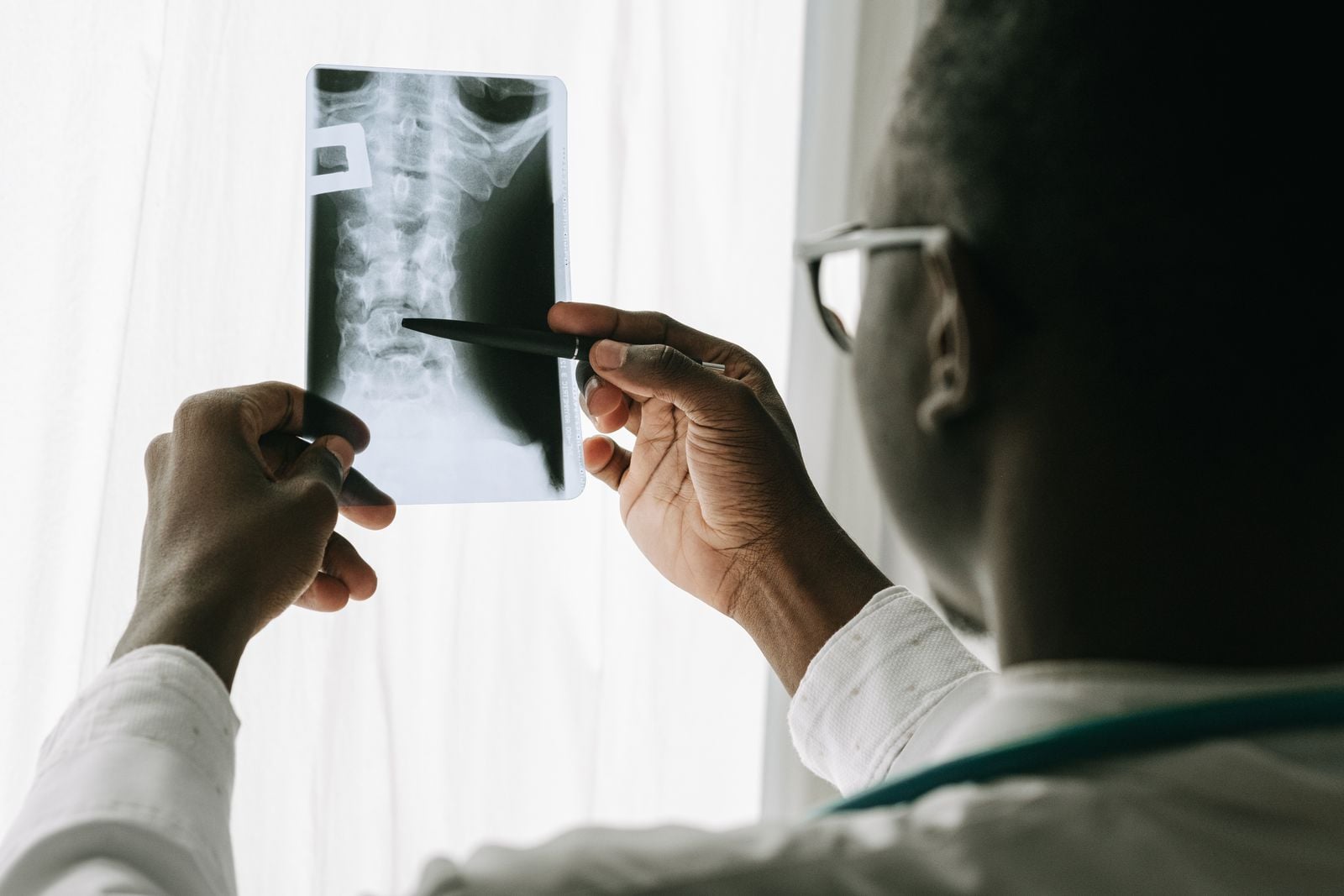
The back pain that follows the stretch
More than half of astronauts report back pain during and after spaceflight, according to Discover Magazine’s reporting on the topic. The lower back takes the brunt. Some of that pain shows up in orbit, as the stretching spine tugs on nerve roots and ligaments that evolved to be compressed. More of it shows up on the ground, when a taller, less-supported spine suddenly has to hold up a body again.
The risk that flight surgeons watch most carefully is herniated disc — a rupture of the annulus fibrosus that lets the softened core bulge out. Some research suggests astronauts may be at elevated risk of disc herniation in the year after return, and the mechanism appears to be exactly what you would guess: a spine that spent six months unloaded, dropped back into gravity, with the muscles around it too weak to share the load.
Johns Hopkins researchers have been studying prevention protocols. A Johns Hopkins News-Letter piece on preventing back pain in space travellers describes the interest in exercise regimens that specifically load the paraspinal muscles in orbit, since standard resistive-exercise machines aboard the ISS do a reasonable job on legs and arms but a poor job on the deep spinal stabilisers.
Why the change reverses so quickly
Coming home is fast. Within hours of landing, gravity starts pulling the elongated spine back down — compressing any swollen disc tissue and pulling a straightened curve back into its familiar S-shape. Within days, most of the elongation is gone. Within a week or two, most astronauts are back to their pre-flight height on paper — though the muscle atrophy takes far longer to reverse.
The mechanism is simply gravity doing its usual work. Every step, every seated meal, every night’s sleep on an Earth-normal mattress presses the spine back toward its compressed, curved baseline. Nothing here is damaged by the stretch — the spine is just returning to its loaded equilibrium.
This is why the child-sized hug matters as an image. A grandchild launching at a returning astronaut’s midsection is not undoing months of physiology in one squeeze, but it is the kind of everyday compression — arms around a torso, weight pressed against a chest — that begins the reversal. Standing under Earth gravity is the treatment. Being held is part of standing.
What it feels like from the inside
Astronauts describe the height change as strange rather than dramatic. Clothes fit differently. Reach is off by an inch or two — enough to bump the head on hatches that were fine on the way up. Some report a sensation of stretching along the lower back in the first days in orbit, which typically fades as the body settles.
Anaesthesia is a more serious consideration. A Frontiers in Physiology paper on physiologic changes in microgravity notes that spinal anaesthesia in a microgravity-adapted body would behave unpredictably, because the cerebrospinal fluid distribution and spinal geometry have both shifted. Any surgery on a recently-returned astronaut has to account for a body that is, mechanically, not quite the one it was six months ago.
The soccer ball, the sensors, and the same principle
NASA has been using microgravity for years to isolate physical effects that gravity normally hides. This summer, Expedition 74 astronauts on the ISS ran experiments on an official 2026 FIFA World Cup match ball, watching how the embedded sensors — which add subtle mass asymmetries to the sphere — affect rotation and stability without gravity to mask the wobble. As USA Today reported on the soccer ball experiments, in microgravity, ball behavior can be observed in ways that are impossible to observe on Earth.
The same logic applies to the spine. On Earth, spinal mechanics are locked in a constant compression cycle you cannot turn off. In orbit, you can. The astronaut is the experiment. The two extra inches are the readout.
A parallel Yahoo News account of the Kibo module footage notes that the same reasoning drove earlier Adidas ball studies in 2019 — mass distribution effects that are invisible under 1G become obvious at zero.
Why the number is roughly three percent, not more
Whatever combination of disc swelling and spinal straightening is doing the work, the body cannot elongate indefinitely. If the discs are part of the story, the annulus fibrosus — the outer ring — is tough, fibrous, and has a hard mechanical limit; once the nucleus pulposus is fully hydrated and the vertebrae are separated to the annulus’s slack length, further disc expansion stops. Ligaments running the length of the spine cap the overall stretch regardless of which mechanism predominates.
Three percent is roughly the ceiling. Some crew members report slightly more, some slightly less, depending on baseline disc hydration and age. Disc hydration naturally decreases with age, which may influence how much height individual astronauts gain in microgravity. The same physics that makes a 70-year-old shorter than they were at 30 also makes a 55-year-old astronaut a less dramatic case than a 35-year-old one.
The children in the arrivals hall
The most public version of the height change is the family reunion after landing. Astronaut children, especially young ones, sometimes notice that a parent seems taller in the first hours home. Photographs from Soyuz and Crew Dragon recovery sometimes catch this before flight surgeons have finished the initial measurements.
The reunion itself is part of the reversal. The physical pressure of a hug, a lifted child, a hand pressed on a shoulder — small compressions that begin nudging the spine back toward its Earth geometry. By the time the returning crew member sits down to their first proper meal at a table, the spine is already beginning to settle back down. By the time they sleep in their own bed, most of the stretch is unwinding.
Everyone who has ever measured a child against a doorframe knows some version of this: bodies change shape faster than we expect. The preschooler who seems to have grown overnight is doing something not entirely unlike what the astronaut is doing on the way home — bodies adjust in the direction of the load they’re under.
The stretch as a preview of Mars
Six months on the ISS is roughly the transit time to Mars under current propulsion assumptions. This is not an accident. Much of the ISS’s medical research programme exists to work out what six-plus months in microgravity does to a human body before crews attempt trips where they cannot come home in a hurry.
A Mars-bound astronaut would arrive at the planet two inches taller, with paraspinal muscles measurably weaker, and with a spine that has not felt real load in half a year. Then they would step out into Martian gravity — about 38 percent of Earth’s — and have to walk, work, and possibly fall on a spine that is out of practice. Flight surgeons are working on the exercise and re-loading protocols now, on ISS crews, so that the first person to stand on Mars is not the first person to herniate a disc there.
Back on the ground, the returned astronaut sits down to dinner, hugs a child, sleeps eight hours, wakes up a fraction shorter, and by the end of the first week is measurably back to the height on the pre-flight medical chart. The two inches were never really gained. They were only ever borrowed from the gravity that had been holding them down.