
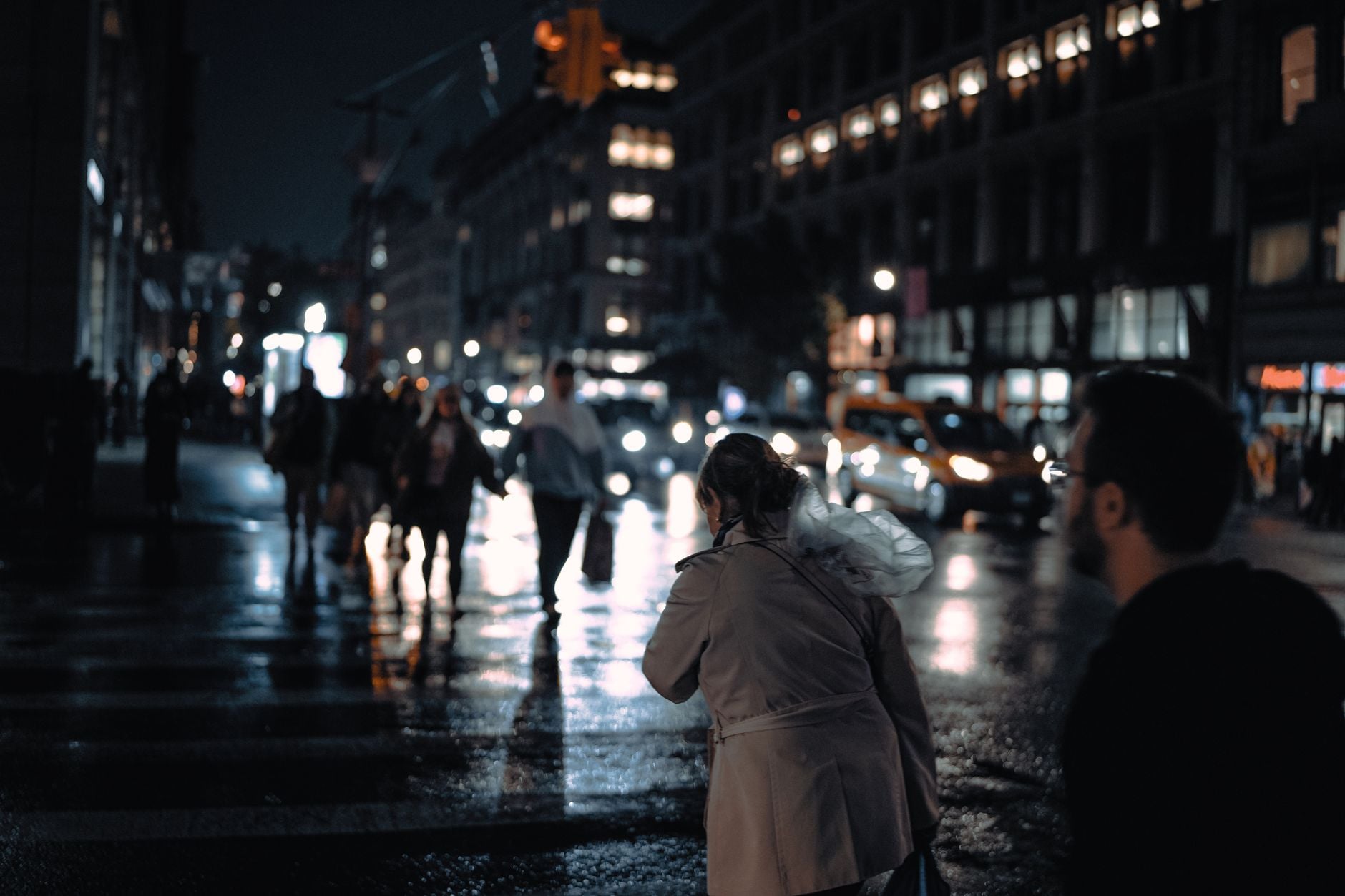
Most people carry a small collection of these moments. A stranger who turned around on a train platform. Someone who put a hand out between two men about to start swinging. A person who crouched beside someone on the pavement and stayed until help arrived.
The moments that remind us to stay kind are usually not our own good deeds. They are the times somebody else moved first.
Psychology has spent half a century explaining why those moments should be rare. The bystander effect, taught in almost every introductory course, says a person is less likely to help when others are present, because responsibility gets divided among everyone standing there. The popular version drops the careful wording and becomes a flat claim about strangers in cities: in a crowd, nobody helps.
The Artful Age
A weekly letter on aging well, family across generations, and the creative life after the kids leave home.
That version answers a question nobody in trouble is actually asking. A victim is not wondering whether each individual’s willingness has been diluted.
They are wondering whether anyone will come.
What 219 recordings of real conflicts showed
In 2020, a team led by Richard Philpot at Lancaster University published the largest attempt so far to answer that question using recordings of real events rather than staged ones. The paper, “Would I be Helped? Cross-National CCTV Footage Shows That Intervention Is the Norm in Public Conflicts”, appeared in American Psychologist. Across 219 surveillance clips of genuine public conflicts, at least one bystander did something to help in 90.9 percent of them. The average number of people who intervened was 3.76 per incident.
This is one study, and much of what follows is about its limits. It is also a study of things that actually happened, which is rare here, because staging a violent emergency in a laboratory is neither ethical nor practical.
The footage came from actively monitored municipal cameras in the inner-city areas of Amsterdam in the Netherlands, Cape Town in South Africa, and Lancaster in the United Kingdom, covering streets lined with shops and drinking venues, parks, plazas, pedestrian walkways, and the outsides of transport stations.
One decision in the method matters more than it looks. The camera operators, working to identical written guidelines across all three cities, were told to record every incident of public-space aggression they noticed, from the mildest animated disagreement up to serious violence. Earlier video work had relied on police-reported incidents, which pulls a sample toward the worst events and away from the ordinary ones.
The raw collection came to 1,225 clips. The team excluded anything outside an inner-city setting, anything that was not a conflict between at least two people, anything where police or paramedics were already present at the outset, duplicates, and footage too poor to code. What remained was 219 clips: 63 from the Netherlands, 61 from South Africa, and 95 from the United Kingdom. Four trained research assistants coded them against a written codebook, and a randomly chosen 11 percent was coded twice to test agreement, which reached Krippendorff’s alpha values of .85 and .87.
What counted as helping
This is worth seeing before deciding what 90.9 percent means. Intervention was a list of observable acts: pacifying gestures, calming touches, blocking contact between the two parties, holding or pushing or pulling an aggressor away, consoling someone who had been attacked, and giving practical help to a person who had been hurt.
An open hand raised toward an angry stranger counts. So does crouching next to someone on the ground. The authors name this themselves as the first reason their figure might be too high, and set against it a limitation running the other way: the footage has no sound. Nobody could code the person who said “leave it” or “I’m calling the police.” Aggressive interventions, which sometimes end a fight, were not counted either.
The mean of 3.76 helpers also needs its spread. The standard deviation was 3.01, and the average includes the roughly one incident in ten where nobody intervened at all.
It describes a distribution, not any particular street.
Earlier methods produced wildly different numbers, and the same paper lists them: 10.8 percent from assault case files in a 1983 study, 73.8 percent from a later analysis of police-reported assaults, and between 26.2 and 39.5 percent from live observation inside bars. Philpot and colleagues argue that case files and in-person observation both under-capture what bystanders do during chaotic events. Those figures are given here as that paper describes them, not read in the originals.
The finding that reverses the popular reading
An average of 16.29 people were present at these conflicts, which lasted an average of 3.27 minutes. The more bystanders were present, the more likely it was that someone stepped in. Each additional person was associated with roughly a 1.1-fold increase in the odds that the victim received help, with a confidence interval running from 1.03 to 1.18.
That sounds like a refutation of the bystander effect. It is not, and the authors say so. Their study looked at the scene rather than the individual, and never compared how one person behaves alone against how the same person behaves in a group, which is precisely what the classic experiments measured. In their words, the research “does not evaluate whether bystanders are less likely to provide help when in the presence of other bystanders compared with when they are alone.”
Both findings can hold at once, and the arithmetic is not difficult. Each individual in a crowd may be less inclined to act, while the crowd contains more people from whom a helper might emerge. The paper calls this the difference between responsibility diffusion and mechanical helping potential. The folk version took a result about individuals and quietly converted it into a prediction about scenes.
Three cities that should have differed
Cape Town, Amsterdam, and Lancaster differ enormously in how safe people feel in public, and the researchers expected that to register in one direction or the other: more caution where risk is higher, or more urgency where need looks greater. Comparing the Netherlands and the United Kingdom against South Africa, no difference in the likelihood of intervention could be detected, and a Bayesian comparison of models with and without national context favored no association. With 219 clips and wide confidence intervals, this is better read as an absence of detectable difference than as a demonstration of sameness.
The authors offer an interpretation, and label it as one: that the overall rate is not set by how dangerous a place feels, and that any sign of danger appears to work as a signal that something ought to be done.
The person who does not move
There is a second person in most of these moments, and the folklore treats them harshly. A separate line of research is more generous. In a 2018 review in Current Directions in Psychological Science, “From Empathy to Apathy: The Bystander Effect Revisited”, Ruud Hortensius and Beatrice de Gelder argue that the traditional explanations, which are all built around reasoning and judgment, leave out what the body does first.
Their account, offered as a proposal rather than a settled result, describes two opposing systems. The immediate response to witnessing an emergency is self-oriented distress and a fight-freeze-flight reaction, under which avoidance and freezing dominate and helping does not occur. A slower, other-oriented feeling of sympathy then activates a second system that counteracts the first, and whether anyone moves is the net result. In their own experiments, only the disposition toward personal distress predicted the negative effect of other bystanders being present, and it did so through reflexive rather than deliberate preparation. Their closing line is that people do not actively choose apathy but are reflexively behaving as bystanders.
That review rests substantially on the authors’ own small neuroimaging and virtual-reality studies, and they are careful about what it replaces. Cognitive, situational, and dispositional explanations, they write, are not mutually exclusive.
What these studies cannot tell you
The CCTV sampling leaned toward inner-city districts dense with bars and clubs, so alcohol was plausibly a factor for some of the people on camera. The areas surrounding central Cape Town, where public crime is considerably higher, were not sampled, and there is nothing here about music events, sporting crowds, or campus settings. The design is observational, so it describes what happened rather than establishing what caused it, and the authors’ own summary is that the work trades counterfactual rigor for external validity.
What survives is still worth holding onto. In 219 recorded conflicts across three countries, in nine cases out of ten somebody did something, and usually several people did. The replication data, statistical scripts, and full coding codebook are posted openly, which is how a finding this counterintuitive ought to arrive.
Taken together, the two lines of research suggest a correction to how these moments get filed away. The person who steps forward is not the exception the textbook version implies. And a person who once stood still while somebody else moved was, on the second account, running a reflex that started before any decision was available to them.
Philpot and colleagues think the field has been asking the wrong question, and propose a replacement: not why don’t individuals help, but what makes an intervention work.