
Nearly 2,900 kilometres beneath Earth’s surface, the rocky mantle gives way to a vast ocean of electrically conducting liquid metal. No instrument has ever sampled that outer core directly, so almost everything known about its chemistry comes from seismic waves, magnetic measurements, calculations and experiments that recreate a few moments of extreme pressure and temperature in the laboratory.
One of the more striking ideas to emerge from those experiments is that silicon and oxygen dissolved in iron may not stay dissolved forever. In a 2017 Nature study, researchers melted iron-silicon-oxygen alloy at pressures comparable with Earth’s core and found that silicon dioxide, SiO₂, could crystallize as the alloy cooled.
That does not mean scientists have watched silica crystals drifting through the real outer core. It means laboratory results established a physically plausible mechanism, and models built from those results explored what that mechanism could do to the core over geological time.
The Artful Age
A weekly letter on aging well, family across generations, and the creative life after the kids leave home.
The density problem at the centre of Earth
Earth’s core is overwhelmingly iron-rich, but pure iron does not quite fit the measurements. A long-standing estimate put the outer core at roughly ten percent less dense than pure iron under comparable conditions, while more recent work has placed the shortfall closer to eight percent. C&EN’s overview of core chemistry traces that problem back to the work of geophysicist Francis Birch in the 1950s.
The missing density is one reason researchers have spent decades testing light elements such as silicon, oxygen, sulphur, carbon and hydrogen. Different mixtures affect not only density but also melting behaviour, heat transport and the convection that helps maintain Earth’s magnetic field.
The problem is that nobody can drill anywhere close to the core. The Kola Superdeep Borehole in Russia reached a little more than 12 kilometres, while the core-mantle boundary begins nearly 2,900 kilometres down. The rest has to be reconstructed indirectly.
What the diamond-anvil experiment actually showed
Diamond-anvil cells make a tiny piece of Earth’s deep interior possible on a laboratory bench. A microscopic sample is squeezed between diamond tips while lasers heat it to thousands of kelvin, allowing researchers to study matter at pressures otherwise found only deep inside planets.
Kei Hirose and colleagues used that approach on liquid Fe-Si-O alloy. Their experiments reached core pressures and revealed a broad range of compositions in which SiO₂ crystallized from the metallic liquid. The researchers then modeled what would happen as an initially hotter Fe-Si-O core cooled through time.
The important distinction is between what was observed and what was inferred. The crystals formed in the experimental samples. Their long-term behaviour inside Earth, their abundance and their contribution to core convection depend on models of the core’s composition and thermal history.
Why calling it quartz snow needs care
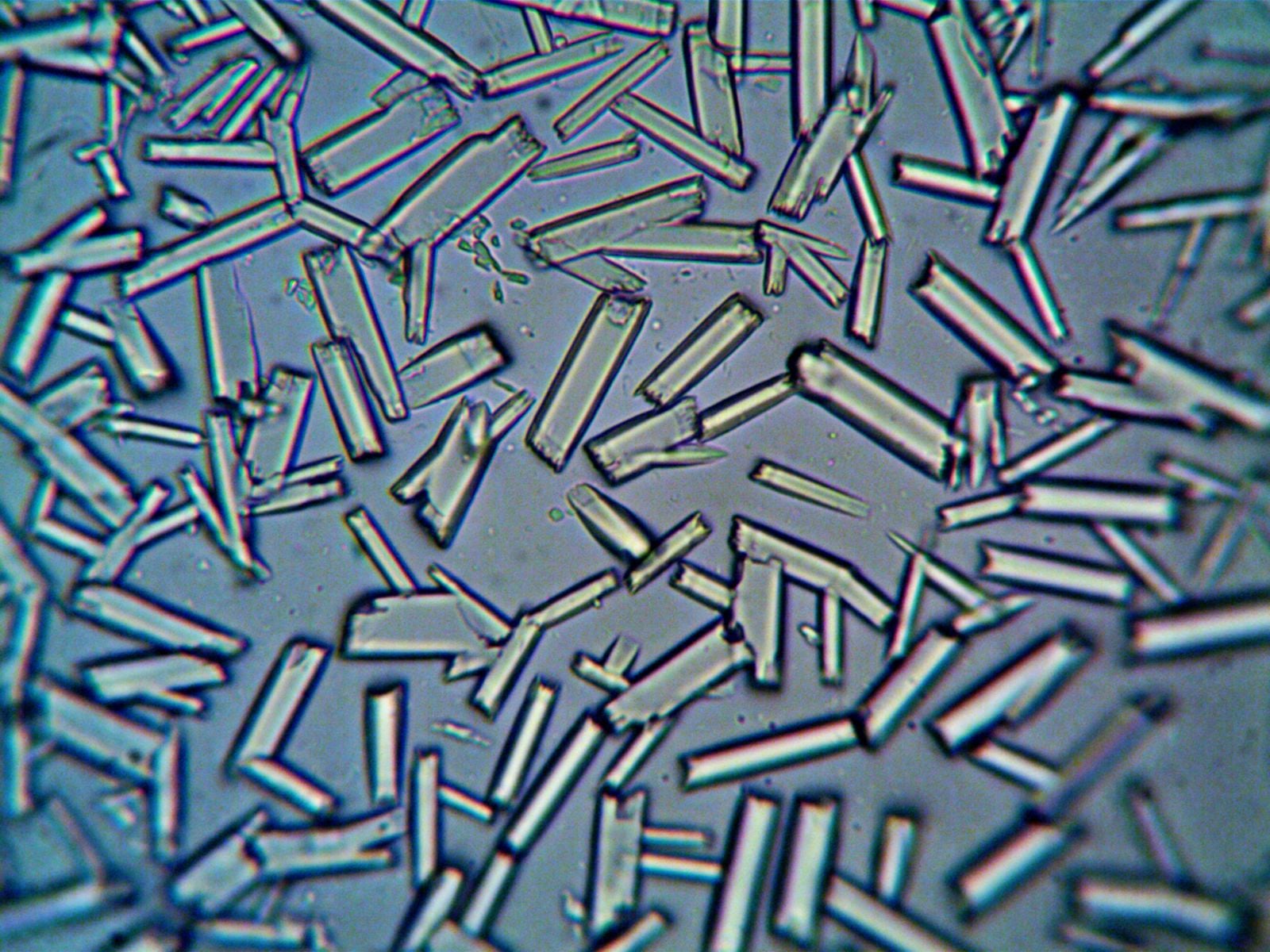
SiO₂ is the chemical formula of ordinary quartz, which makes “quartz snow” an appealing shorthand. But silica does not keep the familiar quartz crystal structure when subjected to the pressures of Earth’s deep interior.
A 2026 Geophysical Research Letters study of high-pressure SiO₂, for example, examined stishovite, post-stishovite and seifertite across pressures extending to 160 gigapascals. Those are very different crystal arrangements from the quartz found in a countertop or beach sand.
So the useful part of the analogy is chemical rather than mineralogical: silicon and oxygen can combine into solid SiO₂ under relevant conditions. Whether substantial amounts of that material separate from Earth’s present outer core is a different question.
The part scientists still disagree about
The 2017 result is not the last word. In 2019, a separate team tested Fe-Si-O alloys and found evidence for two immiscible iron-rich liquids rather than straightforward SiO₂ crystallization. Their PNAS study reported that the results suggested SiO₂ would not crystallize from molten Fe-Si-O at the core-mantle boundary.
That disagreement matters because the deep core cannot be sampled directly. Small differences in temperature, oxygen concentration, silicon concentration and phase behaviour can change which process a model predicts.
The safest picture is therefore not one of confirmed silica snow filling the outer core. It is a competition between experimentally motivated models for how silicon and oxygen behave in an iron-rich liquid under extraordinary conditions.
Why precipitation could matter for the magnetic field
Earth’s magnetic field is generated by motion in its electrically conducting outer core. Heat escaping from the core helps drive convection, while the freezing of the solid inner core also releases light elements into the liquid, adding compositional buoyancy.
The 2017 SiO₂ model proposed another possible source of compositional convection. If silica separates from the liquid near the top of the core, the remaining SiO₂-depleted metallic liquid changes composition and density. The study’s calculations found that the resulting buoyancy could have supplied enough energy to help power core convection and an early dynamo.
That is a model result, not a measurement of present-day silica precipitation. But it explains why a seemingly small piece of high-pressure chemistry attracted so much attention: changing which elements remain dissolved in iron changes how the entire core can move.
The outer core certainly does move on surprisingly short observable timescales. A 2026 study summarized by ScienceDaily from European Space Agency material found that a broad region of iron-rich fluid beneath the equatorial Pacific shifted from weak westward motion to strong eastward flow in 2010. The inferred eastward flow has weakened since 2020.
That flow reversal does not prove anything about silica precipitation. It does, however, underline how dynamic the liquid core is despite being hidden thousands of kilometres below the surface.
Hydrogen adds another complication
Silicon and oxygen are only part of the light-element problem. Hydrogen is especially difficult to study because it can escape from iron as experimental samples are decompressed, making recovered material a poor record of what happened under pressure.
A 2017 Nature Communications study tackled part of that problem with high-pressure, high-temperature neutron diffraction. Researchers observed hydrogen entering iron after hydrous minerals released water, supporting the idea that hydrogen could have entered metallic iron very early in Earth’s formation, before other light elements were incorporated through hotter melting processes.
More recently, researchers pushed the estimate further. A 2026 Nature Communications study combined laser-heated diamond-anvil experiments with atom probe tomography and estimated that Earth’s core could contain about 0.07 to 0.36 weight percent hydrogen.
Expressed in a more intuitive way, that is the hydrogen equivalent of roughly nine to 45 oceans of water. The researchers themselves stressed substantial uncertainties in the calculation, so 45 oceans is an upper-end estimate rather than a settled inventory.
A core that is chemically complicated
The familiar four-layer diagram of crust, mantle, liquid outer core and solid inner core is still useful. What it hides is the amount of chemistry happening inside those broad layers.
The outer core can contain several light elements at once. Their solubilities change with pressure and temperature. Some may separate into distinct liquids, some may enter solids as the inner core grows, and some may have been incorporated during the earliest stages of planetary accretion.
Even the boundary between core and mantle is not a simple smooth surface. Seismic observations reveal patches and layers with unusual velocities, but those structures have several possible origins. Partial melting, chemical reactions between core and mantle, accumulated material and changing iron-alloy chemistry can all enter the discussion.
What remains unknown
The concentration of silicon and oxygen in the core is still debated, and that uncertainty feeds directly into the silica-crystallization question. A mixture that crosses the SiO₂ saturation boundary in one model may remain stable or separate into two liquids under another set of assumptions.
The thermal history is uncertain too. How quickly the core has cooled depends on how efficiently the mantle removes heat, while the timing of inner-core growth affects how much thermal and compositional energy has been available to drive the dynamo at different stages of Earth’s history.
That is why a laboratory crystal cannot simply be scaled up into a literal description of what is falling through the core today. The experiment provides a constraint. Seismology, geomagnetism, thermodynamics and later experiments decide how much weight that constraint should carry.
A snow that may exist only under crushing pressure
The image remains extraordinary even with the uncertainty left intact. Under more than a million atmospheres of pressure, a metallic liquid containing iron, silicon and oxygen can cross a chemical boundary as it cools and produce solid SiO₂.
Whether Earth is doing that on a large scale today remains unresolved. What laboratories have already shown is almost as strange: squeeze a speck of iron alloy between diamonds, heat it to planetary temperatures, and chemistry familiar from the surface rearranges itself into forms that could help explain how Earth’s hidden metallic interior has evolved for billions of years.