Three-year-olds tackling a mental rotation puzzle — choosing which of two small fire trucks matches a larger one after it has been turned in space — can approach the problem much like adults do. A Florida International University study published in Infant and Child Development found that most children in the study used a whole-object, or holistic, strategy rather than checking the image piece by piece.
The research involved 148 children between the ages of 3 and 7. Using infrared eye-tracking, the researchers watched where the children looked while they decided which rotated object matched the target image, without requiring them to explain how they reached the answer.
The children identified as using the holistic approach solved the problems about twice as fast as those whose gaze patterns suggested a slower, piecemeal strategy. The result offers a more detailed look at how early some familiar forms of spatial reasoning appear.
The Artful Age
A weekly letter on aging well, family across generations, and the creative life after the kids leave home.
What mental rotation actually is
Mental rotation is the ability to imagine an object changing orientation without physically moving it. You use a version of it when deciding how a jigsaw piece needs to turn, when orienting a map or when comparing two shapes shown from different angles.
Developmental psychologists study the skill partly because spatial abilities are associated with learning in mathematics, science and reading. Similar-looking letters such as b and d, for example, require children to learn that orientation can matter even when two shapes share many visual features.
That makes the question of how young children solve rotation puzzles important, not simply whether they get the answer right.
The fire truck test
The experimental set-up was deliberately simple. A child viewed a large picture of an everyday object, such as a fire truck, alongside two smaller versions positioned differently.
One small image could be rotated until it matched the large image. The other was a mirror image, meaning ordinary rotation would never make it identical.
The child’s job was to choose the matching one.
An eye-tracker mounted near the screen used infrared light to record where the child was looking during the trial. Instead of relying on a young child to describe a cognitive strategy in words, researchers could examine patterns of fixations, visits and viewing time.
Two ways to solve a puzzle
The eye-tracking analysis revealed two broad patterns.
Some children focused repeatedly on individual parts of an object. Their attention moved among features such as wheels, a ladder or the cab, and they spent more time studying details. The researchers classified this pattern as a piecemeal strategy.
Other children made fewer visits and fixations and spent less time examining individual details. Their pattern was consistent with treating the object as a single unit, the holistic strategy.
Most children in the study fell into the holistic group. That whole-object approach also appears commonly in adult mental-rotation research, although adults can use piecemeal strategies too depending on the task.

Why this changes the timeline
Researchers have long known that young children can answer mental-rotation questions. What has been less clear is what they are doing mentally when they arrive at an answer.
The FIU team, led by Karinna A. Rodriguez, found gaze patterns consistent with the same two broad strategies described in earlier mental-rotation research. Crucially, the majority of children showed the holistic pattern.
That does not mean a three-year-old performs spatial tasks with an adult’s speed, experience or accuracy. It does suggest that an important whole-object problem-solving strategy is already available much earlier than adults might assume.
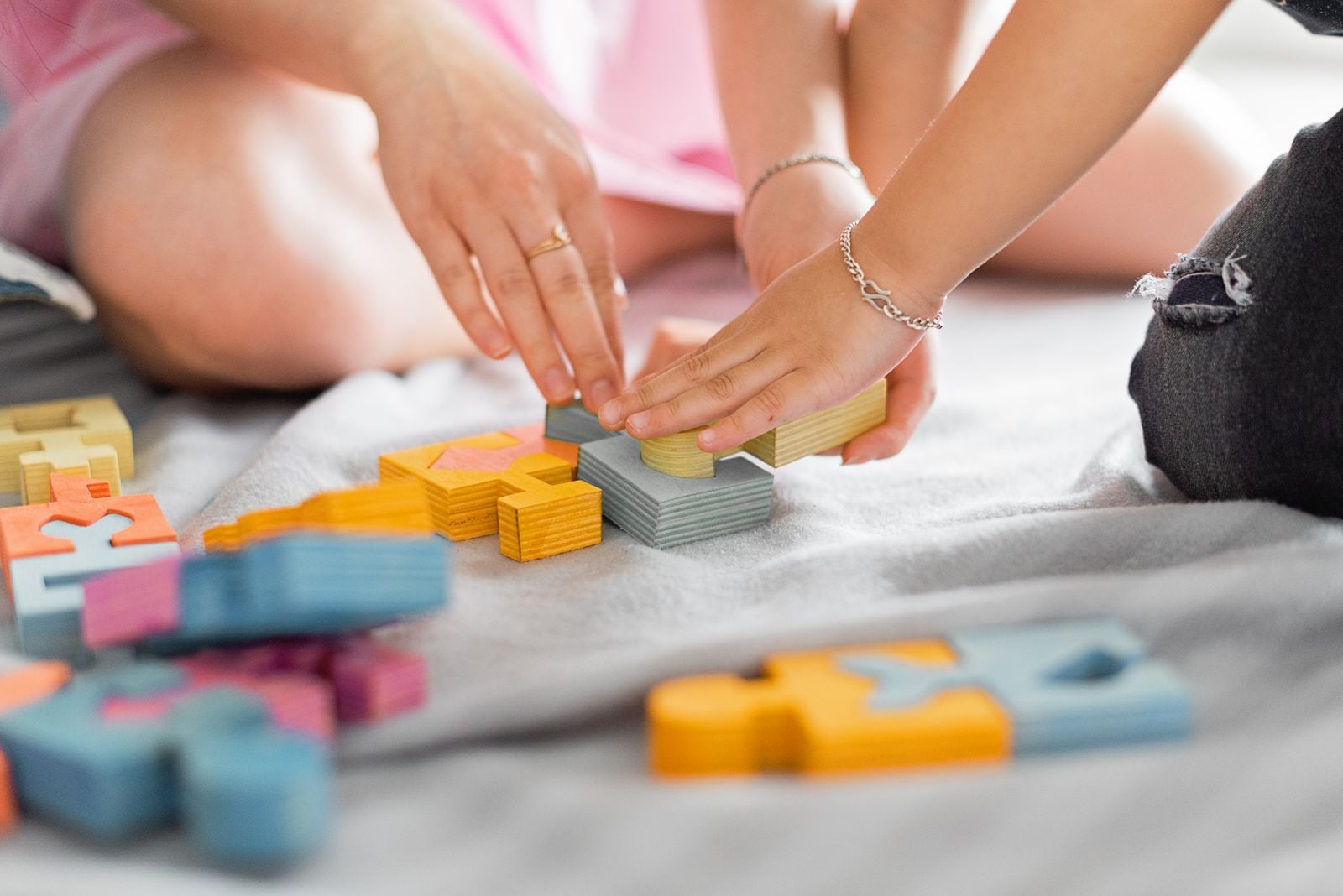
For early education, that gives familiar activities a little more weight. Puzzles, blocks and tangrams are not merely preparation for spatial reasoning later on. They give children opportunities to practise spatial transformations they are already capable of attempting.
The blocks-and-puzzles evidence chain
The FIU finding fits a broader body of work connecting early spatial skills with mathematics and other areas of learning.
In a University of Delaware and Temple University study, three-year-olds were asked to reproduce six model structures using separate blocks. Children who were better at copying those block structures also tended to perform better on an early mathematics assessment.
That is an association rather than proof that one afternoon with blocks causes stronger maths ability. But it is one part of a consistent reason researchers pay attention to the spatial decisions involved in building, rotating, fitting and comparing objects.
A separate decade-long study examined whether preschool play patterns were associated with mental-rotation performance at age 13. Children classified by their parents as showing more masculine-typical play at age 3.5 scored higher on the later mental-rotation measure than children in the feminine-typical group.
The result held across boys and girls, but the researchers did not show that one style of play caused the later difference. As PsyPost’s report on the study notes, children with stronger early spatial tendencies might also have been more likely to choose spatially demanding play in the first place.
Why eyes can reveal what words cannot
Asking a four-year-old to give a precise account of how they solved a spatial puzzle has obvious limits. A child may know which truck matches without having the vocabulary to describe the sequence of mental operations behind the choice.
Eye-tracking provides another route. Researchers can measure which parts of the image attract attention, how often a child returns to them and how long those visits last.
In the FIU study, those measurements produced two distinct statistical profiles consistent with holistic and piecemeal processing. The comparison with adults comes from earlier research using similar strategy concepts, rather than from an adult control group tested alongside the children.
What this means for a Saturday afternoon
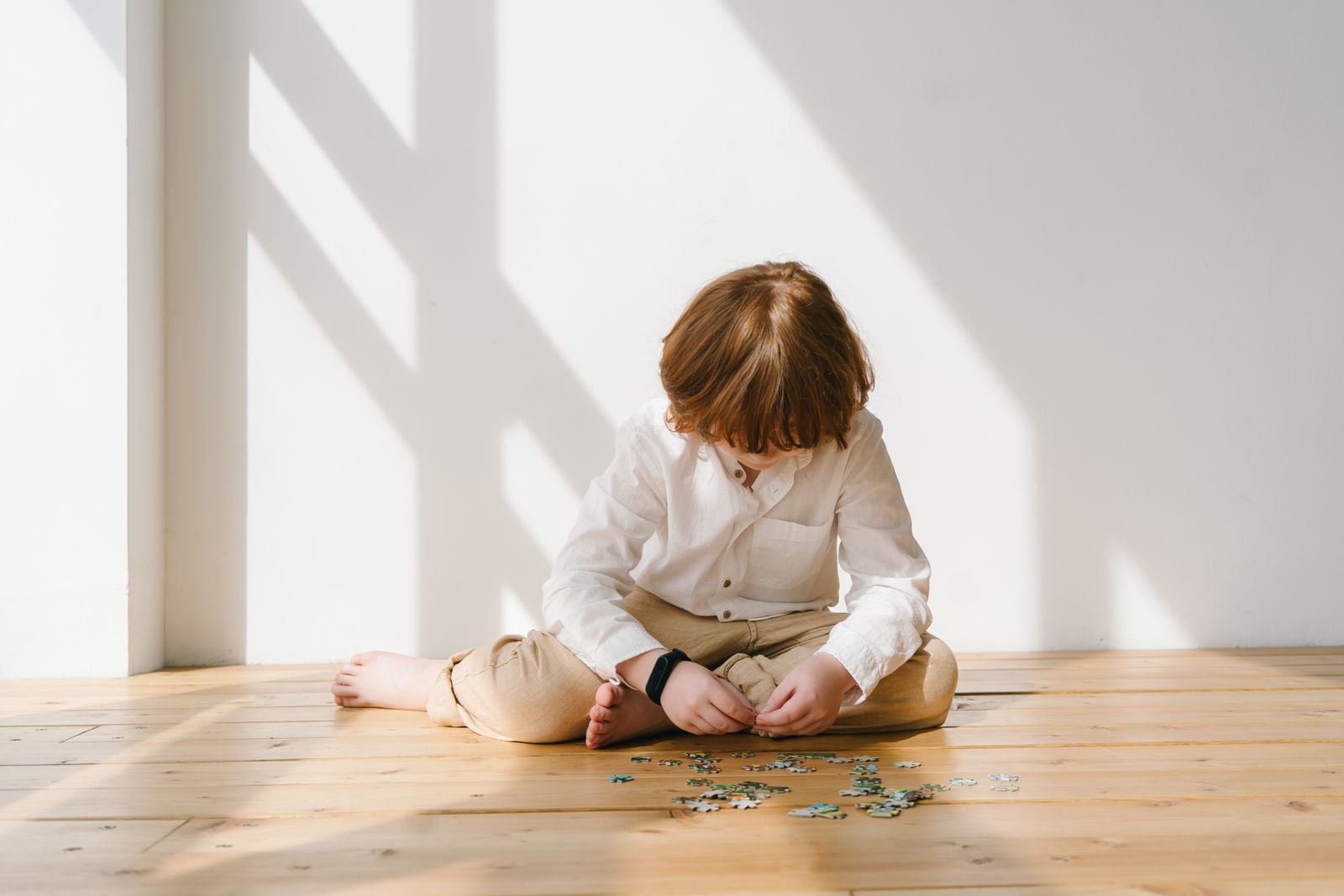
The practical takeaway is modest. Puzzles, blocks, tangrams and other spatial activities give children opportunities to turn, compare, combine and mentally reorganise shapes.
Language can be part of the same experience. Words such as above, below, edge, corner, curved, flat, upside-down and next to give children labels for relationships they are already seeing and manipulating.
A tangram is useful precisely because it can invite both kinds of attention. A child can look at the animal or house as a whole while also deciding which particular triangle or square fits one part of it.
Three-dimensional puzzles, wooden blocks, jigsaws, LEGO, magnetic tiles and pattern games create similar opportunities. None is a magic shortcut to later academic achievement; they are simply accessible ways to practise spatial reasoning.
The letter-flipping connection
The reading connection is more tentative than the spatial-puzzle finding itself.
In their public explanation of the research, Pruden and Rodriguez suggest that children who use a more piecemeal approach to mental rotation may overlap with children who have difficulty discriminating similar-looking letters such as p and q.
That remains a research possibility, not a demonstrated explanation for why a particular child reverses or confuses letters. The eye-tracking study did not establish that a piecemeal strategy causes dyslexia or other reading difficulties.
What the work does offer is a potential research direction: understanding children’s spatial strategies earlier may eventually help researchers study how those strategies relate to later reading development.
The strategy is already there. The practice sharpens it.
The most interesting part of the FIU finding is the shift in perspective. Preschool play is often described as preparation for the cognitive work that comes later, but some of that work is clearly already underway.
A three-year-old turning a wooden triangle before placing it into the right opening is using a basic spatial operation that adults rely on in far more complicated settings. The scale and expertise are different, but the need to imagine how an object changes when it turns is recognisable.
So the next time a child on the rug picks up a puzzle piece, rotates it once and settles it into the right slot, the movement is worth noticing. A small twist of the wrist can reflect a surprisingly sophisticated piece of spatial reasoning already taking shape.